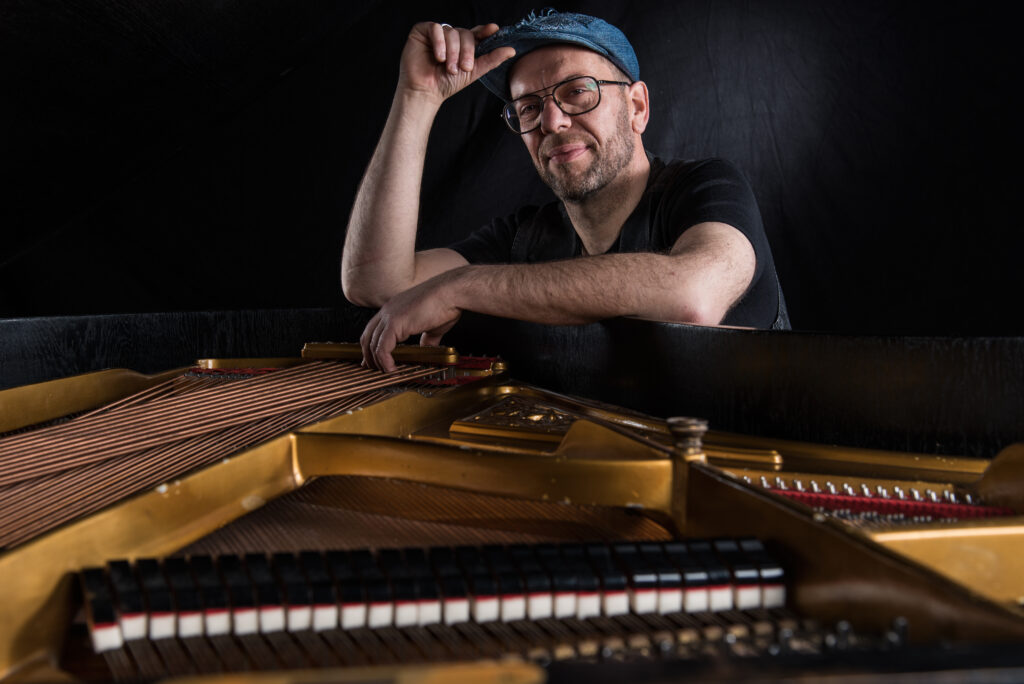


Name: Gert Kapo
Nationality: Albanian, Germany-based
Occupation: Pianist, composer, improviser
Current Release: Gert Kapo's solo debut album Amanet, featuring Rhani Krija, Hayden Chisholm, Armin Alic, Michael Theissing-Tegeler and Ahmed Eid, is out via Royal Street.
Recommendations: Book: The creative act: a way of being - Rick Rubin; Music: Most stuff from The Bulgarian Voices and/or J.S. Bach ;-)
[Read our Hayden Chisholm interview]
If you enjoyed this Gert Kapo interview and would like to know more about his work and music, visit his official website.
For the thoughts of one of his collaborators, read our Sebastian Studnitzky interview.
Do you think that some of your earliest musical experiences planted a seed for your interest in improvisation?
Some of my earliest musical experiences/memories are my father playing popular movie tunes and songs from around the time I was born (1977), for us and our family friends. Also, Albanian folklore, which was kind of omnipresent in the area of Berat (South Albania), where I grew up until I was 8 years old.
Folk music in general and in the Balkans specifically comes to life and stays alive by improvising over life topics and takes the shape of songs which eventually become part of culture and tradition.
When did you first consciously start getting interested in musical improvisation?
When I started studying classical Piano in Cologne (Germany), I realized that I was fascinated by all the concerts by jazz students at the the Hochschule. I spent much more time listening to jazz concerts than classical in general.
I was around 17 years old at the time. That's when I realized that I wanted to explore that musical path.
Which artists, teachers, albums or performances involving prominent use of improvisation captured your imagination in the beginning?
The full answer would be too long and include too many names. Just to name a few bands and musicians:
Weather Report, and also the music of each member of that band: J. Zawinul, W. Shorter, J. Pastorius, separately from each other were certainly big influences early on and I listened to their music a lot.
Herbie Hancock (…of course ;-), Miles Davis, George Gershwin, Bela Bartok, Debussy, Ravel, Brahms.
Later, I also discovered artist like Bojan Zulfikarpasić, Nguyèn Lè, Karim Ziad from the European world jazz scene. They were a significant source of inspiration. But at the same time also Funk, Soul, Blues, Jazz etc. where and still are a constant in my everyday musical life.
I also had a very lucky first encounter with the members of the original “Buena Vista Social Club” on their first and unofficial preparatory concert for the first ever European tour, just after the same titled movie from Wim Wenders was released. That marked and sealed my love for Cuban music and opened a new road which eventually led to playing a lot of Latin music in general, which also includes a lot of improvisation.
So traditional Cuban and Afro Cuban music was something I listened to a lot in the early years.
[Read our Alejandro Valdés interview about the New Cuban Flamenco]
Tell me about your instrument and/or tools, please. What made you seek it out, what makes it “your” instrument, and what are some of the most important aspects of playing it?
Well, the piano is my first love, and I guess it will stay like that. There is a very intimate connection to it because I grew up listening to it already in my mother's womb.
My parents are both pianists. It comforted me in difficult times, and gave my the most bliss in practicing rooms and on stages while searching, all the while sounding and looking so beautiful. Playing the piano is a necessity for me, and I wouldn't trade it for nothing else.
Since I'm a tech-curious person, I also developed an intense interest for other keyboard- and electronic instruments. That came also through discovering different styles of music where such instruments are being used. I started exploring keyboards and synthesizers in my mid-twenties and to this day I am very fascinated by the sheer possibilities synthesisers and other electronical instruments offer.
So I'm always looking for ways of expressing myself using the possibilities that this electronic world offers. I enjoy experimenting with electronically produced sound a lot. I guess that's also a kind of balance with the piano …
How would you describe your own relationship with your instrument – is it an extension of your self/body, a partner and companion, a creative catalyst, a challenge to be overcome, something else entirely?
An extension of my soul, always a good partner in crime, an absolute catalyst in different forms. It makes me feel calm while and after playing it.
I never feel like it's a one on one challenge. It only becomes a challenge when trying to play difficult stuff others or myself wrote. But the piano, in itself, is not the challenge. For me, it one of the most beautiful inventions of humanity.
Derek Bailey defined improvising as the search for material which is endlessly transformable. What kind of materials have turned to be particularly transformable and stimulating for you?
Music with folkloric origins is in my eyes quite transformable. That's how it's carried on through generations, in most cases without being written … In that regard it is almost the same, whether it comes from the Balkans, the Orient, Afrika, South or North America, the Caribbean.
Over the last years, I have started to feel a stronger pull towards the music of my country and the Balkan area. I guess it's because I grew up listening to it a lot in my youth.
Also, the harmonic freedom and complexity that jazz offers and its aesthetics are very stimulating and inspiring. Last but not least: The Groove stimulates me best!
Do you feel as though there are at least elements of composition and improvisation which are entirely unique to each? Based on your own work or maybe performances or recordings by other artists, do you feel that there are results which could only have happened through one of them?
The uniqueness of composition and/or improvisation is the fact that each human is unique. Therefore, even though all what is past on to us musically is built on tradition and education, we still make our versions of the story(s) each time we compose or improvise.
I can say with certainty that I wouldn’t create the music I make or play the way I play if I wasn't born in Albania during the time of socialist dictatorship.
And, maybe I wouldn't play the same either if I hand't received my first mixtape from a US Christian missionary stationed in Tirana, mainly with music from George Gershwin and other jazz composers and interpreters when I was 11-12 years old.
So yes, it's a puzzle … which comes together individually as one lives on.
When you're improvising, does it actually feel like you're inventing something on the spot – or are you inventively re-arranging patterns from preparations, practise or previous performances? What balance is there between forgetting and remembering in your work?
When improvising I'm trying to materialise a feeling or a thought and translate it in sound. Even magicians prepare (… a lot) and make arrangements, and illusionists have tricks. There is a process taking place that can be compared to, learning to speak a language or a dialect. On the other hand there is such a thing as free improvisation.
For example together with my friend David Rival, who is a very talented electronic musician and producer, we recently started an improvising-duo-project playing electronic music with a jazzy / dubby / space appeal, for which the only prepared things are some sounds and banks that we know we are going to use during the performance.
The balance between forgetting and remembering in my work is as harsh as the fact: if you don't use it, you loose it. But I record or write so I don't forget the goodies. The really good stuff stays with one though.
In terms of your personal expression and the experience of performance, how does playing solo compare to group improvisations?
In group improvisation there is no room for the ego whatsoever. It is about creating something together. Solo improvisation is almost the same, only you have to be the player and the listener.
Since you don't have to react to other musicians, you can get quite busy with your own thoughts. So it's more about the balance between finding that inner voice, letting it speak and trying not to judge the outcome too much.
In your best improvisations, do you feel a strong sense of personal presence or do you (or your ego) “disappear”?
My aim is always to let the ego “disappear”.
That's quite a balance one is searching for, while at the same time offering a personal artistic view on music, which obviously requires a personal presence while doing it, since the listener identifies you because of your personal way of playing and writing music.
In a live situation, decisions between creatives often work without words. From your experience and current projects, what does this process feel like and how does it work?
It's a way of communicating without words and through music and signs. I it enjoy very much. It takes place on an instinctive level which at the same time requires experience until you learn all the signs and getting good at reading expressions and body language of your fellow human beings.
So it's an exciting thing to deal with from a psychological standpoint.
Stewart Copeland said: “Listening is where the cool stuff comes from. And that listening thing, magically, turns all of your chops into gold.” What do you listen for?
Try to listen to the inner voice and what you have to say by staying faithful to the mission of the piece of music you are playing, always questioning if what you are playing is adding value to the music.
If you listen “right,” your “chops” might get better, or your taste … You still have to be able to play hear (if you want to be an instrumentalist), and for that you have to practise so you can play what you hear, or learnt from listening.
After all the most natural way of learning music is through listening. Reading music also helps. But most importantly you must learn how to hear to become a good musician.
There can be surprising moments during improvisations – from one of the performers not playing a single note to another shaking up a quiet section with an outburst of noise. Have you been part of similar situations and how did they impact the performance from your point of view?
Yes I have! It's always different when such things happen. Sometimes they happen by accident …
In a free jazz impro session, that's probably what's required … in a ballad or second movement of a symphony not quite the right thing to do.
Still, I do love surprises when they are done with taste and no bad intentions.
I have always been fascinated by the many facets of improvisation but sometimes found it hard to follow them as a listener. Do you have some recommendations for “how to listen” in this regard?
Maybe go by trying to feel the vibe. Sometimes an explanation on the music from the interpreter helps.
Try to search for context from an emotional view, find the balance between what’s exiting for the soul and opens up windows, but also what makes you think, just not to much maybe.
In a way, improvisations remind us of the transitory nature of life. When an improvisation ends, is it really gone, just like a cup of coffee? Or does it live on in some form?
It evolves, changes shape. Just like a lot or most things in nature.
In the best cases, it causes a feeling or leaves an impression on the listener and the musician, opens up rooms in your imagination, makes you more kind. Maybe it helps you figure out something you couldn't find an answer for … it teaches acceptance.
It makes you feel good about the decision to choose the risk of improvising, which means going out and live life.