Name: Future3
Members: Irina van der Plas, Miguel P. Couto, Rodrigo Ambrogio
Nationality: Dutch-Romanian (Irina), Portuguese (Miguel), Argentinian (Rodrigo)
Current release: Future3's new album Despite the Rumbling is out via Jazzego.
Shoutouts: Each one has different influences, but we believe that the openness and multiculturality of the Berliner festival and club culture are a driving force that allows for new musical mixtures and possibilities. Hopefully these ideas are an important concept in the sound of future jazz.
Regarding specific musicians, the future sound is still to be written and is harder to tell who’s doing that. We all have different opinions about it, but we agree about the importance of Esbjörn Svensson Trio, Alfa Mist and Yussef Dayes in the modern/futuristic sound of jazz.
Recommendations for Berlin, Germany: There are loads of new listening bars with incredible sound systems popping up in Berlin! Places where a slower and more focused consumption of music is promoted. Tea and Vinyl, Ikii, Rhinoçéros, Bar Neiro, to name a few, in case you ever come to town.
Things we are passionate about but rarely get to talk about: Irina has been watching a lot of documentaries about the Arctic and its native remote populations and villages. Rodri drinks too much mate, so that is a passion, too. Miguel loves spending time behind his computer researching music and coding.
[Read our Alfa Mist interview]
[Read our Yussef Dayes interview]
If you enjoyed this Future3 interview and would like to find out more about the band and their music, visit their official homepage. They are also on Instagram, and bandcamp.
What were some of the musical experiences which planted a seed for your interest in jazz?
Rodri: in my case it’s not so much about an experience, but about a friend showing me two albums by Erik Truffaz (Bending New Corners and The Dawn) when I was still a teenager. They completely changed my perception of music (I was mostly into metal at that time), but jazz still felt unreachable and impossible to play.
[Read our Erik Truffaz interview]
It wasn’t until I studied jazz in the final years of university that I started to be able to play in this way and that I also discovered the drummer Brian Blade (another huge influence), cementing my actual interest for the genre.
Irina: I started playing music from a very young age onwards, but to me it didn't feel like ‘play’. It felt quite serious, and there was a wrong and a right way to do it. Whenever people asked me to “just play something”, I would clam up, and I'd have to scrape my brain for the latest piece I'd learned by heart. When I got older, I'd go to and even organise jam sessions, but I still didn't really get how everyone was playing so freely.
That's when I became obsessed with trying to understand what was going on, I wanted to be a part of what was happening! I wanted to express myself freely, and not through channelling what someone else had already written. I found that studying jazz was the best way to do that.
Miguel: My musical studies started “late”, at around the age of 17/18. Back in the day I was working a summer job to go on an Interrail through Europe but instead I decided to buy a crappy bass (which I still own!) and a small amp. A couple of months later I enrolled in jazz school (Escola de Jazz do Porto) and I became completely addicted to the music.
Most importantly, I was tremendously influenced by my first bass teacher, Alberto Jorge Piedade. The man was a beast on the instrument (one of the best I’ve ever seen live), but also a living jazz encyclopedia with a very generous heart. From him I learned a lot about jazz but also how to play with other musicians.
Looking back on it, I really had no idea what the hell that music was about! I just knew I loved it so I was consuming it on a daily basis. I was being exposed to jazz in the most important way: through my ears. Little did I know that was just the beginning of a lifelong exploration and study of one of the richest and most complex music forms ever.
What does the term jazz mean today, would you say?
Freedom. And freedom to also not call it ‘freedom’.
The tag itself carries a century of history and stories, and probably no one has still been able to properly define it. And that’s totally ok with us. If someone wants to call Future3 pop, or jazz, it really doesn’t matter. What we carry into our music is the tradition of freedom, harmony, and improvisation/improvement that jazz has graced us with for so long.
Each of our single performances is going to be different. If it’s a cloudy day, maybe we’ll solo through gloomier paths; if it’s warm and sunny, we might play at a faster tempo. The restlessness in us is the perfect fuel to play ‘jazz’.
As of today, what kind of materials, ideas, and technologies are particularly stimulating for you?
We love technology, electronic instruments and the live manipulation of audio to produce unique sounds. It’s such a shame how expensive hardware is, otherwise we would be experimenting way more.
While we appreciate computers and VSTs, nothing compares to the real time response of physical instruments. A computer does not naturally produce audio waves that can directly affect your body. A piano does. A pedal going through an amp does. This also reduces the number of possibilities, which is actually a blessing in disguise nowadays.
There are a lot of small nudges or ideas that hit from every direction and we’re usually quite open to trying them out. You would be surprised how many ideas actually come from “mistakes” or accidental bumps into a pedal board.
Our production style follows pretty much this pattern: we add, add, and add more elements to then remove some in the final stages of production.
Where do most of your inspirations to create come from – rather from internal impulses or external ones? Which current social / political / ecological or other developments make you feel like you need to respond as an artist?
Mainly from listening to a lot of music. From many different artists and genres. One of the most beautiful and overwhelming things about the internet is how much incredible, weird and inspiring music we have at the reach of a click.
We are very strong and avid spokespeople against Spotify, big tech, and AI in music. Our music carries this anger, and carries many more other emotions that we absorb from the world around us. In ‘Despite the Rumbling’ we touch the topics of capitalism, AI, the socio political panorama in the world, but we also focus on collaboration.
Collaboration is one of the most important and inspiring topics for us. We want to share music, stages, and record songs that will live forever, with other artists.
Tell me a bit about the sounds & creative directions, artists & communities, as well as the colleagues & creative hotspots of your current hometown, please. How do they influence your music?
Berlin is oftentimes seen as an electronic music (techno) city. While that is partly true, it is also true that Berlin is way richer and diverse than that.
The jazz scene is incredibly varied with people coming from all over the world to make music here. (We have the examples of Jamichael, Kota and Kelly who feature in the album - coming from as far away as Russia, LA, and Australia.) Of course, everyone brings their own experiences and flavors from the places they lived in - their music is already different from a starting point.
This is an essential part of jazz: the constant movement, rediscovery, and openness to being influenced by each other. Jazz is in its nature collaborative and Berlin offers a great opportunity for that.
What role do electronic tools and instruments play for your creative process?
Each instrument, tool, plugin, or object has a specific and unique sound to it. Grabbing a new instrument or synth often gives us a fresh pallet of inspiration and sonic textures. This exploration and restlessness is very intrinsic to us as individuals and therefore to Future3. We’re always trying to get better and usually a fresh sound helps us calm down a bit in that sense.
For example, we had been messing around quite a lot with the concept of re-sampling our own music which opened new possibilities during the post production phase of ‘Despite the Rumbling’.
In the beginning of ‘Mystic Sheep’ or ‘does it?’ the sounds you hear are all based on granular synthesis and re-sampling.
Thanks to technological advances, collaboration has become a lot easier. What have been some of the most fruitful collaborations for you recently and what approaches to and modes of collaboration currently seem best to you?
We live in a great age for collaboration. Without technology, our album would have ended up sounding and looking very differently!
Our label, Jazzego Records, and our mastering engineer Gonçalo Peixoto are in Portugal, and our mixing engineer, Paulo Germano mixed the whole album in Brazil. We'd send him our comments, and he'd have a new version ready only a few hours later, despite living halfway across the world. Also, the designers of our record’s artwork, Koen Taselaar and Simone Trum, live in the Netherlands.
We are so lucky to have technology assist us in making our music sound the way we aim to.
Jazz has always had an interesting relationship between honouring its roots and exploring the unknown. What does the balance between these two poles look like in your music?
In our first EP, ‘Places’, you can hear that we had quite a “jazz standard” approach to the structure of the songs, dividing them up in classic sections like ABAA or ABCA for instance, with solos in the middle.
In our latest record, we approached the music a little freer, with structures less set in stone. You can still hear the roots of jazz come through - using rich harmonies and having sections dedicated to solos, but exploring with all kinds of synthesizers and sampling methods.
How much potential for something “new” is there still in jazz? What could this “new” look like?
We think there is lots of potential for something new. It's hard to think of what that might look like, because if we did, we'd apply it already. Though we'd imagine that we'll probably keep adding technology to creations.
Perhaps music will become increasingly complex, both rhythmically and harmonically.
For many artists, life-changing musical experiences take place live. How do you see that yourself?
Definitely. We've always created with the goal of playing live. In fact, we sort of rushed to get our first EP out in order to be able to contact venues and play live.
People underestimate how much every single person in the room, in the audience, adds to the creation of the music in the moment. We all co-create what comes out that very moment. Even if the show gets recorded, we often find that the essence of the moment doesn’t fully translate (though that is what we try very hard to bring across in our recorded material, and why we have a live approach to recording).
That's what we find so special about playing live. It's a deep form of communication with each other, and the audience plays an essential role in what it ends up being.
How, would you say are your live performances and your recording projects connected at the moment? How do they mutually influence and feed off each other?
Our live performances have shaped our recordings a lot. We played our songs live for about a year before we decided to record them. They went through a lot of transformations, based on how we felt during the shows.
After we recorded our songs, they still keep evolving on stage. The way we play ‘AREA’ now, for instance, is quite different to what you hear on the EP. It also goes the other way though, the recording process helps us refine details, and helps us decide what to keep and what to get rid of.
Actually, ‘Art, Despite’ on our latest record didn't have that melody at first. We'd already recorded everything and when listening back to it, to get it ready for mixing, we couldn't shake the feeling that something was missing. So we got out the MS-1 and tried out some melodies.
Now that melody is central to the song and we always play it live.
Improvisation is obviously an essential element of jazz, but I would assume that just like composition, it is transforming. How do you feel has the role of improvisation changed in jazz?
It’s hard to generalize, but improvisation feels less “structured” nowadays. There seems to be a stronger focus in improvisation as a group of musicians rather than each musician getting their 32 bars of solo time.
Other genres also started bringing new influences for improvisation through sound modulation which is something fascinating. For example, soloing with a specific distortion on your instrument can be totally different from soloing clean.
Being able to create new musical ideas on the spot through improvisation is still one of the most powerful aspects of jazz.
What, would you say, are the key ideas behind your approach to improvisation?
Staying playful and exploratory are key to the development of our improvisations and songs.
Very often we improvise with an idea, a concept, an image or a feeling in mind. This keeps us away from approaching the songs in a stiff, theoretical way, leading us to be expressive and emotional instead of technical.
The Montreux Festival intends to preserve its archive of recordings for future generations. Do you personally feels it's important that everything should remain available forever - or is there something to be said for letting beautiful moments pass and linger in the memories of those that experienced them?
Having access to old improvisations and performances is an amazing way to grow as a musician, and for the music in general to keep evolving. So we believe it’s positive.
There’s a risk of some people forgetting how ephemeral and unique performances are, but on the contrary it can also help people remember the importance of being present when the magic is happening.

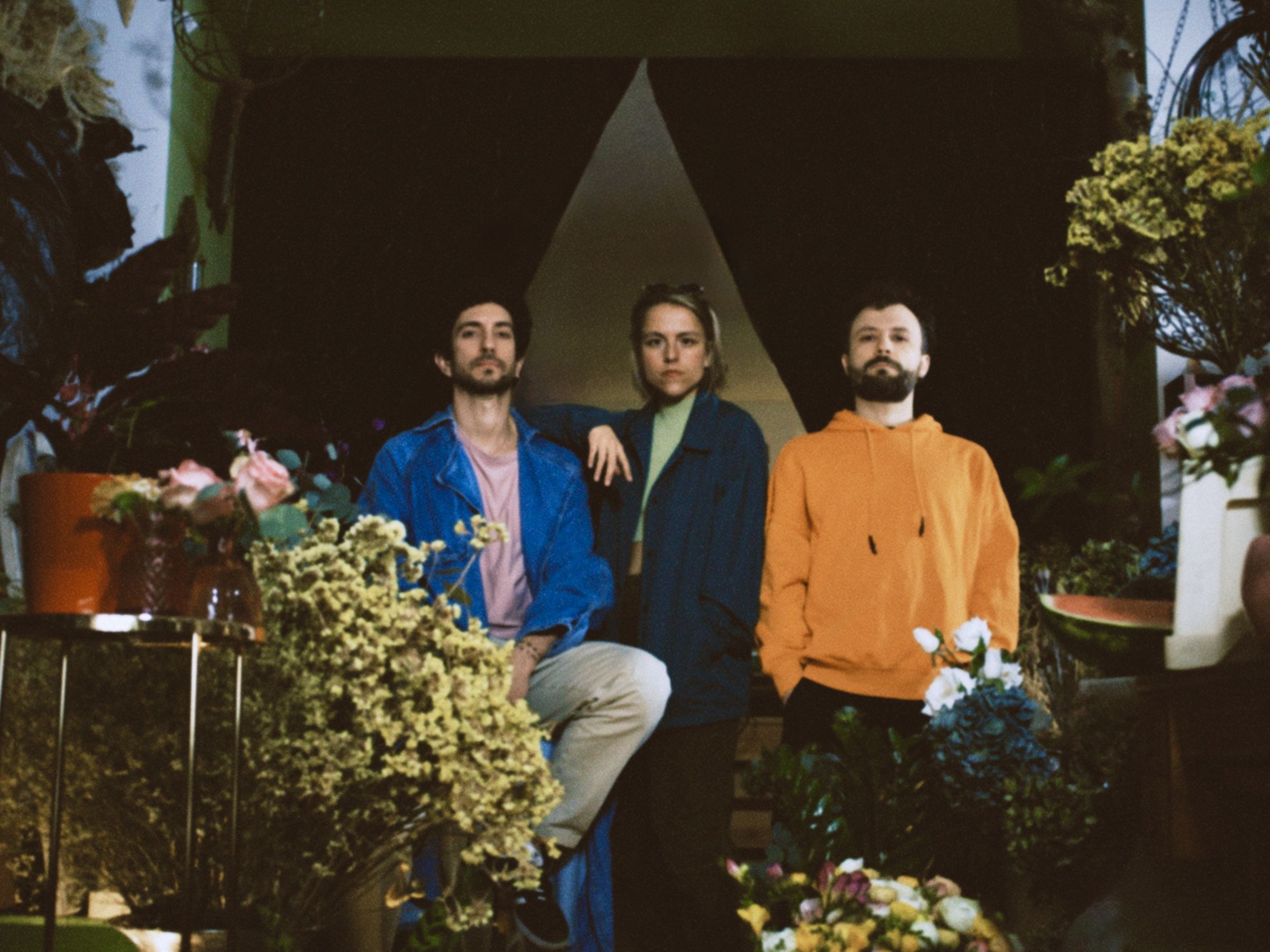 Future3 Interview Image (c) the artists
“People underestimate how much every single person in the room, in the audience, adds to the creation of the music in the moment.“
Video