Name: Safak Oz Kutle aka Oceanvs Orientalis
Occupation: Producer, composer
Nationality: Turkish
Current release: Oceanvs Orientalis's Portrait of the Obscure is out via Crosstown Rebels.
Recommendations:
Painting: Black Paintings by Francisco Goya
Music: "Omar" by Carl Stone
If you enjoyed this Oceanvs Orientalis interview and would like to keep up to date with his music, visit his official homepage. He is also on Instagram, Soundcloud, and Facebook.
When I listen to music, I see shapes, objects and colors. What happens in your body when you're listening? Do you listen with your eyes open or closed?
When I listen to music, I see feelings, certain feelings in abstract forms. It's not like colors or shapes, but it's more like a blurry form of joy or sadness.
Entering new worlds and escapism through music have always exerted a very strong pull on me. What do you think you are drawn to most when it comes to listening to and creating music?
I think one of the things I'm most drawn to is that luxury of escape! Whether making or listening to music, it opens a door in our minds that no other stimulus can, almost like a parallel reality, a kind of depiction of paradise.
In fact, in that utopian world where everything is possible that music transports me to, it's equally as real as the physical world. It's only in this alternate reality that we can perceive and make decisions not just with our logic, but with our instincts and emotions.
What were your very first steps in music like and how would you rate the gains made through experience?
For a while, I thought my relationship with music started when I was 24 years old. But I've come to realize that wasn't the case.
The earliest memories I have of experiencing the joy of making music go back to the mid-90s when I was just a child. I remember recording my voice on cassette tapes and playing them back, marveling at the sound. Then, in the late 90s, I discovered a music creation software called "Music 2000" on the PlayStation 1, and I spent a lot of time experimenting with it. There were also brief stints with instruments like guitar and drums, which I eventually gave up on.
But it wasn't until 2011 when I stumbled upon Ableton that I realized I wanted to dedicate my life to making music.
According to scientific studies, we make our deepest and most incisive musical experiences between the ages of 13-16. What did music mean to you at that age and what’s changed since then?
Between the ages of 13 and 16, I was falling in love almost every other month. So music during that time felt like the soundtrack to a juicy and romantic telenovela.
I hope I've outgrown that phase since then.
How would you describe your own relationship with your instrument, tools or equipment?
Well, because I never properly learned any instrument, I've spent most of my time with Ableton since it's my main instrument. Of course, that opens up many possibilities for you.
But looking at a screen and clicking on a trackpad is far from being as natural as playing guitar or some percussion. So, it’s always a bit of a struggle.
Where does the impulse to create something come from for you? What role do often-quoted sources of inspiration like dreams, other forms of art, personal relationships, politics etc play?
My need to create is a necessity to channel a chaotic mind and thoughts into an ordered system, almost like finding satisfaction from cleaning your house or organizing messy cables.
Dreams rarely affect my creations; I somehow don’t like dream scenes in films either. Or whenever I realize I'm watching a flashback in a movie, I get disappointed somehow :)
I think I'm mostly affected by feelings that come from certain events, like contemplating the universe one hour before the Big Bang.
If music is a language, what can we communicate with it? How do you deal with misunderstandings?
It's interesting, it seems that since I started to express my concerns through music, my relationship with words has diminished. It's as if with music, one can convey everything, and I don't believe there's a limit or norm to it.
Moreover, while music is a language, it's not subject to the rules and constraints that language brings. In a word or sentence structure, only one meaning should be expressed to be understood, but in a note or chord, multiple meanings can be hidden simultaneously.
This seems to completely override the concept of misunderstanding, in other words, there is no misunderstanding in music because there is no right or wrong; it's open to the interpretation of the listener.
Making music, in the beginning, is often playful and about discovery. How do you retain a sense of playfulness and how do you still draw surprises from tools, approaches and musical forms you may be very familiar with?
Sometimes, making music for me involves creating my own instrument in a digital environment. I love the times when I combine several familiar tools and instruments in different ways, sometimes so much that I forget about the composition while working on the technique.
Frankly, I never tire of these endless experiments; for me, it's still a journey filled with discoveries.
Sound, song, and rhythm are all around us, from animal noises to the waves of the ocean. What, if any, are some of the most moving experiences you've had with these non-human-made sounds? In how far would you describe them as “musical”?
I believe that both acoustic and electronic sounds can become musical when tuned in harmony.
They are all pieces of the sounds of the universe, whether human-made or not, natural or synthetic.
There seems to be an increasing trend to capture music in algorithms, and data. But already at the time of Plato, arithmetic, geometry, and music were considered closely connected. How do you see that connection yourself? What aspects of music do you feel can be captured through numbers, and which cannot?
I believe algorithms work more on rhythms and musical scales than melodies. However, I also believe that everything can be formulated in the world of music.
Especially with the current AI revolution, we can see how real things can be replicated with codes and formulas, such as songs, realistic videos, and pictures. Like in the time of Pythagoras and Plato, music is still closely related to those concepts, just on a more complex scale.
How does the way you make music reflect the way you live your life? Can we learn lessons about life by understanding music on a deeper level?
Absolutely! Music is almost a simulation of how life and the universe work.
For instance the law of contradiction works perfectly in music, planetary systems, and human relationships. They all work with the same dynamics.
We can surround us with sound every second of the day. The great pianist Glenn Gould even considered this the ultimate delight. How do you see that yourself and what importance does silence hold?
I always feel about 90% lighter in silence. However, true silence is probably something I've never experienced in my life.
For example, the silence of space—I wish I could experience it once so that I could answer this question better.
Do you feel as though writing or performing a piece of music is inherently different from something like making a great cup of coffee? What do you express through music that you couldn't or wouldn't in more 'mundane' tasks?
With a delicious cup of coffee, you might be able to massage someone's taste perception and trigger a short-term release of dopamine in their brain. However, you can't depict a day where everything falls into place after a hopeless wait, for example.
If art were merely a tool for providing pleasure, it could perhaps be equated with every enjoyable thing in life. Or if it were solely about aesthetics, it could be equated with every beautifully crafted endeavor. But here, the issue involves complex expression and storytelling.
If you could make a wish for the future – what are developments in music you would like to see and hear?
Perhaps some form of skill transfer, like wishing I could download the knowledge of playing drums like Buddy Rich in a day.
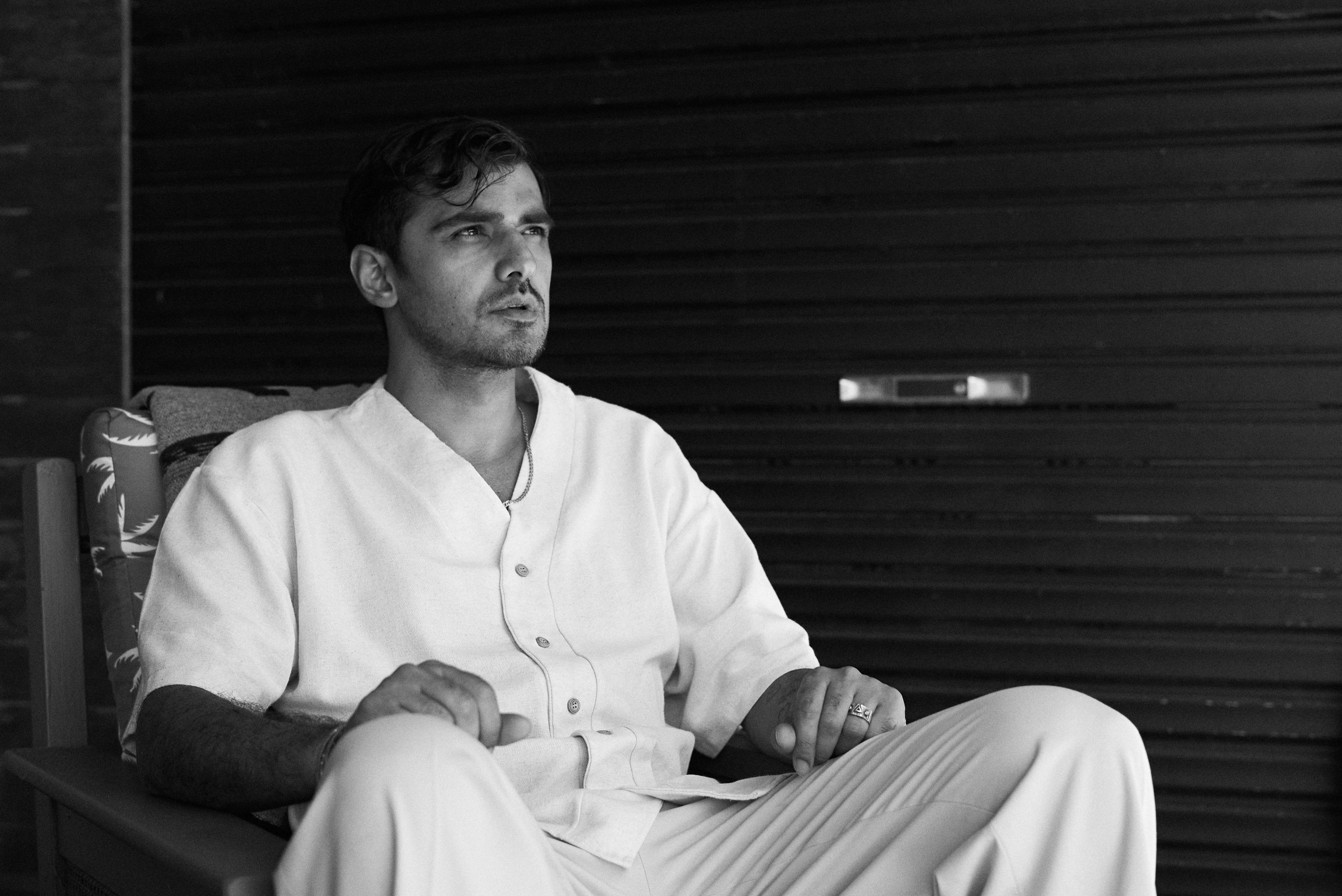 Oceanvs Orientalis Interview Image (c) the artist
"Since I started to express my concerns through music, my relationship with words has diminished.”
Video