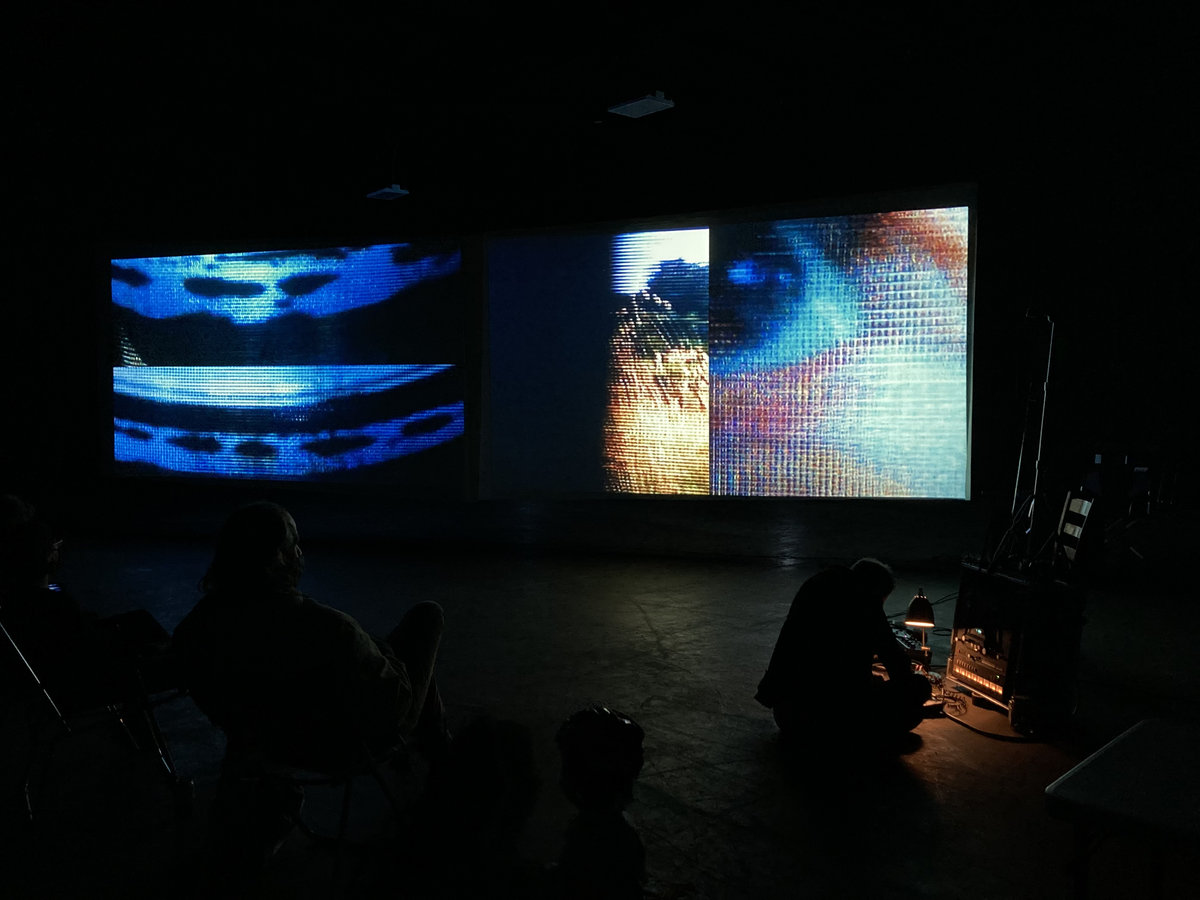


Part 1
Name: John Davis
Nationality: American
Occupation: Sound artist, composer, filmmaker, founder at Bimodal Press
Current release: John Davis's new album Landlines is out via Students Of Decay.
Topic I rarely get to talk about: I like bike touring, which I find is an ideal way to travel, see the landscape, meet people and get lost. It combines my love of cycling with backpacking and travel, and as a complete package it's pretty hard to resist. It's not as easy to regularly visit all the international spots I want to, but living in Northern California provides ample things to explore.
I also love backpacking in remote places, being far from cities and other people, necessitated by nature - learning, listening, breathing and thinking alongside the wilderness.
Recommendations for his current hometown of Vallejo: I would recommend visiting Winslow House Project which is a residency program based out of a Gothic revival farm house here in Vallejo. They have periodic open houses that celebrate the various residency cohorts, as well as other activities and happenings throughout the year. You can find out more here.
And as a bonus visit within the bonus question, I recommend going to Personal Space Gallery in Vallejo which is an exhibition space showcasing a diverse mix of emerging local and established contemporary artists. www.personalspace.space
If you enjoyed this John Davis interview and would like to know more about his music, visit his official homepage. He is also on Instagram.
When I listen to music, I see shapes, objects and colours. What happens in your body when you're listening? Do you listen with your eyes open or closed?
I do both, but typically I tend to keep my eyes open when listening to music, mainly so I don't lose focus, perhaps a byproduct of staring at too many LP jackets.
For me, I find all my senses are mutually dependent, and when listening, rather than fall into subconscious drift or whatever, I think I am looking for equivalences in the interrelationships of all my physical senses. Sound and music (notes, timbres) are more evidentiary and factual than liminal for me, though the end result tends to be a phenomenological one. I guess that's a bit of a contradiction. I would say I am not necessarily 'seeing' something with my eyes, rather, the light entering my body and the vibrations moving over my skin help me 'understand' and process sound and music.
When actively listening to music vs. having it on in the background or whatever, I think I experience a variety of mutual physical and emotional responses, and there are so many different types of music that engage my senses in different ways. For example, being in a crowded nightclub dancing to house music is a very different auditory-sensory experience from being alone listening to a symphonic recording in the morning.
Contrast those with listening to something like Eno's Another Green World, which because of its lyricism, etc, evokes yet another completely different emotional-sensory response. Flip day/night with Eno/symphonic and I will likely experience them in fairly different ways, depending on my mood and the proximity of my dog, for example.
Finally, certain music is deeply connected to my past, so listening to something I played regularly while falling in love for the first time will have a completely different emotional resonance for that reason, as opposed to something I listened to for the first time last week while driving.
If we forget about streaming numbers, target audiences, social media followers, and sales - why are you drawn to sound and music as a creator and listener? What is it that you give and receive through it?
It’s actually easy (and better) for me to forget about streaming numbers, target audiences, etc., and I keep a day job for that reason.
As far as why I am drawn to sound and music as a creator, that's harder to pin down. Ever since I can remember I have been deeply connected to music, and was fairly immersed in it as a child. My mother was musically trained and wanted to expose me to as much of it as possible, even music she didn't necessarily like, and this was true of all the arts actually so I was lucky in that way.
I think too, as with most artists, I am particularly suited to understanding the world through it - relatable forms communicating certain truths about myself and the world around me that's never one or the other thing. Given that, finding a way to express myself in the language that's most relatable is a natural fit. I would also add that time-based media like sound, music or moving images are so elusive and mutable that I never grow tired of engaging them.
According to scientific studies, we make our deepest and most incisive musical experiences between the ages of 13-16. What did music mean to you at that age and what’s changed since then?
As above, I was exposed to all sorts of music from the time I can remember, and music was the great anodyne to the mental chaos I often experienced as a younger person.
By the time I was thirteen I was experimenting pretty heavily with drugs and alcohol, and music was central to that phase of my life (but then that's just as true for all phases of my life). As with most people who are heavily drawn to music, I imagine whatever they listened to at any formative stage played a significant role in their development, or aided in the dizzying aspects of adolescence, for example.
I will say that I can still find the same pleasure in a work of art or music now as I did when I was thirteen, only with a lot more life experience to filter it through. Hearing Alvin Curran's "Songs and Views of the Magnetic Garden" as an adult for the first time, for example, had much the same profound emotional impact as witnessing Pink Floyd perform "Echoes" in the film Live at Pompeii as an adolescent.
Although my tastes have expanded, I can still experience both with similar revelry, and find all the same ecstatic pleasure I first discovered in the magically transcendent pleasures of music.
Tell me about one or two of your early pieces that you're still proud of (or satisfied with) – and why you're content with them.
I still love the first recording ever published of my music, made at the encouragement of my friend Jefre Cantu who was running a record label at the time.
The piece was released as a single track CD-R called Instructional Sculpture for Children, and was made when I was first working with sound in a somewhat naively blissful state of exploration and wonder. I was experimenting a lot with contact microphones at the time and was on the lookout for vibrating/electromagnetic sources. Living in San Francisco meant having access to the Exploratorium Museum which, as I found, is the perfect place to experiment with contact mics.
I was also listening to a lot of Stephan Matthieu and other glitchy 'post computer' music, and was excited to discover I could get similar textures and timbres using just a simple tape recorder and contact mic. I found that those recordings were an ideal undercurrent for some of my ambient guitar sounds, and they gave the track a primitive and disjointed yet cohesive feel that I still really like.
More than anything it was just a really simple and fun phase in music making for me, totally unencumbered while also being uplifted by my musician buddy which was a big confidence boost.
What is your current your studio or workspace like? What instruments, tools, equipment, and space do you need to make music?
I've mostly made do with a bedroom/home studio in my various living environments over the years, though I am always intending to create a bigger space outside the house, primarily for the moving image stuff. Currently I rely on a smattering of percussion tools, and various stringed instruments with an emphasis on electric guitar. I also use modular synth for processing the guitar, have a Prophet 12 that's on indefinite loan, and a grand piano I was given that's in the den of our house (which has been amazing).
I also experiment with various 1/4" and 1/2" reel to reel machines for tape-speed manipulations and loops mostly. I tend to record through microphones or directly into a mixer, and then into a portable digital recorder. I have some decent mics I can get good transparent acoustic sounds with, and I still employ the contact mic from time-to-time. I do a lot of field recording which has consistently been a way to generate material over the years.
Overall I 'try' to keep things as simple and uncomplicated as possible as a way to push myself creatively with fewer options, like gear or whatever. Since I began making music and recording in a DIY way I have never been necessitated by a recording studio, and have no sense of working with engineers, etc. I used to rely a lot on the computer as a source in the beginning, but have moved to creating outside that framework for the most part, like no post-processing, just editing.
That said, I do use some Max/MSP patches that I tweak or have had around for a long time to create sample sequences or do granular processing, for example, and still love it for its fully customizable on-the-fly aspects.
From the earliest sketches to the finished piece, tell me about the creative process for your current release, please.
I made Landlines from scratch which was different from previous releases. By that I mean I have access to most all the recordings I have ever made, and have often gone back and plundered them for inspiration, but this time decided to deny myself the past and work up new material. The former is the lazier approach for me, but I have discovered things completely forgotten or overlooked which have served me later.
I also gave myself a conceptual anchor up front in the notion of nostalgia, which hasn't typically been the case. My process is fairly iterative, and ideas and concepts usually arrive after I start something, a distillation of things becoming clearer over time. Also, I find conceptualizing music (and art in general) a kind of trick that I typically avoid, like a way to make the ineffable easier to relate to, or a thought puzzle for untangling some pre-ordained mystery in the work. Though the tracks range in terms of their individual 'feel', I tried to make them cohesive by concentrating on how the idea or feeling of nostalgia might be represented musically.
I also collaborated with the musician Steph Richards who provided improvised trumpet lines to the title track. She's a really generous person and an amazing artist, and it was the first time I had ever done a file-sharing collaboration that wound up on a record.
Beyond that I worked in pretty much the same way I always do, approaching ideas that begin as a single piano line, a field recording, guitar expression, or rhythmic pattern for example, then going back and tracking onto to those by building up, breaking down, compositing, reducing, re-recording, etc.
What role and importance do rituals have for you, both as an artist and a listener?
Rituals are important for me in my spiritual practice, for example, where I repeat certain actions and behaviors in very intentional and specific ways. However in my creative practice, rituals have never really had any distinct place for me, and instead I think about the process of creating as its own sort of ritual.
That's vague I realize, but I don't really attach any specific meaning to the individual patterns, steps or actions in my practice, mostly just the practice itself. As with playing an instrument, or any creative flow in general, I am bound by repetition and actions, but again it's the whole process rather than specific steps.
As a listener I tend to play vinyl LPs, which have their own attendant rituals. When doing focused listening I sit in a chair in the stereo field and generally try and experience an entire album(s) at a substantially loud volume. Otherwise, I listen to MP3's or the radio in the background without any particular rituals, and similarly, find listening to music its own ritual.