Name: GiNN 諸葛靖
Nationality: Chinese American
Occupation: Producer, vocalist, songwriter
Current Release: GiNN 諸葛靖's most recent release is his single "//MHM//," out via J.H. Creatives
Recommendations: I would recommend you guys two of my favorite songs to put on repeat: (laughs) "BerwynGesaffNeighbours" by BERWYN, Fred Again, and Gesaffelstein; "Um Um" by Sega Bodega
If you enjoyed these thoughts by GiNN 諸葛靖anry and would like to stay up to date on his music, visit him on Instagram.
When I listen to music, I see shapes, objects and colours. What happens in your body when you're listening? Do you listen with your eyes open or closed?
When I listen to music, my body flows—if the vibes hit, of course. I might slit my eyes when the groove is catchy, but I close them when the sound design or mix inspires me.
My mind often visualizes abstract shapes, like a fat rectangle with jagged, rounded ends to describe a sound’s texture. Vivid colors like dark purple and red intertwine, reflecting the emotional delivery I seek, and sometimes I imagine cinematic scenes. I’ve even pictured myself as an anime character in a final battle against my best-friend-turned-enemy.
Eyes closed, I immerse myself fully in the creative aspects; eyes open, I connect the emotional colors of the music to reality—like envisioning a club in the middle of nowhere with someone special inside.
Entering new worlds and escapism through music have always exerted a very strong pull on me. What do you think you are drawn to most when it comes to listening to and creating music?
Music is both my escape and empowerment. Growing up, my parents were strict, especially with academics. I remember grinding through 1,000 ACT math questions a day while finding relief in tracks like “SexyBack” by Justin Timberlake and Timbaland.
Artists like them, along with will.i.am and Far East Movement, brought EDM, Pop, and Hip Hop into the mainstream—and became my inspirations.
Music helps me express complex emotions that words can’t. As an artist now, I blend Mandarin and English rap into my Electro Hop/Pop sound to create something unique.
And yes, I joke that I mix them so well people can’t tell I “suck” at both, but music’s emotional power speaks louder than any words ever could.
What were your very first steps in music like and how would you rate the gains made through experience?
My first steps were clunky but electrifying. I started as a ghost producer in 2017 and finally debuted as an artist in 2022, but by then, I had written over 500 songs (including those I sold).
There were struggles, like finding my fit in mainland China’s music scene, and even when I amassed 100K followers on 抖音 (Chinese TikTok), the growth felt fleeting. Pivoting to my artist lane, I found my best audience in the U.S. and Europe, and with each track, I’ve grown exponentially, especially through 暈(Dizzy) and Tick Tock—pushing technical and personal boundaries.
My journey is about more than refining my craft; it’s about bridging cultures and staying true to my vision. Authenticity is always the key to connect and I really hope that artists can stay truthful with themselves in whatever circumstances; speak your truth and let the world discuss. We don’t have to be afraid to be a part of the discussion whether good or bad; it’s our way to learn and thrive.
According to scientific studies, we make our deepest and most incisive musical experiences between the ages of 13-16. What did music mean to you at that age and what’s changed since then?
Music was a lifeline.
Every school day, I’d plug in my headphones on the bus, exploring new sounds and savoring my favorites. To fill you in, the drive is around 90 minutes, not only giving me the perfect environment to snap my neck from sleep but also to absorb everything from ATL rap to experimental EDM—and yes, some hot-bae K-pop.
Now, I’m on the other side, creating the soundtrack for someone else’s transformative years.
How would you describe your own relationship with your instrument, tools or equipment?
It’s deeply personal. I treat my tools as collaborators, not just instruments. For example, in "晕 (Dizzy)," I used my ankle to mimic the kick drum’s attack in front of my arranger LNCL.
While I embrace simplicity during creation, post-production demands precision—even if we all end up compressed, haha. Currently, I’m working on an audiovisual interactive performance to give my shows an immersive edge.
I'm planning on some tests when I visit the UK and Europe! London in mid-February and Berlin in late February and maybe early March and hopefully more to come if someone gives me a chance.
Where does the impulse to create something come from for you? What role do often-quoted sources of inspiration like dreams, other forms of art, personal relationships, politics etc play?
My father used to say I was “weirdly observant,” noticing things like 36 birds flying across a mountain in 15 seconds. This sense of curiosity drives me at all times.
I channel cultural narratives, personal relationships, and visual art into my music, synthesizing chaos into something meaningful—if only for the people it resonates with.
Are you acting out parts of your personality in your music which you couldn't or wouldn't in your daily life? If so, which are these? What, would you say, are the key ideas behind your approach to music?
Absolutely. My music channels my unapologetic, unfiltered energy. "TICK TOCK" explores my dark humor and frustrations, while "晕" delves into sensuality and introspection with respect for boundaries.
I am what I am. I admit I’m flawed but I’m always open to learning if I am convinced as long as the ideology is both logical and inclusive.
I aim to balance playfulness and depth, delivering nutritious content that feels delicious enough to consume—a philosophy inspired by Gold House CEO Bing Chen.
If music is a language, what can we communicate with it? How do you deal with misunderstandings?
Music conveys emotions words can’t—longing, joy, defiance. Misunderstandings are inevitable, but I see them as connections.
I translate my lyrics line-by-line and hope platforms like Spotify allow bilingual titles someday.
What matters most is the audience’s feedback—how my music makes them feel.
Making music, in the beginning, is often playful and about discovery. How do you retain a sense of playfulness and how do you still draw surprises from tools, approaches and musical forms you may be very familiar with?
I treat every project as a sandbox. With tools like ShaperBox, I experiment with textures and tempos. The key is staying curious, letting go of ego, and approaching each project with a beginner’s mindset.
I’m a baby and to be honest I find arrangers with stronger production skills of what I seek and I lay back as the executive producer because they can make my vision come closer to life.
Sound, song, and rhythm are all around us, from animal noises to the waves of the ocean. What, if any, are some of the most moving experiences you've had with these non-human-made sounds? In how far would you describe them as “musical”?
I’m not a fan of rain, but I love how it sounds hitting different surfaces—like puddles on a street or the roof of an arcade. These small variations create distinct vibes.
Sounds like cicadas in Taipei or ocean waves in LA remind me that rhythm and melody exist everywhere.
There seems to be an increasing trend to capture music in algorithms, and data. But already at the time of Plato, arithmetic, geometry, and music were considered closely connected. How do you see that connection yourself? What aspects of music do you feel can be captured through numbers, and which can not?
Music and math are inseparable—rhythm, pitch, and harmony are all mathematical. But music transcends numbers, delivering emotions and improvisations that algorithms can’t replicate.
On my side, my dark humor, voice texture emotional delivery, and the literal way of respectfully showing admiration can never be copied by machines.
How does the way you make music reflect the way you live your life? Can we learn lessons about life by understanding music on a deeper level?
Music mirrors my contradictions—structured yet chaotic, disciplined yet spontaneous.
Music, along with the hard traps I fell into from artist development and marketing traps, has taught me patience and adaptability, lessons I carry into everyday life.
We can surround us with sound every second of the day. The great pianist Glenn Gould even considered this the ultimate delight. How do you see that yourself and what importance does silence hold?
Silence is vital. It’s the canvas that makes music possible, creating balance and amplifying every note’s impact.
Let the ears rest and kick in when we find suitable so the vibe is stronger. In many ways, less is more.
Do you feel as though writing or performing a piece of music is inherently different from something like making a great cup of coffee? What do you express through music that you couldn't or wouldn't in more 'mundane' tasks?
Music externalizes intangible emotions—yearning, frustration—that mundane tasks, like making coffee, could never replicate. It’s a form of storytelling words alone can’t achieve.
The tiny details from the ways we convey the emotions are as intricate as acting, which I’m heavily interested in and actively seeking opportunities.
Not to exaggerate, my upcoming track, "MHM(嗯哼)" is composed of 50+ full one takes and 100+ alternative takes as detailed to syllables differed in emotions, velocity, and pitch generally speaking.
If you could make a wish for the future – what are developments in music you would like to see and hear?
I hope for deeper integration of underrepresented cultural narratives in mainstream music. It is exactly what I’m trying to pull off at this moment, spreading Mandarin language and culture as far as I can.
On a deeper level, we also cannot hinder the AI influence in the overall music, or creative industries. As AI grows, I would like to see that artists and audiences both preserve the human touch—the imperfections that make music feel alive.
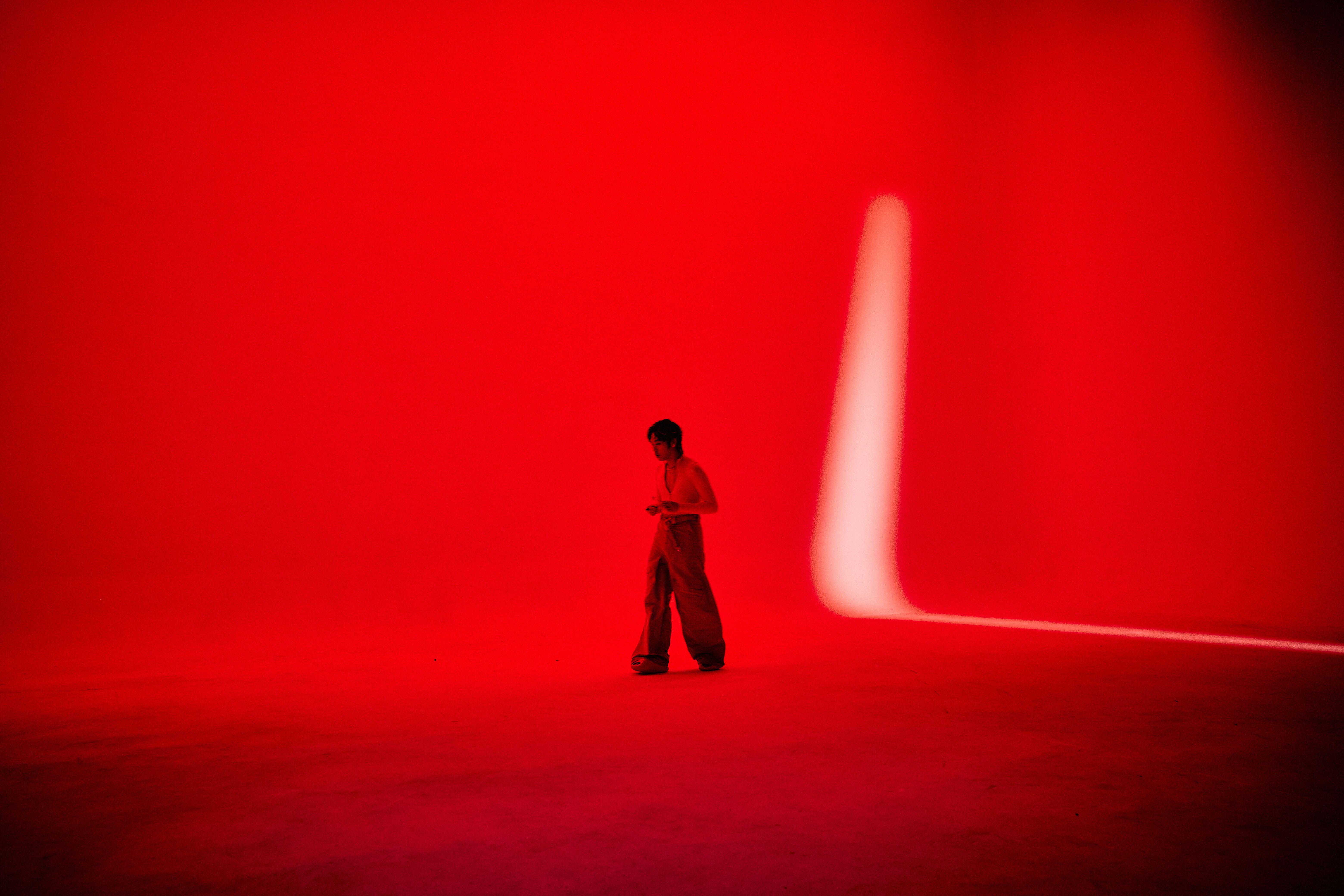 GiNN 諸葛靖 Interview Image (c) the artist
"I channel cultural narratives, personal relationships, and visual art into my music, synthesizing chaos into something meaningful."
Video