Name: Alex Stolze
Nationality: Jewish-German
Occupation: Composer, producer, violinist
Recent release: Alex Stolze's Noise and Wind is out via Neue Meister / Nono Star.
Recommendations: Gustav Mahler - F# Major (10th symphony from 1911); Amos Oz - A Tale of Love and Darkness (2002)
If you enjoyed this Alex Stolze interview and would like to stay up to date with his music, visit his official homepage. He is also on Instagram, Facebook, Soundcloud, and twitter.
When I listen to music, I see shapes, objects and colours. What happens in your body when you're listening? Do you listen with your eyes open or closed?
My eyes can be closed or open, it doesn’t matter … I am listening to music with my body. It's a very non materialistic and spiritual thing and life consists of vibes …
I can dance or dive into very deep emotional landscapes, that connect or disconnect me.
Entering/creating new worlds through music has always exerted a strong pull on me. What do you think you are drawn to most when it comes to listening to and creating music?
Music is an energetic tool and existence that I can only get close to and let vibrate inside of me.
If it fits, I become a part of a world to be created and that's the most fulfilling thing, similar to good sex.
According to scientific studies, we make our deepest and most incisive musical experiences between the ages of 13-16. What did music mean to you at that age and what’s changed since then?
Oh, the first music I was listening to at that age I collected from my sister and it had a huge impact on me. The Cure, Tom Waits, The Smiths, Gusto Mahler and others did reflect my life and when listening I felt the whole world present …
I can still reach that level, mostly while playing a concert or DJing for an audience to dance to. It is fulfilling to create a room of sound and vibration.
Tell me about one or two of your early pieces that you're still proud of (or satisfied with) – and why you're content with them.
I still very much like “Cell to cell“ (2017) , an instrumental piece that also fits perfectly to my recent album release Noise and Wind.
“Alkorhythmus“ (2018) is also a representative of my style and art, that I will continue until I am dead.
What is your current studio or workspace like? What instruments, tools, equipment, and space do you need to make music?
All my tracks are based on a five string violin. I record and produce with Ableton live and use different synthesizers like OP1, Dave Smith Mopho, a Korg drum machine, an upright piano and a Push 2 to control and develop.
Additionally I use digital engines like Kontakt and all kinds of wave and Ableton plug ins.
From the earliest sketches to the finished piece, tell me about the creative process for your current release, please.
The sketches have been collected as far back as 2021 onwards. But it took me until 2023 to bring them to a status where I felt good to show them to potential label partners.
When I signed the contract with Neue Meister on October 6th 2023, I felt the urge to finalize the album and I finished additional recordings during the Winter and the mixes until 7th of May 2024.
What role and importance do rituals have for you, both as an artist and a listener?
I love to listen to music loud, when I am at home. When I create a new piece of music and the process makes me excited I really celebrate the creation with a dance and a drink at night … I dive into the music as a listener, as if I am listening to myself to prove if it's right, what I have to say.
Since I am a caretaker on so many levels, I had to learn to take care for myself as well … ;)
Are you acting out parts of your personality in your music which you couldn't or wouldn't in your daily life? If so, which are these?
Things that can’t be said, spiritualities that can’t be named find life in my music.
Music still is a language without words but strong meanings and it can evoke emotion, visions and thoughts.
Late producer SOPHIE said: “You have the possibility [...] to generate any texture, and any sound. So why would any musician want to limit themselves?” What's your take on that?
In times of narrowed perception guided by algorhithms, I think it is important to frame your work. For me it means to focus on my quintone (5 string violin) and the electronic environment I want to bring it to life in …
“Raash ve Ruach“ is a statement, where I wanted to avoid words in general. It has been said so much and I took some time off the words to breathe.
Do you feel that your music or your work as an artist needs to have a societal purpose or a responsibility to anyone but yourself?
I ve always created music with a strong approach to heal the world a little bit, to build bridges and invent sound combinations to feel the world as one, and that allows the listener to be soft and loud, fast and slow, tense and relaxed.
My approach still is to allow life to be present in all its good appearances.
Once a piece is done and released, do you find it important that listeners understand it in a specific way? How do you deal with “misunderstandings?”
Good question! Misunderstandings are part of life and it is ok if they occur. Most listeners anyway will get my music as intense , dark and sad, but it contains a high amount of vibrancy and a positive approach to life, which is so beautiful.
For me sadness and happiness are coexisting and I think we should definitely give both of them a place in our hearts and ears.
Sound, song, and rhythm are all around us, from animal noises to the waves of the ocean. What, if any, are some of the most moving experiences you've had with these non-human-made sounds? In how far would you describe them as “musical”?
Every sound that we hear can be described as music, some are more comfortable for our ears and some are just annoying and make us want to get far from them.
In terms of animals, there are multiple ways of how we hear and feel when we hear a specific sound. A lion might awake fear of primal danger in us, while a nightingale makes us wonder about the beauty of life … the thing is: we can not close our ears.
We can surround us with sound every second of the day. The great pianist Glenn Gould even considered this the ultimate delight. How do you see that yourself and what importance does silence hold?
I love silence. I live in a big city with content noises, but have my work space including studio in a very rural countryside with no neighbors, just birds, windmills and a train that passes by from time to time.
Silence lets my inner voices become more present and I simply need it.
Do you feel as though writing or performing a piece of music is inherently different from something like making a great cup of coffee? What do you express through music that you couldn't or wouldn't in more 'mundane' tasks?
As I said before, I can express the things that can't be said with words or easily captured like in a great cup of coffee.
What is a music related question that you would like to ask yourself – and what's your answer to it?
Q: How to think of an audience , that would enjoy my music without falling into prototypes of listeners. I make music for myself to express but I also do it for the listener to get an extra cup of beauty from life.
A: Imagine yourself dancing to a piece of music and let yourself be touched by it. Listen to it as if it were alongside your emotion and life. No need to extra focus on it.

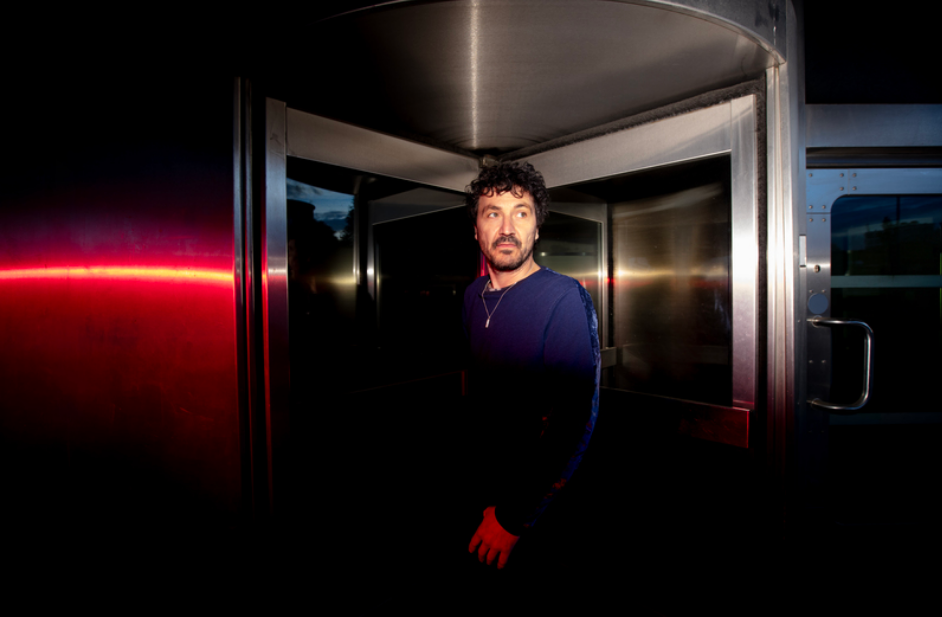 Alex Stolze Interview Image (c) the artist
“In times of narrowed perception guided by algorhithms, I think it is important to frame your work.“
Video