Name: Ewan Moore
Nationality: British
Occupations: Drummer, composer, songwriter, improviser
Current release: Ewan Moore's new album Halftone Paradise is out November 6th 2026.
Pure drum recordings recommendations: Max Roach - Drums Unlimited. If you haven’t heard it, it’s full of incredible melodic drum solos / compositions. He plays with incredible precision and articulation, but I really love it when he opens up and stretches out a bit and the ideas get this kind of looser but really high-intensity feeling to them before he brings it back to where he started again (usually a simple idea).
Also this all-woman Samba Reggae group called Didá from Salvador, Brazil. I saw them on my trip to Brazil and the feeling of hearing them completely filling out (sonically and physically) this tight little side street was otherworldly.
Hometown recommendation: I live in London and I’d highly recommend Morocco Bound Bookshop. It’s a bookshop, cafe, bar and music venue! A selfless plug as I’m playing there every first Thursday of the month with a night I curate called NOISE (New Original Improvised Sound Ensemble). I’m loving curating the night there and hoping to grow it into a recorded project too.
If you enjoyed this Ewan Moore interview and would like to stay up to date with his music, visit him on Instagram, and tiktok.
It seems as though most aspiring artists are drawn to the drums and percussion for one of two reasons: Creating sound/noise and creating rhythm. What captivated you?
It felt good! I guess both sound and rhythm. Even with a very simple beat, when you’re lining up two different sounds, it can be captivating.
Most of all I enjoyed this feeling of the hypnotic and cyclical nature of a groove or pattern over the more linear way in which I had been learning clarinet and piano.
When I listen to music, I see shapes, objects and colours. Others experience emotions. Everything around drums, on the other hand, is based on touch, vibration, and movement. Does this mean that your own perception as a listener is also more connected to touch, vibration, and movement? What happens in your body when you're listening?
I feel it depends on what music you’re listening to.
If I’m listening to a songwriter like David Bowie, I’m more often having an emotional reaction to the music. If I’m listening to James Brown or Talking Heads, I might be feeling it more in my body and want to move, and if I’m listening to an improvising group then I might see colours or have a more transcendent feeling.
I really love prog music at the moment and when it’s hitting right I feel it’s doing all three of these things for me.
What was your first drum set like and what are you using today? What, to you personally, are factors in terms of build and design that you appreciate in drums and percussion instruments?
My first drum set was a Stagg beginner kit. My brother made a kind of hooped decal in a Design Technology class for the resonant head.
Today I have a couple of interchangeable custom kits in the same birch finish so I can play with either a bigger kick or smaller kick and have an extra floor tom if I want it. So much of a kit has to do with how it’s tuned. I like the old Ludwig Acrolites and their sound.
The thing I’m potentially most interested in at the moment is hardware (lol). Maybe because I’m using lots of other people’s kits and practice spaces and so on, but my appreciation for a good throne and pedals is really high.
I love Gibraltar’s stuff for that, I’d take a Gibraltar deal before anything else.
Late Rush-drummer Neil Peart said: “The equipment is not an influence. It doesn't affect the way I play. It's an expression of the way I play.” What's your take on that?
Yeah, you can make a drum kit sound like whatever you want.
I’d like to see Neil Peart practice on a Mapex Tornado with the Sabian B8 cymbals for four hours a day and see if he keeps his holier than thou opinion!
The drums and percussive instruments are an integral part of many cultures, and traditions. Which of these do you draw from in your playing – and why?
I love Samba and I particularly love the Samba from Salvador / Bahia, Samba de Roda and this group Aguidavi do Jêje. I’m not sure rhythmically it finds its way into my music in a very obvious way.
I’m often trying to work interesting rhythmic modulations or heavily syncopated multi-part grooves into what I do, but I’d say I’m just as inspired by their use of instrumentation.
Whilst in Salvador I saw a gig of 8 drummers playing hand drums, congas etc., then one electric guitar playing only tremolo melodic lines with no rests in, and this crooner-style singer over the top. It was amazing.
What were some of the main challenges in your development as a drummer / percussionist? Which practices, exercises, or experiences were most helpful in reaching your goals?
I do a lot of 4-way coordination work based on the Alan Dawson method using the Ted Reed Syncopation exercise.
It’s basically you come up with a ‘partial’ (a rhythm or pattern for 3 limbs) and then you choose a 4th limb to play this syncopated line. The syncopated line just uses quavers and crotchets (and rests).
There’s infinite possibilities and it really helps me create that feeling of having lots of different voices happening simultaneously on the kit.
How would you describe the physical sensation of playing the drums? [Where do you feel the resonances/pulse/groove, what are emotional sensations, is there a sense of release or tension etc …]
When it’s going well it feels like riding a wave, like something else is doing the work and creating the momentum that’s propelling my movement and ideas.
Do you feel that honing your compositional / songwriting skills has an effect on your drumming skills?
I feel studying or practicing any element of music is going to be beneficial to the instruments you study, but I would say that I’ve been writing and focussing a lot less on the drum part and letting that fit in organically once I’ve created the idea.
I really want my next project to have some more ideas that are written almost ‘from’ the drums, or written with specific parts from the conception of the idea.
I've long been intrigued by bands or ensembles where the drummer is the leader and/or main composer. In as far as it is possible to generalise, what do you think changes in terms of the music or performance in these situations?
Interesting question. I’m performing my own project under my own name for the first time this year (19th November, Morocco Bound Bermondsey) and I’ve been thinking quite a lot about this.
Musicians like Art Blakey, Max Roach, Phil Collins, Yussef Dayes all have projects where they are the drummer and band leader and as much as there are maybe more drum solos / intros or ideas that focus around the drums written into the music, the general hierarchical equilibrium stays pretty consistent with most other bands where everyone’s voice has a meaningful impact and there aren’t any ‘passengers’.
I think I’m drawn to bands where each musician’s voice is heard as clearly as the others.
[Read our Yussef Dayes interview]
How has technology, such as drum machines and sequencers, impacted the way rhythm is created and perceived? Has it been a concrete influence on your own approach?
On the EP I put out last year, ‘2058’, I used a drum machine on “Swollen Hands” and “Who Knows?” …
... and loved the interplay between the sequenced drums with their singular velocity versus playing on the kit and the intricacies of the dynamic variation there.
Physical strain is a particularly serious issue for many drummers. How does it manifest itself, how do you deal with it and in how far does it affect your creativity?
I’ve had lower back issues since I was a teenager, perhaps due to the drums, and when it’s bad it can take a pretty hefty physical but also emotional toll.
In the last couple years or so I’ve been doing very consistent core and glute training and so far so good in mitigating any issues.
Plus my ass looks great!
Many recording engineers have remarked that the drums can be particularly hard to capture. What makes drums sound great on record and in a live setting?
An excellent drummer!

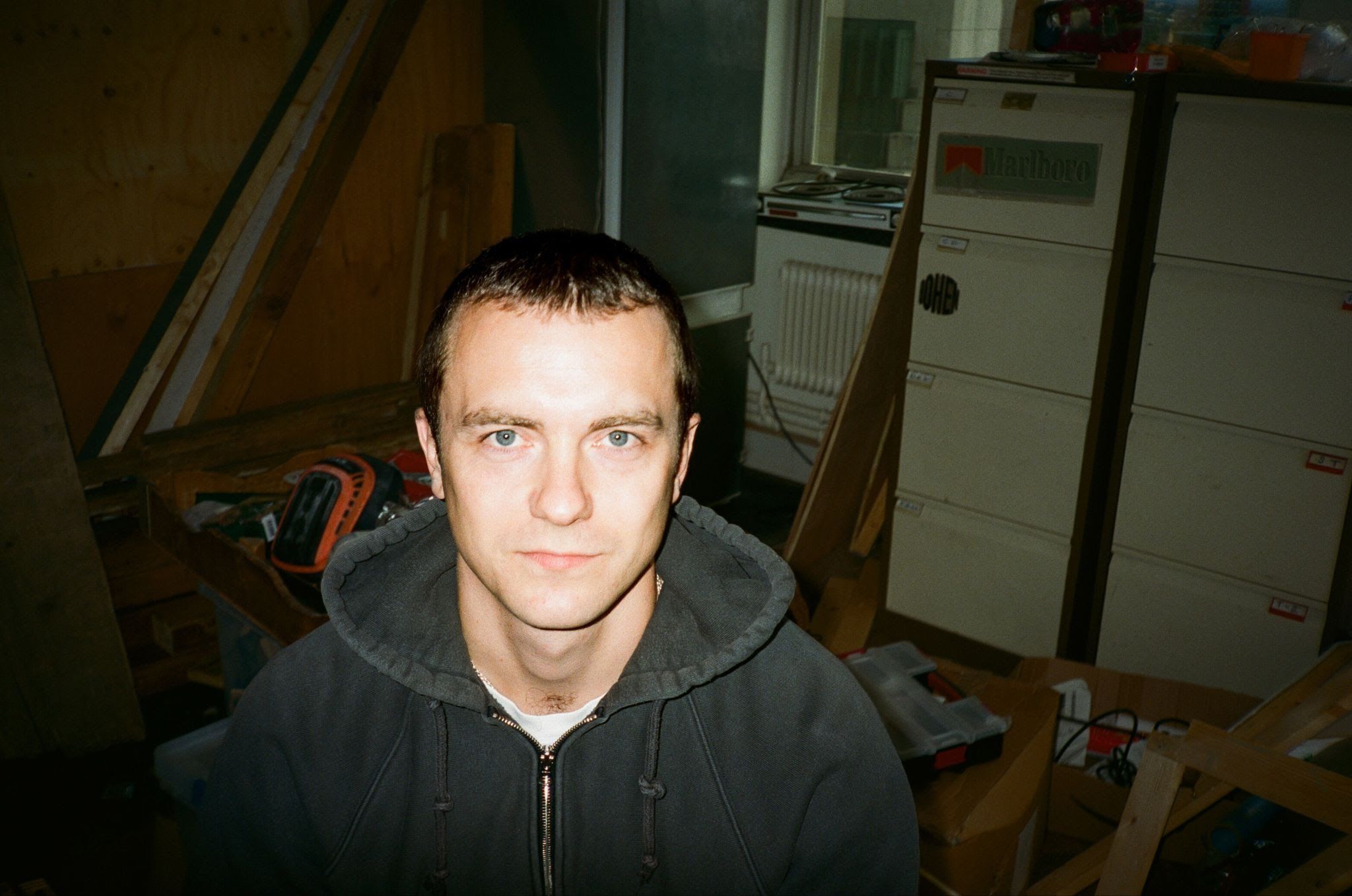 Ewan Moore Interview Image (c) the artist
“When it’s going well it feels like riding a wave.”
Video