Name: Eilis Frawley
Nationality: Australian
Occupation: Composer, songwriter, drummer, vocalist, producer
Current Release: Eilis Frawley's new album Twist my Words is out November 6th 2026 via Sinnbus.
Current event: Ahead of the album release, Eilis will tour. Catch her live at one of the following dates:
01.10.26 – Vienna, Austria – Waves Vienna
02.10.26 – London, UK – The Finsbury Park Ph
03.10.26 – Newport, UK – Loud Women Fest
04.10.26 – Sowerby Bridge, UK – The Puzzle Inn
05.10.26 – Manchester, UK – The Peer Hat
06.10.26 – Brighton, UK – The Brunswick
Kraut-related Recommendations: I’d recommend BEAK>, who I absolutely adore, and Minami Deutsch. I’ve seen both of them live over the past few years, and maybe I’m just a sucker for live music, but there’s something really special about experiencing this kind of music live. I love that feeling of all the tension building through repetition and then being released live. It’s something I don’t quite get in the same way from a recording.
Hometown Recommendations: Definitely recommend checking out a show at Neue Zukunft, and eating a pizza from Slices of Doom beforehand (the marinara is THE best!)
[Read our BEAK>'s Billy Fuller interview]
If you enjoyed this Eilis Frawley interview and would like to find out more about her music, visit her official homepage. She is also on Instagram, and bandcamp.
How would you describe your personal relationship with Krautrock? When and how did it start?
I’ve always really loved the process of doing something repetitively, playing the same thing over and over and over again until it starts to get weird. There’s something really hypnotic about that, and I think that’s probably where my connection to Krautrock is.
There are definitely elements of Krautrock that feel very close to the way I make music: the repetition, edgy drums, layers of percussion, hypnotic bass lines, electronic keys, synths and soundscapes. You can hear my own version of exactly that in my latest release, “Calm Down.”
But I think the term “Kraut” was paired with my music because that’s how people listening to it interpreted it. It wasn’t necessarily something I consciously set out to be, and it definitely wasn’t because of some desperate love for kraut!
The more I think about it though, the more I see the connection. I really enjoy getting lost in repetition and seeing how far you can push a simple idea until it starts to become something else. So maybe there is a little bit of a Kraut musician built in me!
Krautrock always seemed like a phenomenon connected to a very specific era in German history. What about this music and its time do you connect with?
I seem to always fall into genres, touch them slightly, and then get dragged into something else. I’ve never really been someone who stays in one particular musical world for very long.
Definitely moving to Germany ten years ago exposed me to a lot more Krautrock than I had heard before. Being here, and being around that history and influence, made me much more aware of the music and the different ways it has shaped the sounds around me.
I think what I connect with most is that feeling of experimentation — the idea of taking a simple musical idea and seeing where you can go with it, without worrying too much about where it’s supposed to end up.
That’s the only way I know how to make music, blinded by the moment.
Many of the original Kraut musicians loved blues, rock, and psychedelia; they were intrigued by electronics and improvisation; they rebelled against virtuosity, classical education and the superficiality of Schlager on German radio. How much of that do you recognise in your own creative preferences and interests?
I hate Schlager, so maybe we have that in common!
I’m influenced by so much different music. I spent my teenage years dedicated to classical music, then played jazz for a few years. I listen to mainstream pop too, but I’m often more drawn to smaller indie, pop, punk and hardcore bands.
I also work in a music venue, so I get to see a lot of live music, which I think is such a gift. Nothing inspires me more than a great live performance. I love seeing how people experiment, take risks and create something in the moment.
Both in the music and the way it was made, Krautrock was about imagining different worlds. What is the experience of listening to this music like for you and what kinds of worlds is it taking you to? What is your preferred way of listening to it?
I don’t know if this answers the question but I’m definitely focused on creating and imagining different worlds through the process of writing and releasing music.
The idea that music can create a space or atmosphere that takes you somewhere else.
A lot of the Kraut spirit came to life through musicians living in communities, playing and recording together every single day. Have you ever tried working and creating in such a constellation? Is it possible to emulate this process from a home studio?
For me, the main elements are edgy, repetitive drums, hypnotic basslines with not too much tonal movement, added percussion layers, and lyrical content that repeats with small changes. I also hear a lot of synths and electronic sounds: blips and bloops used quite sparingly.
I think it’s that combination of repetition, restraint and small changes that really interests me. I like the idea of taking a few simple elements and letting them evolve slowly rather than constantly adding something new.
What instruments or equipment are you using to create your music? Are there any vintage instruments that you find essential to get your sound right?
I’m not really a gear fanatic and I’m also not rich! But on my upcoming album, I really enjoyed building certain effects directly into the recording process, so they became part of the recorded performance rather than something I added later.
For example I recorded some vocals through a vocal pedal, with the effect already printed into the music. I did something similar with the bass, drowning it with effects whilst recording. I really like that feeling of making a decision early on and committing to it. Making music with today’s technology can lead to such extreme decision fatigue, so this helps (ever so slightly).
Now I’m working with drum triggers for live performance, which I’m really excited about. They let me add percussion live: snare reverbs and delays, claps, little sounds ... it adds so much to the overall sound (and also adds a lot of fun for me).
Could you describe your creative process on the basis of Twist my Words?
This album came together quite differently from how I usually work. I found myself back in my hometown because of a family medical emergency, with only a MIDI keyboard and a microphone with me.
Normally, I like to start with drum ideas, but because I didn’t have any gear, I ended up building a lot of the foundations with MIDI drums / drum machines. From there, I wrote the bass and vocals, and then the rest of the music came together around those elements.
It was actually quite nice to have different limitations to the way I work. Some of the limitations ended up shaping the sound of the album in ways I probably wouldn’t have arrived at otherwise.
Later on the drum machines were replaced by live drums and so forth, making further changes to the sound of the album, but some of the drum machines I kept in as a double though, just for fun.
On my single “GUILT,” the drums almost didn’t change at all from the original MIDI demo. I decided to stay true to the original idea of less is more: not too many fills, not too many changes, just a beat that stays front and centre with small changes happening throughout.
Tell me a bit about the role that improvisation and inventive arrangement techniques (like cut-up) play for your work?
I am the queen of the collage! I love rearranging things, taking pieces from one part of a song and moving them somewhere completely different, layering them, reducing them or extending them. I really love that patchwork style of creating.
Sometimes I love it … a little too much, and I have to tell myself to write a proper chorus instead of endlessly moving between ideas I like and rearranging them 100,000 times.
(I also like moving furniture around, it’s the same thing, right?)

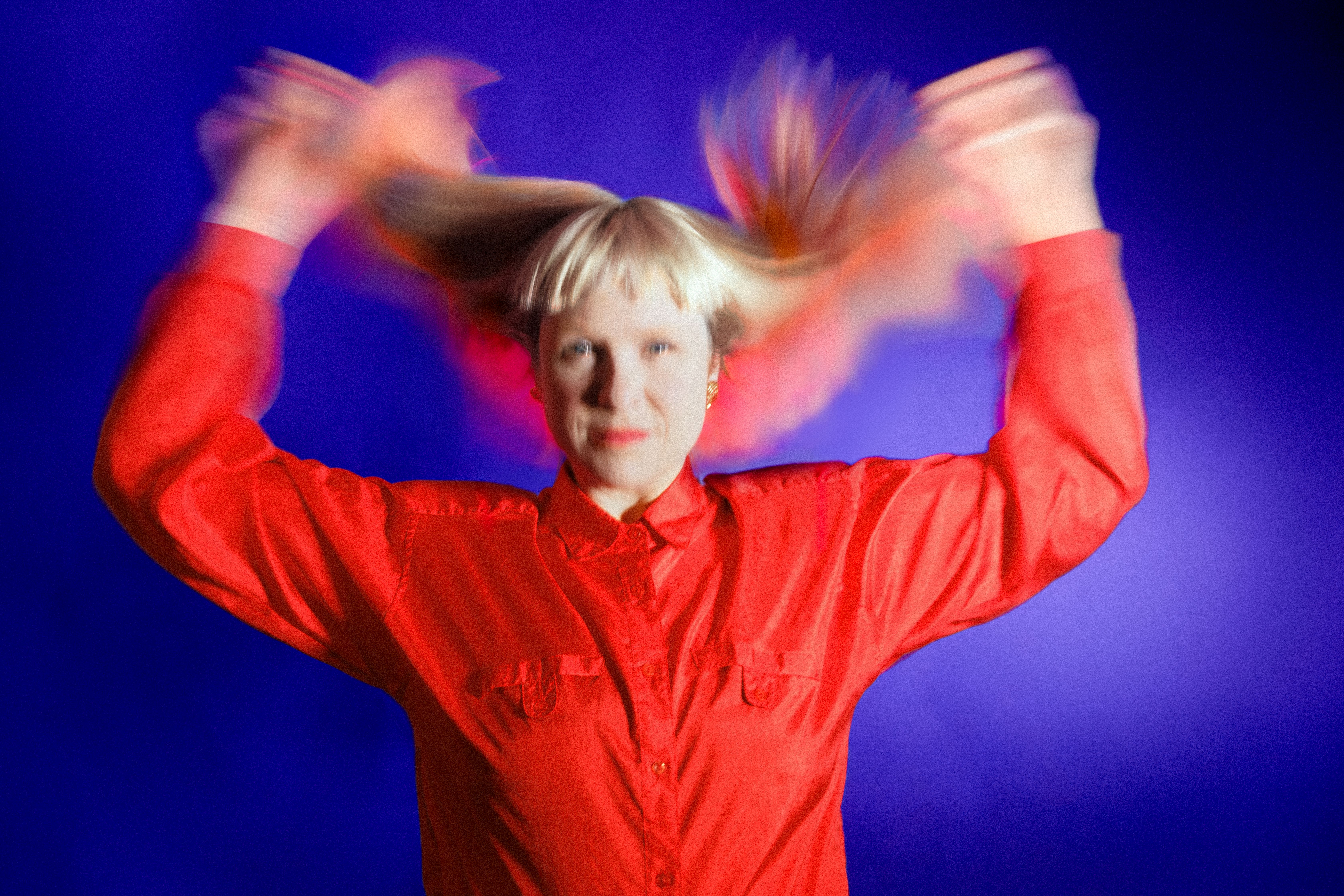 Eilis Frawley Interview Image by Marcelle Bradbeer
“I really enjoy getting lost in repetition and seeing how far you can push a simple idea until it starts to become something else.“
Video