Name: The Dwarfs of East Agouza
Members: Maurice Louca, Sam Shalabi, Alan Bishop
Nationalities: American (Alan Bishop), Egyptian (Maurice Louca), Egyptian-Canadian (Sam Shalabi)
Current release: The Dwarfs of East Agouza's new full-length album Sasquatch Landslide is out via Constellation.
When it comes to experiencing the sensation of “energy” as a listener, which albums, performances, and artists come to mind?
Alan Bishop: Can be so many things, the Italian and Bollywood soundtrack composers of the 60s and 70s, various forms of Jazz from the mid-50s to mid 70s, these are endless black holes where I have encountered so many surprises and discoveries.
Bad Brains 1982 tour. I saw two shows, and it was revelatory to the core - a raw assault of power and precision that I had never experienced from a live band before. Early Meat Puppets shows were equally inspirational, but their field of expression was wider, more unfocused like a train going on and off the track, flirting with disaster at every turn, completely riveting.
There are so many more, but I need to move some boxes right now.
There can be many different kinds of energy in art – soft, harsh, healing, aggressive, uplifting and many more. Which do you tend to feel drawn to most?
Alan Bishop: There are too many other potential variables that could draw me to any of them anytime. Why subscribe to just one?
It subliminally sends a message to others that they should choose or have limits in expression, emotion or methods of operation.
I have had a hard time explaining that listening to death metal calms me down. When you listen to a song with a particular energy, does it tend to fill you with the same energy – or are there “paradoxical” effects?
Alan Bishop: Yeah maybe both, I don't really know.
But I can relate to this directly through what I've always said about living in Cairo - when I'm here I'm calm and relaxed amidst all the noise and chaos, traffic and swarms of people. When I return to the states or Europe, I become more aggressive and less patient with the supposed "order" that exists there.
But I don't think much about observations like this, because things change all the time.
In as far as it plays a role for the music you like listening to or making, what role do words and the voice of a vocalist play for the transmission of energy?
Alan Bishop: Well, it's a weapon in the arsenal that's for sure.
Everything is available at any time, and the less predictable, the more potential of energy available for transmission.
When it comes to experiencing the sensation of “energy” as a creator, how would you describe the physical sensation of experiencing this energy? [Where do you feel it, do you have a visual sensation/representation, is there a sense of release or a build-up of tension etc …]
Alan Bishop: Each experience is its own sensation. The Dwarfs are similar in the way Sun City Girls used to improvise, both being trios.
There are circular forms of energy moved around, cross communications, singular directives, transitional connections, reacting off of frequency reception or directing the flow outward, and forcing shifts in the music that completely change the mood instantaneously. So I don't notice assessments of the moment while in the moment because I'm focused on simultaneous reception and processing of what the guys are doing while executing my contribution to the immediate composition.
I often remember very little to nothing of what happened on the stage afterwards. I would like to think this is because I am tuning into every fraction of every second of the performance and that type of commitment can create the most interesting outcomes, with metaphysical forces also in play, and so the memory must be sacrificed to achieve the result.
But in the end, perhaps these things are within our capability of understanding yet beyond our ability to articulate.
When it comes to composing / songwriting, are you finding that spontaneity and just a few takes tend to capture energy best? Or does honing a piece bring you closer to that goal?
Sam Shalabi: All our music is improvised - even if we ' recycle ' or use something we've done in the past as a launching pad for an improvisation.
We couldn't repeat it exactly anyways because we never rehearse anything we've done before. Our goal is to get in a certain state - a kind of situational ritualistic musical space - where the unexpected but inevitable can manifest itself through us ...
How much of the energy of your own music, would you say, is already part of the composition, how much of it is the result of the recording process?
Sam Shalabi: Well,there is no real recording ' process' that can be distinguished from what we do in a performance or practice space. Either it works or it doesn't ..
Our music's guiding principle is a kind of Hapax Legomenon - a pattern recognition in the present moment that exists one time only ...
For Sasquatch Landslide, what kind of energy were you looking for?
Sam Shalabi: Everything we do is a result of time and space; we never go looking for energy.
The energy = m(us)c(whatever we improvise)squared (whatever we hear when we listen back.)
How do you capture the energy you want in the studio?
Sam Shalabi: As I mentioned, we don't really go looking for or want to force anything in our music.
We are just the vessels for an animating spirit or energy - be it cosmic, quotidian or corporal ...
What role do factors like volume, effects like distortion, amplification, and production in general for in terms of creating the energy you want?
Sam Shalabi: I think that would vary from each member.
Myself, as the electric guitarist, I've never been a gearhead and will often stare blankly when musicians are geeking out on gear. I barely use any pedals and prefer to see what kind of 'effects' or energy and music can be created within the limitation of a mostly clean sound ...
In terms of energy, what changes when youre performing live on stage, with an audience present, compared to the recording stage?
Maurice Louca: I think it makes a big difference even though we are improvising in both setups, and it might seem like both contexts – studio vs concerts - are similar for us.
Obviously the main difference is the presence of an audience, which is often very impactful on the music.
How does the presence of the audience and your interaction with it change the energy of the music and how would you describe the creative interaction with listeners during a gig?
Maurice Louca: For me personally I think it changes a lot having an audience, especially in a context like with the DOEA were it's mostly improvised music.
The energy from the audience can really direct were the performance goes, since it's all wide open to start with. The impact of the audience can and often is key to were we end up on the night.
What kind of feedback have you received from listeners or concert audiences in terms of the experience that your music and/or performances have had on them?
Maurice Louca: Its been a wide range of things.
A DOEA show can be surprising even for us, and it's often hard to know what to expect or how it will impact an audience. We have also played in a certain context where going into we can tell that the people might not know what they are up for, and those are fun in there own way.
But I would say the kind of feedback that really lifts me up is when the telepathy between us gets through to an audience and they are amused as to how this could be all improvised, when it feels even for us that on that night it was almost all composed.
Would you say that you prefer to stay in control to be able to shape the energy or do you surrender to it and allow the music to take over? Who, ultimately has control during a live performance?
Maurice Louca: Trying to be in control in an improvised context doesn't make sense, even as a sentence (linguistically). I think the whole point is to let go and be open to go places.
The best improvisers are always the best listeners, and to find people that you can trust to have that musical free fall with is a wonderful thing
The energy that music is able to generate can be extremely powerful. How, do you think, can artists make use of this energy to bring about change in the world?
Maurice Louca: I think honest expression is the most important and potent tool an artist can have or should aspire to. And when using a medium like music, I agree with you in that it can be extremely powerful.
I don't know how you can quantify the actual change it can do, but in my life personally, music has had an immense impact on me. Certain musicians and artists have helped shape a lot of my views on community, self expression, what it means to oppose power, or simply to think for yourself.
So in times like the ones we are living in right now, it's so deflating and pathetic to see so many artists staying silent to a live streamed genocide in Palestine because they are afraid to lose a job, or be dropped by a label or a sponsor etc ...

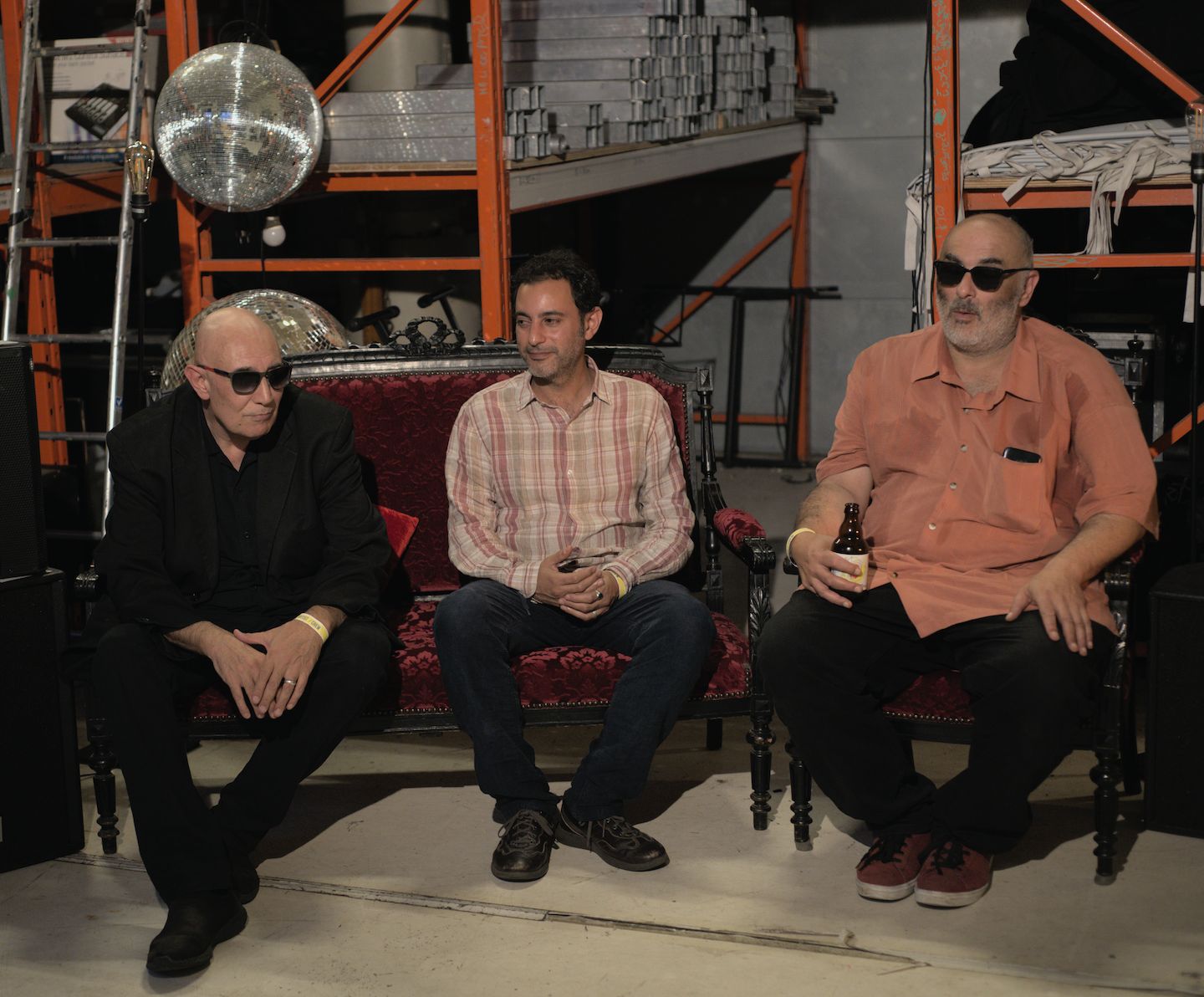 The Dwarfs Of East Agouza Interview Image by Hans Van Der Linden
“We don't really go looking for or want to force anything in our music. We are just the vessels for an animating spirit or energy.”
Video