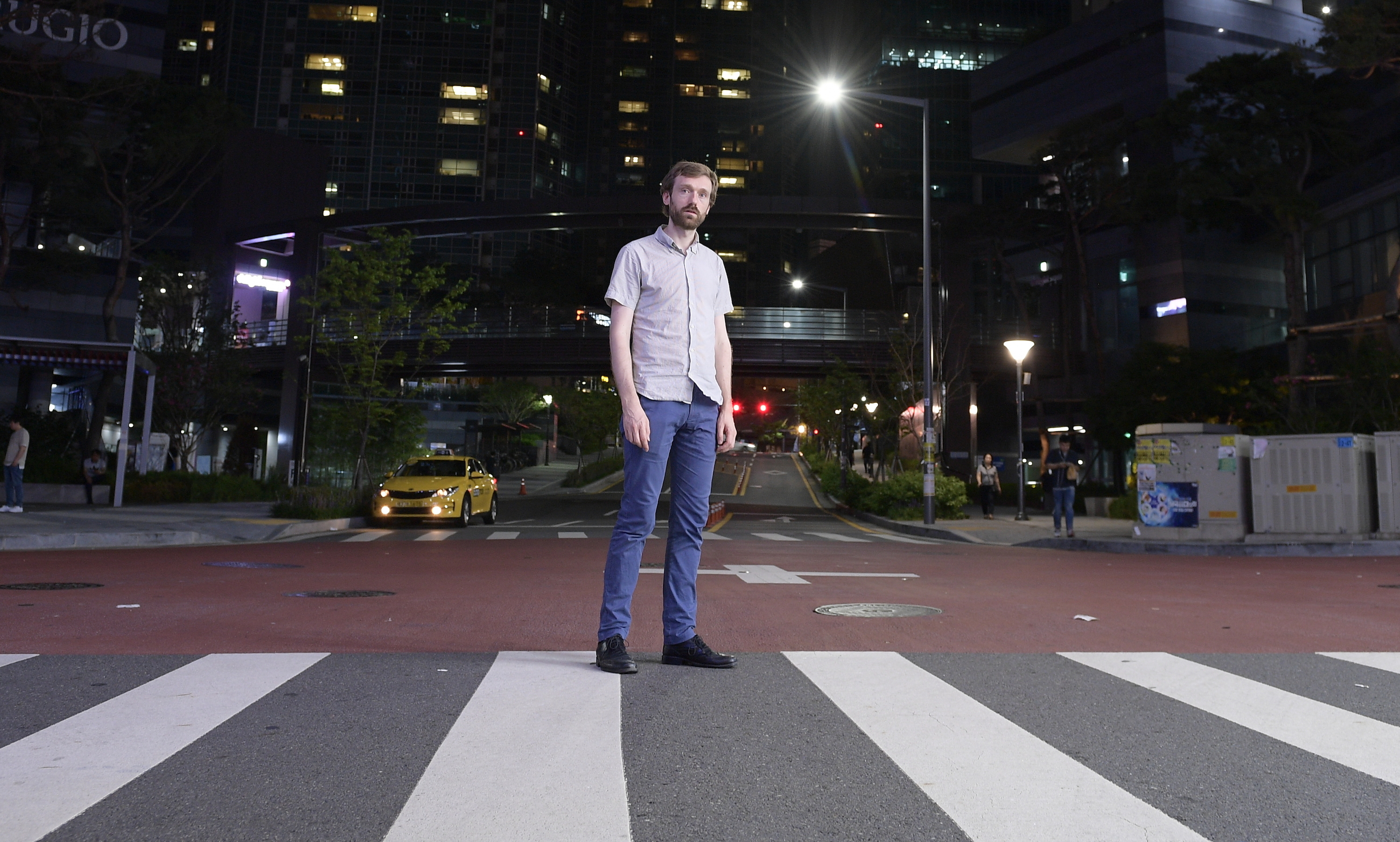


Name: David Thomas Broughton
Occupation: singer/songewriter
Nationality: British
Current Release: Pre-order Heavy Thoughts on TOMO/OTO
If you enjoyed this interview with David Thomas Broughton and would like to know more about his music and upcoming tour, visit his website, Bandcamp and Instagram.
Where does the impulse to create something come from for you? What role do often-quoted sources of inspiration like dreams, other forms of art, personal relationships, politics etc play?
It’s a fairly unknown quantity - and it has shifted over time. Early on it was a desire to be like heroes, my dad and his friends, the idealised artists you learn about with a sense of awe, the desire to be liked, I think you kid yourself that it is an innate need to find some way of releasing what’s in you and artists are compelled to release all this stuff that’s bursting to get out no matter what. There is a reason some take a leap to put yourself and your creating out to the world. It’s a selfish need to be seen and recognised. And the fact some shun the trappings of fame is a cliche to fit in with a view of fame-shunning artists to elicit the respect of peers or a community that only respect a perceived intention.
That said, the cynical rant above gives a small boost, an initial impetus that’s then placed you in a world that can become immersive. It is both selfless and self-centred. Unless you try to make crowd pleasers you are satisfying your personal interest. What feels and sounds interesting to you. The motivation becomes a more personal challenge to create. The influences shift over time though.
Youthful melancholy can either stay with you through adulthood, where you are continually exploring sadness and personal emotions, or mutate into celebrating the joys of life and nature. Then through this you can circle back through the global challenges and dwell on climate catastrophe and the plight of humanity. It’s one of those situations where you are pulled apart by horses, the balance between the light and dark. So my work often pulls you in both directions (maybe Plunge of the Dagger is a good example where I was compelled to juxtapose the nebulous sentiment of the lyrics and trudging music with the existential tragi-comic words of Luke Drozd.
My sons are really into space, and the enormity of what they are reporting as they learn is really crushing. I’m easily crushed.
For you to get started, does there need to be concrete ideas – or what some have called a 'visualisation' of the finished work? What does the balance between planning and chance look like for you?
I have never afforded myself the time to take a ‘visualisation’ into practice. When I do allot time to practice and write, it’s with a blank space that slowly gets populated with scraps from memory. Sometimes I’m compelled to write down a couplet or two, and these are then referred to and built upon during a session.
What I’ve mostly done is carry these fragments with me on stage. New material develops over a few live performances to see what could manifest. But even when something is recorded for release it is rearranged live and rarely as a finished piece. And I think most pieces never reach a finished state. So, everything you hear on record is a work in progress essentially. This is a factor of the single take approach I have used in the majority of my work. So in terms of the balance, it leans heavily on chance.
This improvised single-take collaboration with Matt and Neil that will be released this year.
Is there a preparation phase for your process? Do you require your tools to be laid out in a particular way, for example, do you need to do 'research' or create 'early versions'?
With a severe technical deficiency, I have always linked things up as unprofessionally as possible. The disorder is a kind of challenge I use to direct chance elements, like the risk of things not working or batteries running out, and having to overcome these in the moment. It has been an interesting way of ensuring elements of urgency and spontaneity to move myself forward or shift into a new direction. So, if anything I am purposefully unprepared.
Also, my memory tends to be lacking, a combination of never giving time to practice and performance nerves. I do sometimes prepare a setlist with some mental notes for elements to use during a performance, but as soon as I set foot on stage, I lose all that. Even with band shows, I have to prepare the players to just roll with it.
Do you have certain rituals to get you into the right mindset for creating? What role do certain foods or stimulants like coffee, lighting, scents, exercise or reading poetry play?
There are no rituals. I’ve managed to sustain nerves on early tours with alcohol, it also loosened me up to be creative, but as I became more comfortable on stage the process of creating and the challenge of getting through the performance journey has been the stimulant. I guess there is some link with a freer mind giving the space to pull ideas together. A ritual of taking time away from stresses of a busy life, sitting calm and in isolation. Or a solo walk.
I like to walk without distraction, no earphones. Just the sounds or the world around. Recently I’ve found speeding through the city on a bicycle is a place I can improvise singing without disturbance. I reason that I’m passing people too fast for them to register what the noise is. That time before arriving at my destination. But these are relatively fleeting moments. Historically my creation space has been live on stage.
For your latest release, what did you start with? If there were conceptual considerations, what were they?
Started with the idea that it would be good the make something with Matt and Neil together.
My personal concepts never really move from the embodiment of what I said in the previous questions. Run on emotion, with no real technical skill, the space that Matt and Neil have created to allow my contributions to be more sparse interjections at times, has given this collection of sounds something different. Hopefully still comfortable for (the few) dedicated David Thomas Broughton collectors.
Tell me a bit about the way the new material developed and gradually took its final form, please.
Lyrics float in fragments for years - jotted notes and rhyming couplets - there is a moment when a few of these coalesce around some looped guitar and simple melody. Neil and I have performed a number of times over the years and we feel comfortable that we can create something that fits our complementary parts.
In reality, Neil has done a great job of finding something in my jarring loops to create deceptively simple but shifting patterns and textures. The chats with Matt gathered some useful shared positions on improvisation and song. Essentially, we were all happy just to jam for a weekend and see if anything floated. Like a lot of my material it lives in a moment, a first take. Michael Ward did a bit of mix work after the recording to get to the finished release.
What makes lyrics good in your opinion? What are your own ambitions and challenges in this regard?
I swing between cliche and anti-cliche standpoints. Also, I used to sit on a purist fence about the use of ‘And’ to start lyrical lines. The more you fixate on something the more it is everywhere. But I cringe at listening back to some of my output, the step I can take to mitigate this is to remember that sometimes a lyric I have included on recording has been spontaneous or spontaneously mispronounced, errors are due to process and an inevitable consequence.
I absolutely love a complex narrative, but am unable to write like that myself. I don’t write a lot of words and make sure that there is room for interpretation and a lack of clarity. I think it probably developed from anxiety about revealing too much.
What are areas/themes/topics that you keep returning to in your lyrics?
So, to follow on from the previous questions, the lack of revealing too much is down to the fact I often only feel I have agency to write from the perspective of my own lived experience. But to document the ideas I want to, it sometimes involves trying to perceive someone else’s position or inhabit a character, but the character is generally framed in the context that I can understand. I wrote a few songs for the collaboration with Juice Vocal Ensemble from the perspective of complex characters I observed around Yorkshire, or exaggerations of those.
I think it’s been mentioned before, and although I never intend to dwell on it, lyrical themes are generally reflections on the awkwardness of being human.
Many writers have claimed that as soon as they enter into the process, certain aspects of the narrative are out of their hands. Do you like to keep strict control or is there a sense of following things where they lead you?
I don’t know about that. Perhaps, given that a lot of it stems from what happens when I play live, with new perspectives developing around the edges of core ideas, sometimes led by the acoustic space or the audience reaction/interaction. There’s bound to be something that comes up from the unconscious mind and who knows what triggers the direction it takes when they get involved in the narrative?
There are many descriptions of the creative state. How would you describe it for you personally? Is there an element of spirituality to what you do?
I can’t really subscribe to spirituality in any form. And sometimes feel cold about that. However, there is warmth in how creativity can influence your emotions. If that is spirituality for you, then so be it. I was talking with friends about electromagnetic traces from any action - they like to dig deep into theoretical physics. But what some people can feel about a place, the feeling that something significant happened on a place, is due to the electromagnetic traces that can be left in a physical space by someone experiencing extreme emotions. And there are some people who can perceive these very tiny subatomic shifts, getting a physical reaction to it. So the power of emotion that can be drawn from getting the right combinations of music and words, melody and dissonance can elicit physical response. We all feel that sometimes, when that combination hits us.
Once a piece is finished, how important is it for you to let it lie and evaluate it later on? How much improvement and refinement do you personally allow until you're satisfied with a piece?
Pieces I have made using the semi-spontaneous approach are let loose into the world. An ethic I established for things to remain ‘of the moment’ has probably been a reaction to the fact I don’t have patience to work and rework toward a perceived perfection. Nothing is perfect and neither should it be. I’m satisfied that there is a representation of a moment in time where I felt I was doing something representational of myself at that time.
That said, I’m constantly turning over old songs and pieces of music in my mind, pieces that I created in the past that I can imagine in a new reworking. Having the energy to organise people and time to realise those is a thing I’ve yet to achieve.
How do you think the meaning, or effect of an individual piece is enhanced, clarified or possibly contrasted by the EPs, or albums it is part of? Does each piece, for example, need to be consistent with the larger whole?
Interestingly, I haven’t always pictured things as a whole. But a factor of process - single take recordings running through a set of disparate pieces - and a factor of the lyrical content often coming from the same place - means that albums and eps find their own thread or narrative.
Someone recently analysed the whole of my album ‘Crippling Lack’, describing a narrative arc, and pieces that represent characters in a story of duality, and the two sides of me battling through the album to come to a compromise by the end. Who knows if that was a subconscious thread I had integrated, that the conscious me never picked up on? It is interesting that once you put a group of songs together there can be a new perceived completeness.
In terms of what they contribute to a song, what is the balance between the composition and the arrangement (including production, mixing and mastering)?
I don’t think I’m well placed to give detail on this. I don’t really know what the distinction is between composition and arrangement. It can totally depend on- some things come perfectly formed and befit little interference, other ideas need to be teased out or complimented with additions, and how well that is executed depends on the people and circumstance. As an instinctive artist with a limited palette I probably feel like it depends if you have an aesthetic you can inhabit confidently.
Music and the accompanying artwork are often closely related. Can you talk about this a little bit for your current project and the relationship that images and sounds have for you in general?
This will be one of the few times I’ve not illustrated or created the sleeve. Of course we usually strive to represent the record visually for the sleeve. Coming from a visual arts family, it is just instinct to have music and visual art have connection. For this latest project, using the brutalist architectural abstraction of my brother’s (Dan Broughton) painting both defines this trio record as a separate project. But also links to the themes in the songs in my mind.
After finishing a piece or album and releasing something into the world, there can be a sense of emptiness. Can you relate to this – and how do you return to the state of creativity after experiencing it?
For the release of an album I never really let them go fully - when you perform songs and ideas you have on record it’s still a part of your life. The emptiness after a live show is quite crushing sometimes, I know lots of performers talk about this. You are sharing a moment with many people and there can be a burst of community afterwards when you man a merch desk or have a post gig drink, but those people disappear back to their lives and you are left intensely alone. The state of creativity when you’re creating away from that though, I don’t feel is difficult to get back to after you let one thing go. I think most artists have multiple projects they just crack on with one of the others for a bit - albeit with the occasional pang of imposter syndrome or writer’s block. Sometimes that step away or taking a walk can last days, weeks or months though.
I would love to know a little about the feedback you've received from listeners or critics about what they thought some of your songs are about or the impact it had on them – have there been “misunderstandings” or did you perhaps even gain new “insights?”
I kind of answered this in a previous question about one interpretation of the album ‘Crippling Lack’ but I also canvassed fans when we worked on the 2019 reissue of ‘Complete Guide.’ I had received comments over the years about how it had been important for people as either emotional support through difficult times or had brought them together with loved ones. I think that it shows how people value having someone else express their feelings in a way they haven’t before. But I guess we all know this - we all have songs as crutches through emotional times.
As for misunderstanding, yes. Someone had a very different take on Ever Rotating Sky from the actual inspiration. But, I like the fact that people can take something entirely different away from a piece. It becomes something of wider value.
Creativity can reach many different corners of our lives. Do you personally feel as though writing a piece of music is inherently different from something like making a great cup of coffee? What do you express through music that you couldn't or wouldn't in more 'mundane' tasks?
I like to spend time in the kitchen, I’m no technical chef but I don’t think the approach is that far removed from some form of self expression.
Please recommend one thing to visit in your hometown or the city you're currently living in.
I’m currently out in Tokyo and I would recommend a proper Japanese tea experience. Where you get taken through all the types and they pair them with different sweets and palette cleansers. From delicate to intense flavours.