Name: Daniel Blumberg
Occupation: Composer, producer, visual artist, songwriter
Nationality: British
Recent release: Daniel Blumberg's score for The Brutalist is out now. It features contributions by John Tilbury (piano), Axel Dörner (trumpet) and Evan Parker (saxophone). Other artists involved in the music were, among others, Vince Clark, Pierre Borel (saxophone), Simon Sieger (piano), Joel Grip (bass) as well as Antonin Gerbal (drums).
Recommendations for his current hometown of London: Cafe OTO in London is my favorite music venue, it’s where I go to see live music and where I met most of the musicians who played on The Brutalist soundtrack.
Topic I rarely get to talk about: Filofaxes.
[Read our John Tilbury interview]
[Read our Vince Clarke interview]
If you enjoyed this Daniel Blumberg interview and would like to find out more about his work, visit him on Instagram, and bandcamp.
Which composers, or soundtracks captured your imagination in the beginning? What scenes or movies drew you in through their use of music?
I didn't come to scoring for film through soundtracks. I was mostly just a fan of cinema, and my introduction to films was always through the director.
The first films I was really mad about were Krzysztof Kieślowski’s. I stumbled into Dekalog when I was about 17. I started to watch his films and then went on to discover directors like Fassbinder and Robert Bresson.
But I always navigated films through the directors rather than listening specifically to the music or picking out certain performances.
It was all about the voice of the director.
What were your very first active steps writing film music?
I met Brady [Corbet] when he was putting together his first film, and he invited me to some of recording sessions for Scott Walker’s score. There I met Peter Walsh, with whom I’ve now made three albums and two soundtracks. Those were really the first instances I truly began thinking about what film scoring was, and then Curzon and BFI commissioned me to write some music for their Agnès Varda film season, which was my first time working with picture.
I had mostly collaborated with improvising musicians in the past and with free improvisation, there’s a real openness to time and duration, so it was an interesting experience to work out how musicians could play in a way that felt dynamic within such a specific time-based medium.
[Read our Alphaville interview which includes memories of their time working with Peter Walsh]
How would you rate the gains made through experience - can one train/learn being an artist?
No one teaches you how to be an artist when you’re in school – you have to make decisions on your own about what you want to pursue and how you want to work. You have to be responsible for the way you work.
Personally, I learned a lot from reading books and watching films, something I now understand with scoring allowed me to better understand the language of the medium.
For your own creativity and approach to writing film, what was some of the most important things you learn from teachers tutorials, other composers or personal experience.
I’ve learnt mostly from friends or collaborators. One of my mentors growing up was David Berman, who died a few years ago. He was someone I spoke to constantly since I first went to Nashville at the age of 18.
One of the best books he sent me was Daily Rituals: How Artists Work, which talks about how artists organize their time and structure their days. He really introduced me to poetry too, I miss his recommendations, I’ll remember my dialogue with David for the rest of my life.
Peter Walsh has taught me so much about the recording process. I couldn’t even use ProTools before we started working together. Seymour Wright (who played a bit of alto saxophone on The Brutalist) has introduced me to so much music and art over the years, most projects I work on have some form of guidance from him.
How would you rate the importance of soundtracks and film music for the movie as a whole? How do you see the relationship between image and sound in a movie?
I love many movies that don’t have soundtracks, (for example Peter Watkins or Alice Rohrwacher) so I think the importance of the music really differs depending on what the film itself requires.
But one thing for me I think is important is to always remember that, as a composer, you are tasked with supporting the director’s vision. You’ve been asked to help or push their vision in that department, in much the same way that a cinematographer or production designer has been given that same responsibility.
In terms of the relationship between image and sound, I tend to come out of all of my favorite films feeling like I had an overall experience rather than picking apart the various constructs of how they’re created.
There are dedicated scores, soundtracks, temp tracks that ended up staying in the finished movie, and even scores that were written without the composer seeing the movie first. How do these different premises affect the finished movie, do you feel?
During The Brutalist I was quite insistent that Brady and I didn‘t use any temp music apart from music that we had created together. With a movie, you have a chance to create this total environment between the sound, image and text, and contextualizing it all from scratch seemed like the right way of going about it.
People of course do it in different ways, but I think for us it was important to feel like the music was all coming from the same world we were building.
How did you get started scoring The Brutalist and what were some of the specific challenges?
I wanted to create as much music as possible before I saw any pictures of the film, so Brady and I started from the script. We were living together during pre-production and shooting, so we were in constant dialogue.
He wanted to shoot to my music in some cases and have live music on set, so just out of sheer practicality I had to do a lot of work ahead of time, which felt like a really exciting way of marrying the images and the music to make something fluid.
As creative goals and technical abilities change, so does the need for different tools of expression, be it instruments, software tools or recording equipment. Can you describe this path for you, starting from your first studio/first instrument? What motivated some of the choices you made in terms of instruments/tools/equipment over the years?
When I write, I like to use very basic keyboard sounds that suggest a potential of what the music could eventually be. The idea there is that if it feels right during this very early stage, it’s going to be great when it’s actually recorded with acoustic instruments later on.
Over the years I’ve recorded a lot of acoustic music with extremely particular performers who have very unique techniques and sounds. I’ve also increasingly become interested in the potential of recording and microphone techniques.
I find the dynamics of capturing musicians in space the most exciting thing about what I do – organically capturing the dynamics in a room or a particular space rather than using computers to do so. 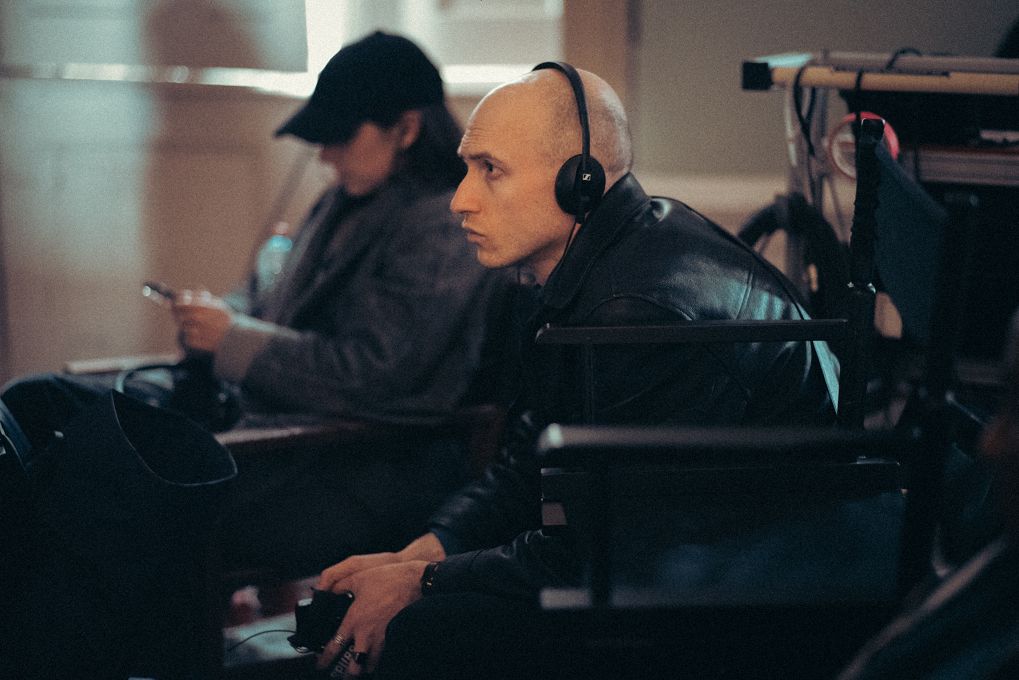
Daniel Blumberg Interview Image by Trevor Matthews
Can you take me through your process of composing The Brutalist?
For The Brutalist, Brady and I started talking about the movie from the minute he’d finished the script, and I made a piece of music quite early on that became a bit of a blueprint for the soundtrack. That piece was recorded at Cafe OTO on prepared piano, which meant we interfered with the strings of the piano, adding screws, paper, coins, really any object we thought would sound good to create a more percussive sounding instrument. Those recordings were then used almost like samples throughout the score.
During pre-production, Brady and I were living together and started working together every night and talking about various cues. There were times he wanted to shoot to music, so I would make demos in our apartment and we would listen together and tweak them, and then on-set they would play those demos over the speakers for the cinematographer and actors to be able to respond to the music.
It created an immediate back-and-forth between the picture and sound: they would tweak the picture to the music and then I would tweak the music to the picture and overall sound design later on. It was a delicate dance between the dialogue, score and sound.
After creating those demos, I began recording with particular musicians across Europe. Incredible players like Evan Parker, Axel Dörner, Sophie Agnel, John Tilbury and Joel Grip. I have build a portable recording set-up with very high quality microphones and a Sonosax recorder that fits in a small suitcase. The microphones are all Schoeps and Neumann u89s which like the Sonosax can capture the dynamics of what’s happening in the room very accurately. I recorded these musicians in their particular environments and spaces where they felt most comfortable.
After months of traveling, I assembled the recordings with Peter Walsh and we mixed all of the music ahead of the final sound mix.
I would assume that a major part of composing for film is the ability to interpret the images and the narrative at play. Tell me about how this works for you and how these interpretations in turn lead to sounds and compositions.
I don’t like to have recording sessions to picture, meaning I don’t show the musicians moving images while we record because I like to retain the opportunity to focus solely on the music, and also avoid illustration. But it differs from session to session.
For example, when I was recording Evan Parker on soprano saxophone, I showed him two still images of the set in Carrara, Italy: one was a wide-shot of the marble quarry vista where the squares of marble appear very small almost like pixels, and then another a very close-up shot within the quarry where the marble is in huge slabs and very heavy.
I showed him these two images, one zoomed-out and the other zoomed-in, and that, along with the music I’d written, were the two starting points for his improvisation.
Another example of using picture was for a particular scene in which Brady was using an in-camera effect on the VistaVision camera that very specifically stretched the light around the frame.
I showed this effect to the musicians playing Erzebet’s theme, which is the main romantic theme for the main character’s wife, as I wanted them to play the music in that same way, stretched out and sort of woozy and druggy.
So in that instance the images were really helpful in trying to explain the direction I wanted the recording session to go.
What, from your experience and perspective, does the ideal collaboration between you and a director look like?
It was really an ideal situation between me and Brady, and I was very aware throughout that it was a rare and special moment. I was working to help Brady, who I love deeply as a friend, to help him realize this project and story he’d written with Mona [Fastvold], one that I thought could be one of the greatest works of his life and such an important work. So from the start, it was so important to me to try to make music that could be worthy of that story.
Working with someone like Brady that I trust so much – having slept on his sofa over the years, lived with his family, etc. – I felt comfortable asking these very noncompromising, spectacular artists to contribute to the score, as I knew they would be treated well and their work would be respected. It’s much easier to ask people to work with you if you truly believe in that work you’re inviting them into.
Brady and I have had a dialogue for many years since we first met, and not only do we support each other, we also push each other, and through this process of collaboration, we learn new things about the other. All in all, it was ideal.
How do the other aspects of a movie's sound stage – such as foley and effects – influence your creative decisions?
With The Brutalist, it felt very important for the three departments creating the stereo sound to be in complete dialogue with each other. When you’re making a score, you are sharing the sonic space with diegetic sound and the dialogue, and the dialogue is commonly the lead singer.
I was lucky enough to be on set and able to set up extra microphones whenever we needed it. With the scenes in Carrara, I was able to record the reverb impulse response of the marble quarry and then apply that to the recordings of Evan Parker’s saxophone to make it sound like he was actually playing within the quarry.
I was in constant dialogue with our sound editor Steve Single, and we were very communicative about the intersection of the sound.
For instance, I had recorded Axel Dörner (Trumpet) and Simon Sieger (Tuba) playing sounds that mimicked the sound of a drill, and then the Steve would have to balance that with the actual diegetic sounds of a drill. It was a complicated process, but I think you can feel those processes rather than necessarily noticing them throughout film and it takes you further into Adrien [Brody]‘s character and particularly in the 2nd half of the film when he gets more and more disorientated with reality.
It's a collaborative medium and as much osmosis there is the better to make the story as undiluted and as direct as Brady’s vision.
The balance between visuals, fx and film music is delicate. What, from your point of view, determines whether or not it is a successful one?
A successful balance is one where the director is represented and his intentions are realized.
Cinema is complicated – when you’re making a painting or drawing, it’s so direct. You get a piece of paper, move your hand around and you’re creating an image that exists in its totality on that paper. And in a sense music is much like that too – you can record a song on a guitar and it is the work in totality. Cinema is very different, there is a narrative the director wants to tell in a very specific way, and with a particularly huge narrative film like The Brutalist, the scale of it requires a huge amount of collaborators. And the potential problem with collaboration is that your ideas get diluted through different opinions and it’s not as direct.
What I find most inspiring about the directors I love is that they are able to retain that initial directness of their vision through it all – the actors and their performances, the visuals, sound, costumes, etc. That’s one of the main things that i think determines a successful film for me, the authorship of the director.

 Daniel Blumberg Interview Image by Ilana Blumberg
"A successful balance between the different elements of the score is one where the director is represented and his intentions are realized."
Video