

Part 1
Name: Daniel Bierdümpfl
Nationality: Austrian
Occupation: Composer, guitarist, improviser, multi-disciplinary artist
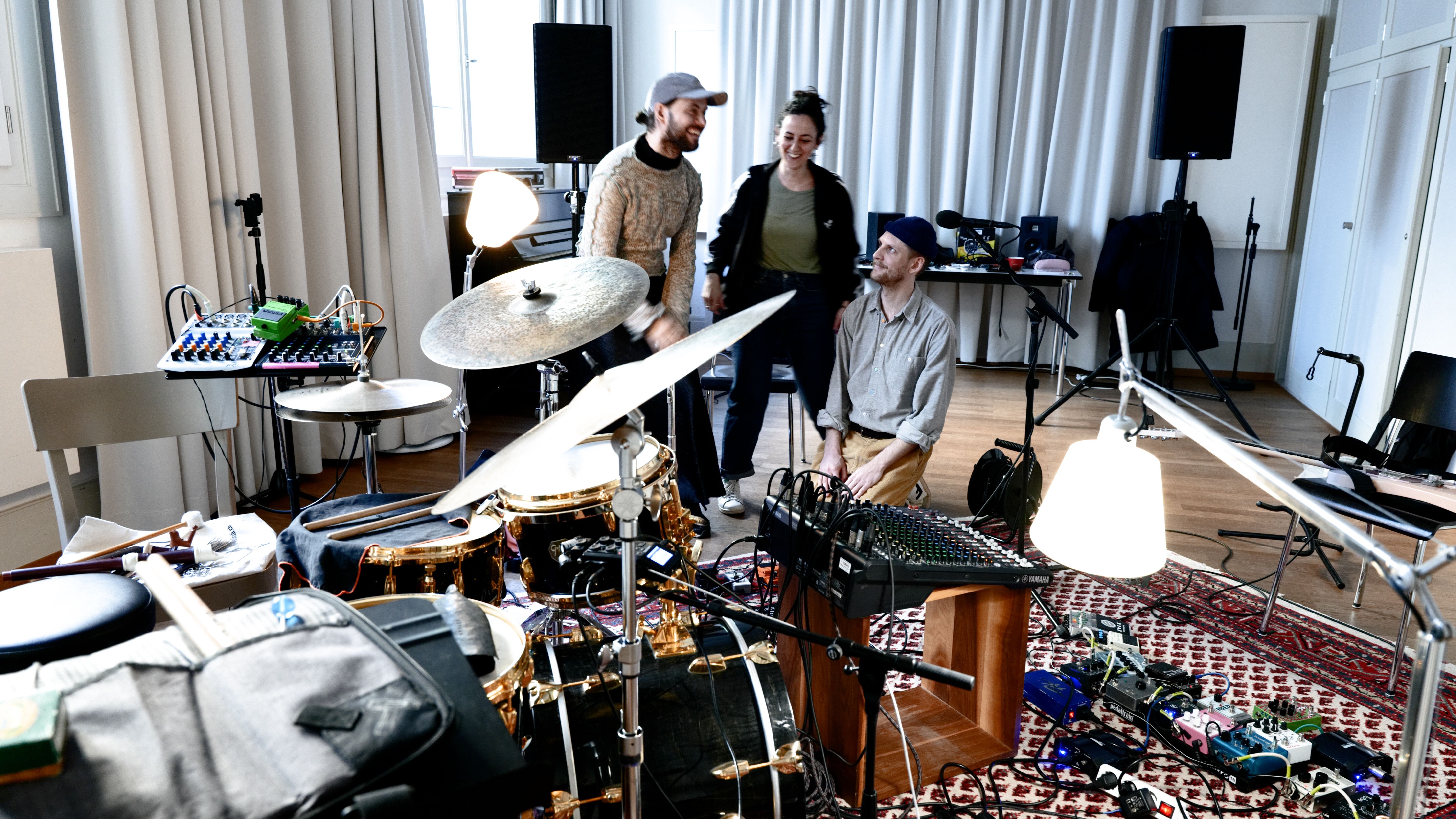
Current Release: Daniel Bierdümpfl on guitar anf fx teams up with Marina Tantanozi (transverse flute, bass flute, fx, vocals) and Jakub Švejnar (drums, no input mixer, vocals, recorder flute, radio) for Music for Advanced Fools, out via unit.
Hometown Recommendation: The Meinklang Hofladen in Vienna, Austria.
If you enjoyed this Daniel Bierdümpfl interview, and would like to know more about his music and upcoming live performances, visit his official homepage. He is also on Instagram, bandcamp, and Facebook.
When did you first consciously start getting interested in musical improvisation? What was your first improvisation on stage or in the studio and what was the experience like?
I think my first experiences with improvisation were sometime during my adolescent punk phase, when I had completely fallen into pentatonic purism and simply wanted to shred some killer solo over fast chords.
Improvising punk songs with friends in damp, poorly insulated basements, drinking beer, gave me a lot of pleasure in my youthful rebellion. We were far too lazy to rehearse arrangements, so we just shredded away like that - which, to be honest, is still pretty much how I deal with my laziness today.
But the more you swing your own machete through the jungle of music and subculture, the more countless problems and questions reveal themselves, of course: What is going on here? Who are we, actually? Why do we make music? What even is improvisation, and does it actually exist? Why do I have to do my taxes?
I think, however, that the point in my life where all these questions came together, and where my awareness and interest in improvised music began to take concrete shape, was around the founding of my duo Grandmothers Favourite with Lukas Handlbauer (drums) in 2022.
Our first album, Root Canal Therapy, was created one evening in the rehearsal room - out of frustration and as an escape into music. Neither of us was doing particularly well, and I think we were simply trying to drown our unresolved conflicts in sound.
Unfortunately, Lukas moved to Berlin shortly afterwards, and I had gone from being in a duo to becoming a solo act. At the time, as now, I was organizing a lot of concerts, and I remembered a cwaaazzyy drummer from Prague who had once played in my living room with his band Jungle Debris. His name was - and still is - Jakub Švejnar.
“Why would he want to play with me?” I initially thought. But then I simply picked up my nonexistent courage and the telephone and called him: “bli bla blu, I want to play with you! Would you like that too?” - that’s what I said, more or less. Since then, we have regularly played and argued our way between the Czech Republic, Austria and wherever else.
Jakub had already been active in the improvisation scene for quite some time and had developed his own distinctive musical language on the drums, which impressed & inspired me enormously. Hats off, Jakub - you are a cwazy dude with cwazy chops.
Jakub has taught me an enormous amount and continues to do so. The family tree that grew out of our duo Grandmothers Favourite continues to sprout branches, and I have to admit that despite all my projects and concerts, I’m still not sure whether I have ever truly improvised.
Tell me about your instrument and/or tools, please. What made you seek it out, what makes it “your” instrument, and what are some of the most important aspects of playing it?
I mainly play guitar. Why? Hmm ...
Probably because the guitar is such an accessible and approachable instrument. Rich or poor, everyone plays guitar. The guitar seems to be THE classless instrument of the people. All over the world you encounter guitars and their owners.
Sometimes you also encounter lonely, abandoned guitars. What I mean is: I often don’t even have to bring a guitar with me in order to be able to play my instrument somewhere. Sometimes all it takes is a glance into a dumpster and — there it is: a guitar. This has genuinely happened to me several times. In pubs, these things are simply hanging on the wall. So there is almost a guitar inflation happening in this world. (Play something else people, for gods sake! Bagpipe, flute or Concertina maybe.)
Many parents send their children to guitar lessons because it is an affordable, socially accepted, popular - even almost heroized – instrument. In fact, I increasingly wonder whether it is even my instrument.
I probably would have chosen a different instrument if I had been allowed to choose one as a child. Well, now I’m a guitarist and that’s just how it is. At the moment I actually prefer playing piano, but I can’t afford one. I also had to sell my double bass for financial reasons 🥲 hello, help, please give me double basses. Thank you.
I also play with a lot of effects, which I constantly rearrange or replace over time. So I don’t have a pedal board, as is customary, but instead arrange my effects in a semicircle in front of me, depending on what makes sense for that particular day, venue, recording and lineup.
My outputs therefore range from mono to five outputs. I experiment with the sonic vocabulary and the full frequency spectrum that the effects make available to me, and I try to encounter something new and surprising within these chains of effects.
In the end, an instrument, quite literally, is a tool of music. At least in improvised music, it is becoming less and less important to me which instrument I play, or whether I play at all. On guitar I probably simply have the largest vocabulary and therefore feel that I can express myself more easily. In the end, it is more about the overall product and the music itself.
How would you describe your own relationship with your instrument – is it an extension of your self/body, a partner and companion, a creative catalyst, a challenge to be overcome, something else entirely?
Everything that one is and feels apparently transfers itself onto and into this thing. And this thing, in turn, seems to carry me out into the world.
Like an echo sounder, a cartographer mapping what music is capable of reaching, The sound - and sometimes oneself - travels across the world, touching people, oneself, and sometimes even nothingness. It is mediator, partner, enemy, friend. It inspires, it makes you angry, sometimes it refuses to cooperate, it choreographs the possibilities.
One’s own instrument is so much more than that, and the list could go on forever. There would still be qualities I couldn’t put into words. Perhaps, however, I could put them into music maybe:
Derek Bailey defined improvising as the search for material which is endlessly transformable. What kind of materials have turned to be particularly transformable and stimulating for you?
Music is a game. “Improvising” means constantly asking for new “vocabulary” to me - new material, without wanting to collect it. The collecting happens inevitably through being human.
What matters much more to me is how I can break my automatisms. A constant re-evaluation of whatever has once again become an automatism. Wherever a break occurs, you have the feeling, for a moment, that there it is: the music itself.
So it’s not necessarily about collecting, but rather about a moment of productive destruction. Seen this way, it is certainly a desire for constant transformation - and definitely feels stimulating.
Music is not merely harmony, rhythm and cultural conditioning, but also noise, emotion, politics, communication, etc. For me, the search for improvisation is an answer to the constant repetition that simplifies the processes of being human.
You inevitably encounter yourself and everyone involved in the game.
Do you feel as though there are at least elements of composition and improvisation which are entirely unique to each? Based on your own work or maybe performances or recordings by other artists, do you feel that there are results which could only have happened through one of them?
For me, improvisation is also composition. The only difference is the particular process that leads to a composition. Every compositional method inevitably leads to different music. Which one you choose perhaps also depends on the type of person you are.
A neurotic and/or anxious person may not necessarily want to embrace the arbitrariness of improvised music with joy every evening.
And one must always ask whether the act of composing serves a particular purpose, and if so, what purpose? Is it entertainment music? Does it have a ritual background? Should it be repeatable? Should it be digestible? Should it provoke? Or perhaps should it simply be nothing at all?
Depending on what you want - or do not want - to achieve, I think it makes sense to submit yourself to whichever process feels most natural or meaningful for you or for the product. Within each process, you encounter different aspects of being that guide the music in different ways.
There is just as much novelty hidden in the repetition of arrangements that you may even play for your entire life as there is in “free” improvisation. These are not always musical events, but also - and above all - internal negotiations with oneself. Positions and impulses.
However, I do not think I dare to generalize about what, when, where, for whom and by what means becomes possible within these apparent contradictions in the realization of music.
When you're improvising, does it actually feel like you're inventing something on the spot – or are you inventively re-arranging patterns from preparations, practise or previous performances? What balance is there between forgetting and remembering in your work?
Improvisation is collective reverse archaeology of the intelligible and the spirit. A forward movement, dusting off discoveries that have not yet become dusty. Nothing to be invented, but rather to be found.
The horrible and unromantic truth is that we humans love to repeat. And I am as human as it gets. In repetition we can find something that feels new. I cannot answer whether we find new things in music at all, because it all seems to already be there.
Sometimes, while browsing through traditional music and field recordings from around the world, I stumble upon music that feels timeless and hyper-modern. People have played and improvised with sounds for thousands of years. Not only people - animals too. How could we claim to invent anything?
It all seems to be there.
But to answer in a non-poetic way: I very rarely play or practice at home because I really like the way I play and feel when I pick up the instrument on the night of the gig. My ears are fresh and I feel more creative. Technically speaking, I’m not super fit all the time, but I try not to care too much about that. Despite doing so, I cannot prevent myself from falling into repeating patterns or ideas. I think no one can.
Nevertheless, I’m slowly starting to think that maybe I shouldn’t try not to repeat myself, but rather practice a lot of different and new things in order to eventually have an endless vocabulary that can intuitively flow freely in reaction to the music.
Let’s see when that might happen.
Artists from all corners of the musical spectrum, not just “free jazz”, have emphasised the importance of freedom in their creativity. What defines freedom for your improvisations?
I think one of the reasons why I play “improvised” music was, among other things, an attempt to find an answer to the question of whether something like freedom even exists.
(Trigger warning for hyper-individualists and those who want to become one!)
I read a lot about free will and, for the time being, came to the conclusion that free will does not actually exist, and that we are merely supposed to be “the language of our genes.” But that doesn’t make the search for it irrelevant or uninteresting.
“Human beings possess a will just like every other living creature. Whether this will is free is a matter of definition. A will manifests itself in the ability to choose between different possible courses of action, that is, to make a decision.
The will is not free in the sense that it is absolutely unrestricted, because decisions are influenced by a multitude of internal and external factors. But it is free to choose, from a limited number of options, the one that best corresponds to its intentions and goals.
The idea of free will may be an illusion produced by the brain. Whether this illusion is merely a by-product of a highly complex network of nerve cells or a product of evolution that promotes survival remains disputed.”- Max Planck Society
I think one can feel free in music. I also believe there is something spiritual in music that simply moves through us. Seen this way, we would be more like receivers, or perhaps mediators.
Maybe the freedom of creativity ultimately lies simply in not feeling compelled to do anything.