Name: Caterina Barbieri
Nationality: Italian
Occupation: Composer, performer
Current release: Caterina Barbieri's Myuthafoo out via light-years.
If you enjoyed these thoughts by Caterina Barbieri and would like to stay up to date with her music, visit her official website. She is also on Instagram, Soundcloud, and Facebook.
The following thoughts about various aspects of her work are sourced from several interviews Caterina Barbieri has given over the years. For a deeper dive, follow the links to the full versions.
For the thoughts of one her collaboratos, read our creative profile for Kali Malone.
Inner Worlds: The Female Spiritual Tradition
"I’m really inspired by female pioneers in electronic music. I think of people like Laurie Spiegel or Pauline Oliveros or Éliane Radigue, who all had a deep, spiritual approach to music and synthesizers, and really valued their own instinct.
Éliane Radigue was basically meditating with an ARP synthesizer, and she was really into Tibetan and Eastern philosophy. Back in those years, nobody was even able to conceive of such an open-minded approach. All of her colleagues were super theoretical about music, and almost dismissive towards her way of talking about it.
It’s a tradition I really value, the spiritual approach."
From: Document Journal
"Music is a way for me to channel energy and cultivate the cosmic vastness of the inner world. This contrast between the negation of the outside world and the openness of the inner world is very fascinating for me, and is a bit of an archetype of the female existence and the tradition of female poets, mystics and artists.
In the past, a lot of female thinkers lived very segregated and repressed lives: they were always looking at the world from a window, or through a filter. And because they couldn’t move freely in the outside world, they used to redirect their energy into the inner world and cultivate the power of the mind instead."
From: Fact Magazine
Technology
"For me the relationship with technology is this very creative active engagement and feedback with the machine. I really resonate with this idea of embracing chaos. We can build our ideas about music, our rules and some techniques, but the music always happens when we stop thinking.
Sometimes it’s unpredictable. You can spend many days in the studio trying to achieve something and getting quite frustrated and then all of a sudden the magic happens and it’s often when you’re not forcing yourself into these preconceived ideas that you have about your music or what you want to achieve.
I think those moments are facilitated by technologies when you engage with them in a more active way and embrace the unpredictability and chaos and improvisation with the machine."
From: Crack Magazine
Working with Modular Synthesizers
"I've never read a manual. I've never jammed with the modular. I hate this whole modular music scene.
Of course I'm associated with that because I play analogue synthesizers, but for me the approach to these machines is very deep, it’s very spiritual."
From: Mix Mag
For me, modulars are very interesting because they’re a bit wild.
Some stuff happens beyond your control and you’re just facing this stream of life and it’s a bit like life where you have the illusion of being able to control it but it’s too beautiful to be controlled and tamed and music is the same, modulars are like that for me.
From: Crack Magazine
"I’m very inspired by repetition and recursive elements, because they really create a hypnotic state—and, for me, music is a form of hypnosis.
I’m interested in creating a very specific state of mind that is close to a trancelike state—and I’m interested in exploring the psychophysical effects of repetition, which bring you into this state where time seems to stand still. But actually, it’s constantly moving and quite dynamic.
The first piece of gear that I bought was a sequencer because I knew I wanted to work with the permutation of pattern, almost as a way to reprogram the brain."
From: Document Journal
"The stream of sound is an interesting aspect of analog synthesisers. Synths are fields of continuous electricity. Sound flows constantly. You don’t press a button to play or stop a musical process.
The idea of composing from silence by means of an additive design as well as the “start/stop” logic related to the digital practice are undermined. You tune yourself to an ongoing sound field and make it selective. Eventually, the music is already there even before you start.
In this perspective, composition becomes an act of subtraction rather than a demiurgic act of creation from scratch. This shifts the attention from the object and subject of perception to the field where the perception is occurring, “a non-specific viewpoint."
From: Sound on Sound
"Western traditional music builds things up, piles notes on top of notes, its base is silence. But in the non-Western tradition, and I'm drawing now the parallel to classical Indian music because that's something I really love, and that has influenced my work as well [...] music begins from sound, the sound of the drone produced by the tambora.
The tambora is a stringed instrument that produces a very rich sound on top of which the improvisation happen. So, all the possible notes that the musicians actually can use during the improvisation are already there in the drone. The sound of the drone, in the Indian classical tradition is the highest source of value. It's also the most pervasive gestural archetype in that music. While in Western music, it's more the idea of the plucked strings, the sound of a string that is plucked from silence.But the drone of the tambora is already going, so it's the unstruck sound.
And I find this very interesting because you can see how this is reflected in the music as well. In Indian classical music this idea of the stream of sound, which also represents the continuous sound of the universe and the cosmic vibration that permeates the universe translates into a cyclical design in music. A design based on cycle, variation, permutation of cycles. This translates into more paratactic, modular, reticular, fluid design."
From: A performative presentation with Caterina Barbieri | Loop
[Read our Sarathy Korwar interview about more on the cyclical concept of Eastern music]
Sound
"Sound is a framework that is very physical, but it can get quite metaphysical in terms of the conversations that you can have around it.
Of course, in my music I don’t use beats or drums – or very rarely – but I use a lot of fast and intricate patterns so there is always a cinematic element, a sense of movement, and something that feels like a psychomotor induction. You feel a pulse, a rhythm, a groove in the patterns. I prefer to play my music in front of a standing audience because of that – there is an invitation to explore your physicality, even if you don’t end up dancing."
From: Mix Mag
"When we listen to a sound we become that sound, because we physically resonate with that vibration of the ether and with that wave. It is a simple physical principle but it is also the key to understanding the ecstatic nature of music: sound transports us outside the limits of our individual physicality and those of our ego, and in this process we embrace a larger and more collective dimension, which transcends the human and the terrestrial, and becomes a cosmic perspective.
Music thus becomes a spiral of connection between the interior and the exterior, the subject and the object: between confinement of the ego and cosmic freedom detached from time and space, beyond the oppositions of duality: it is the continuum of life and of becoming.
Like all forms of ecstasy, however, it also corresponds to a kind of double unconscious desire for death — to dissolve oneself in sound, as well as to lose one’s ego and encounter oneself in a more open dimension of continuous transformation."
From: Flash Art
In general I try to avoid iconic timbres from legendary synthesisers that are immediately recognisable and deeply embedded in our music culture. I use simple waveforms because I want to minimize the extra-musical, extrinsic cultural references of my sound and keep the identification of the sound source blurred.
When the listener fails to grasp the source behind a sound, she/he engages with a more active listening attitude, reliant on the intrinsic properties of sound as a physical object rather than the extrinsic properties of sound as a cultural object. In this way I find the perception of the sound object itself is enhanced and refreshed.
From: Sound on Sound
Creative Process
"I think my music is influenced by the type of venues I got to play at the beginning of my career, especially big industrial spaces.
One of my favorite venues in the world is Kraftwerk in Berlin. It was a power plant factory, but it really looks like an industrial church—incredible, high ceilings; big, massive reverb. A lot of people that play there tend to work with drum music, or very ambient, textural dark tones. But for me, I was really interested in playing with the reverb of the space and in hearing isolated gestures, and the decay of sound.
So, I started working with these patterns, with very isolated melodic gestures. And that really influenced my style, because I started working with intricate melodic patterns. I was really inspired by how the space was reacting to this, because it was adding melodic information, creating reverberations and delays and echoes.
I think this is an essential element of music history—like, if you think of how churches in the past influenced the development of polyphonic music, just because people were singing and hearing their echo, the response of the space. Physical space really affects music."
From: Document Journal
"The most exhausting, but also gratifying, aspect of my work is that of succeeding in integrating entropy into the creative process; an entropy that, in my case, derives above all from the random aspects of the machines that I use for composing. In fact, much of my compositional practice consists in incorporating the randomness of the modular hardware into my musical writing, in a way that is effective and interesting.
To do this I use various generative processes of musical sequencing, also some that are random or semi-random, but all the same it takes me ages to write a sequence that satisfies me [laughs]. After all, a lot of chaotic redundancy emerges from these very technologies: a lot of “anti-content” that needs to be filtered out, manipulated and readjusted so that an intensity of meaning can be produced, which has its own balance and grace."
From: Flash Art
"Music is time and it unfolds in time but music is also space. Personally, I’m intrigued by the idea of enhancing the perception of time and space through music, but at the same time dissolving it into something very fluid and very dynamic.
It’s a very specific type of time experience that I try to trigger because I’m personally interested in exploring it and it’s probably the main thing that interests me about music. This state of suspension of time somehow where there is still movement.
I use a lot of acceleration and deceleration in my music just because working with modular you have this very fluid approach to time. So you can patch the clock that controls the temporal elements in music in a very fluid way, in a very gestural manual way.
I like to work with acceleration and deceleration of time and to create the sort of suspended state where you have this feeling of running while being still and having this sort of tension towards something but also this tension doesn’t lead to anything because I’m interested in creating expectation or building up these climaxes that are not going anywhere."
From: Crack Magazine
"Repetition changes nothing in the object repeated, but does change something in the mind that contemplates it,” says Gilles Deleuze. I love this quote by Deleuze and I often refer to it when talking about my work with repetition.
I use repetition and other recursive musical elements as a media to create a specific psychic state, similar to trance or hypnosis. It’s an altered state of consciousness, where it’s easier to become receptive and present in the moment. A state of hyper focus, that exists beyond binary thinking: dualities between subject and object, inner and outer, physical and spiritual seem to crash all at once. Music carries you outside of your body, unbounded in time and space.
I think of music as a transformative experience — a process rather than a form: it’s more about the changes we, as listeners, undergo rather than the changes the material itself undergoes.
From: Something Curated

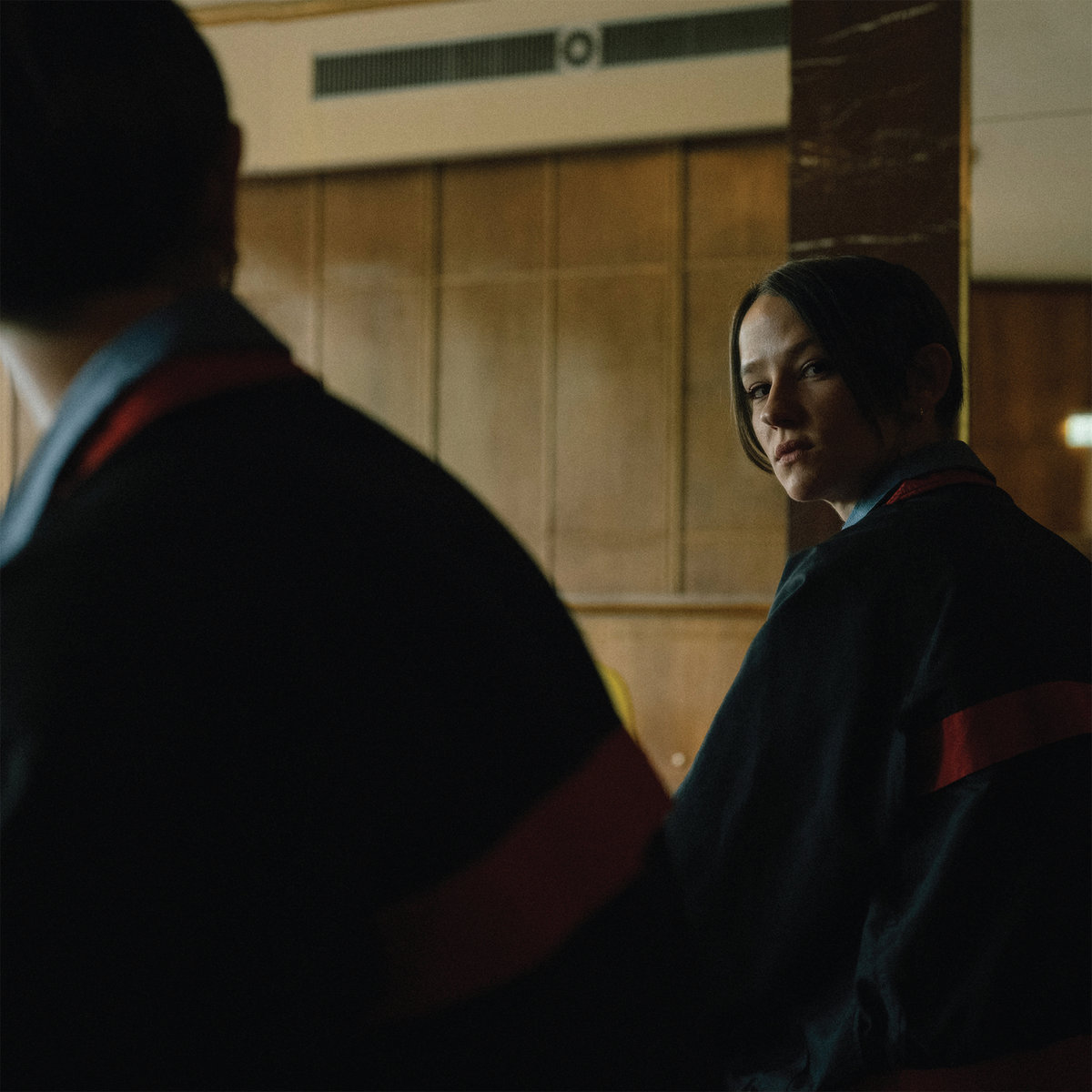 Caterina Barbieri Interview Image by Camille Blake
"We can build our ideas about music, our rules and some techniques. But the music always happens when we stop thinking."
Video