Name: Cosimo Fiaschi
Nationality: Italian
Occupation: Soprano saxophone player, improviser, composer.
Current release: Cosimo Fiaschi's unveil / unfold is out via INSUB.
If you enjoyed this Cosimo Fiaschi interview and would like to stay up to date with his music, visit him on Instagram.
For a deeper dive, read our earlier Cosimo Fiaschi interview.
Do you feel as that making music is a process of adding elements until it is done – or one where you chisel away pieces from something that is already there?
I’m definitely paying as much attention as possible to subtle elements.
The process for my solo work is mostly focused on treating multiphonics as generative material, which means that the material itself plays a crucial role in shaping the form and direction of the piece, even though I’m well aware that the process is obviously arbitrary.
For instance, in unveil (autonomous morphology), the core of the piece is a single multiphonic, treated as a complex sound object whose internal details I kept uncovering over time: pitches, dynamics, the speed of the beatings and so on. These details become the form: the sound quality of a partial that gradually emerges, the instability of a prolonged tone through circular breathing, and the different spatial direction of pitches.
So, for the first piece, it’s definitely a process of chiselling away what’s already present. But the overall process is still ongoing, since there are huge differences between recording and performing live.
What were some of the starting points?
For the first piece, I found a sound that was very magnetic, layered, characterized by an almost synthetic timbre. The piece makes use of a bell “preparation”: a cork inserted into the bell of the instrument, that allows the instrument to reach sounds that would otherwise be inaccessible.
What immediately caught my attention was the way the upper partials seemed to spread naturally through the space. Following that characteristic gradually led me toward the overall shape of the piece. In this regard, I have to thank Francesco Toninelli for his beautiful work in underlying this phenomenon in both recording and mixing.
The second piece is rooted in the form I’ve been developing with Michał Biel in coda (juxtaposition of sound and silence).
In unfold (residual voices) the sound quality is very fragile, almost like a humming voice. The whole piece develops through a simple series of a few multiphonics investigating duration (how different is a sound that lasts for 7 seconds from a 5-second sound followed by a silence of the same duration?) and, for the recorded version, the only outcome that made sense to me was a long section of silences and sounds full of air.
The final section remains particularly interesting to me because it focuses on the threshold where sounds appear and disappear, and on how memory and perception operate around that threshold.
Do you like to set yourself limitations? If so, which were some of those limitations for the new pieces?
I’ve been working on these two pieces released by INSUB. records for a year. As soon as I felt I was grasping something meaningful (around summer ’24) I simply decided to set a period for the recording, which happened on June 14th 2025. In a way, that deadline became a limitation in itself.
But I didn’t think of limitations per se. In these two solo pieces, the focus felt so precise that many possibilities simply fell away as a consequence of following the logic of the material. In order to let it emerge clearly, many things were already excluded.
What are among your favourite spaces to record and play your music?
This solo setting can be performed almost anywhere. For the recordings, however, I chose a treated medium-sized studio room.
Live performances tend to thrive in churches and large halls. So far, I played in different contexts: from very small rooms (like living rooms, basements), to bigger ones (churches and big stages), by the shore, in a garden and so on.
It seems that I’m following the road that Steve Lacy opened in his book Findings, where he writes about Situation for Soprano Saxophone (that I know).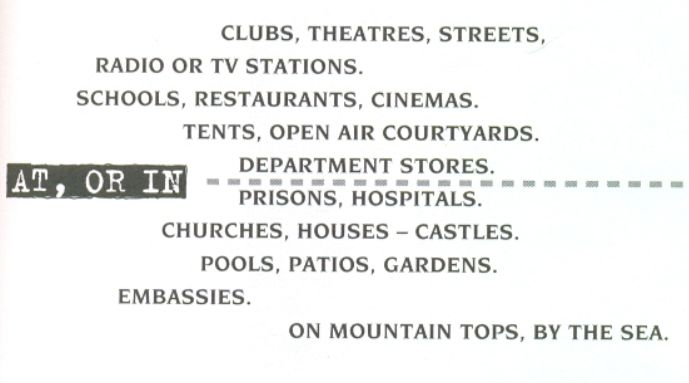
Generally speaking, I definitely prefer to play acoustically, even in large spaces. We have become so accustomed to hearing instruments through loudspeakers that we often forget how unstable an acoustic sound can be. Standing a few meters closer to the instrument can completely change what you hear: certain partials emerge, others disappear, and the balance of the sound shifts.
For me, proximity to the sound source is as important a parameter as dynamics.
Reducing one's options and techniques often implies a different way of working with the materials. Tell me about yours, please.
I’ve kept digging into the same sound objects over the last two years, and I wrote countless possibilities for the two pieces both as sketches and in a proper score. Writing things down allows me to compare different paths and understand why one musical decision feels more convincing than another. It also helps me get rid of complexity when complexity is not actually serving the main direction of the piece.
French producer Guillaume Duchastel told me: “Minimalism is about more than owning fewer things. It’s about focusing on what truly matters”. What are some of your strategies for separating what matters from that which doesn't?
It’s hard to say in a general way. For my recent solo pieces, what truly matters is staying inside the sound itself, so I’m very focused on not overloading it, otherwise the listener's attention will probably shifts toward other parameters. It’s obviously very subjective but I think that we need to not take some musical aspects for granted.
My main interests are pretty narrow and clear. For example, I’m interested in how radically a long tone can change depending on the nature of its attack. Or how differently silence is perceived when it arrives abruptly rather than through a gradual diminuendo. And again, how different is a sound that lasts 5 seconds from one that lasts 7? Or 10? 15? 5 minutes?
I think this requires patience and perseverance, but it also prevents me from approaching sound superficially.

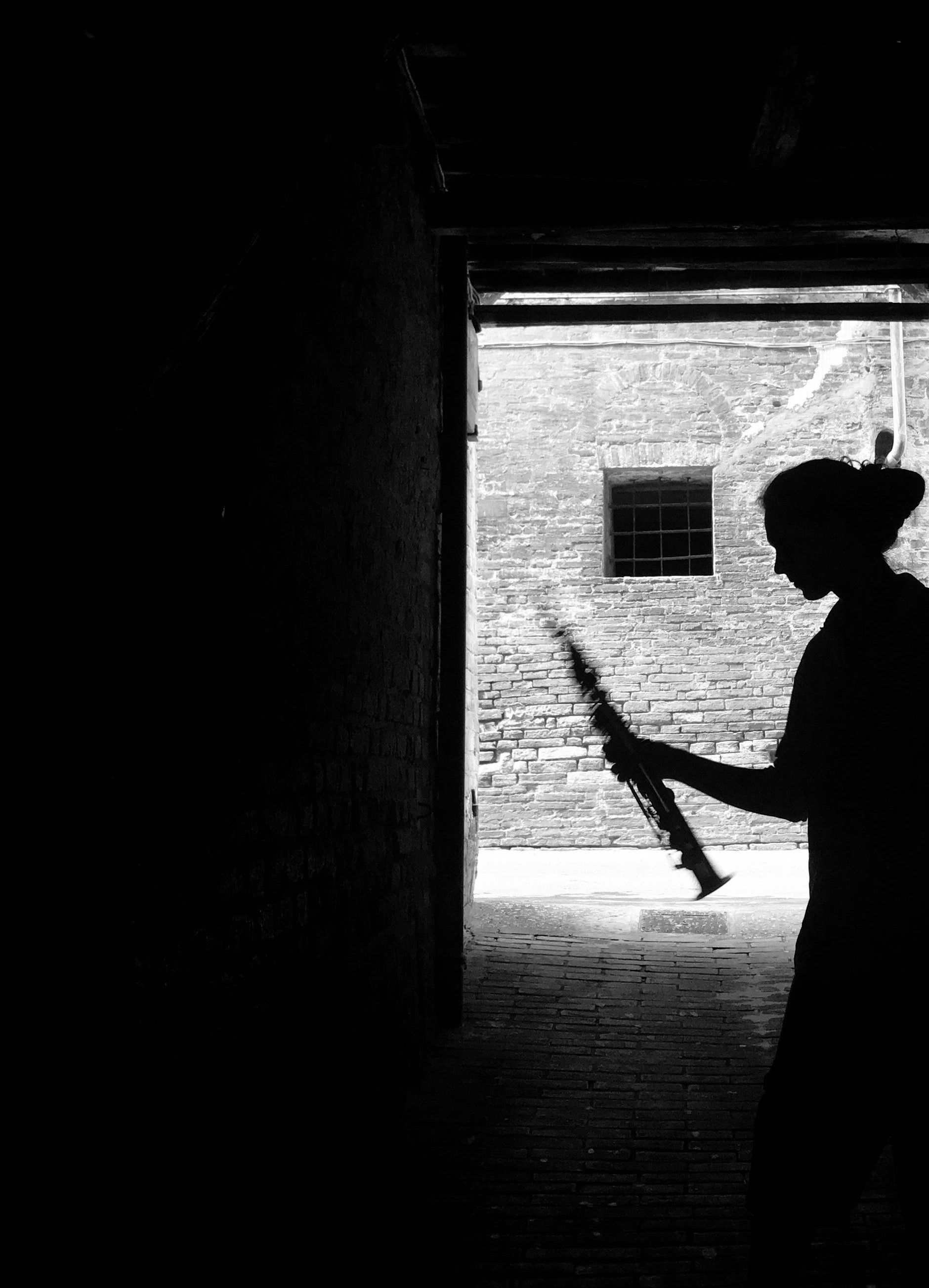 Cosimo Fiaschi Interview Image by Valeria de Siero
“I’m paying as much attention as possible to subtle elements.“
Video