Name: Claudio Puntin
Nationality: Swiss
Occupation: Composer, clarinet player, improviser, producer
Current release: Claudio Puntin on (clarinet, contra alto clarinet, and bass clarinet teams up with Chris Dahlgren (viola da gamba) and Jim Hart (vibraphone, marimba) for Soft Landing Option, out now via unit.
Recommendation for Berlin, Germany: The artists' settlement "Gaswerksiedlung."
Things that I am passionate about but rarely get to talk about: I am interested in the improvising nature of all human beings. Improvising together musically opens up fresher and purer emotions than any thought-out, written word ever could. Let's get to know each other — now it's your turn. Show me your art, and let's jam together. That, too, should grow in balance.
[Read our Chris Dahlgren interview]
If you enjoyed this Claudio Puntin interview and would like to stay up to date with his music and current live dates, visit his official homepage. He is also on bandcamp.
When it comes to experiencing strong emotions as a listener, which albums, performances, and artists come to mind?
The question presupposes that strong emotions can be experienced detached from context. That alone is already a difficult premise on which to base an answer.
I would have to take a wide detour to define this more clearly, since emotions do not exist in isolation — they always arise within contexts and in resonance with the other parameters that shape a life.
So, in all likelihood, what's needed first, for any of these questions, is an articulation of how emotion stands in proportion to musical experience. Human beings are always feeling something; the task is to define which sensations correspond to the emotions being asked about here — the ones triggered by music.
As we know, emotion is one half of the architecture of human consciousness; the other half is the mental-intellectual. Only in balance do both sides come into full expansion. The question of which albums trigger emotions thus requires a more precise framing, since every album triggers some emotion in some form. What is really being asked here is probably: which feelings have personally affected someone, standing in resonance with their own emotions. The listenership would have to be reduced to a single person for this to make sense.
To name a few albums out of dozens that have personally influenced me, I would select the following: Skuli Sverrisson: Seria 1 & 2, Hermeto Pascoal: Festa dos Deuses, Conlon Nancarrow/Ensemble Modern: Studies, Louis Sclavis: Chine, Hamlet Gonashvilli: Hamlet, Minae Minae: Gestrüpp, Keith Jarrett Trio: Still Live.
There can be many different kinds of emotions in art – soft, harsh, healing, aggressive, uplifting and many more. Which do you tend to feel drawn to most?
The linguistic classification of emotional qualities attempts to categorize feeling from a mental-intellectual standpoint.
But feelings are precisely that side of our sensing which forms the counterpole to mental consciousness — they cannot, therefore, be represented or functionalized through words. They can only be experienced.
I have had a hard time explaining that listening to death metal calms me down. When you listen to a song or composition, does it tend to fill you with the same emotions – or are there “paradoxical” effects?
This question, too, carries a number of fixed premises about expectation and surprise.
In a balanced equilibrium between the emotional and mental worlds, there is no expectation of this kind, since openness to possibility is unrestricted.
In as far as it plays a role for the music you like listening to or making, what role do words and the voice of a vocalist play for the transmission of emotions?
This question touches on a new subject.
Text resonates within the realm of experience and is therefore active in the intellect — it refers, in other words, to the past. Music can only be experienced in the present moment. These are different levels of sensing: one operates through thought and the past, the other through feeling in the present.
For this reason, music conceived together with text is, for me, usually musically reduced — it is a different art form altogether. Such music aligns the abstraction of music with the fixed thoughts of the text.
Identification — especially of a social kind — is thereby forced into concepts and patterns, and held fast there. Pure music involves no such alignment.
When it comes to experiencing emotions as as a creator, how would you describe the physical sensation of experiencing them? [Where do you feel them, do you have a visual sensation/representation, is there a sense of release or a build-up of tension etc …]
As already described, this level of experience — creative emotion — cannot be described. Fortunately so. It is the free space that all of us have, the divine that keeps open for us the one space of guaranteed freedom.
This may well be the purpose of our being human; I, at least, feel carried by this thought. Music and art are the space in which I sense being human, both individually and socially.
When it comes to composing / songwriting, are you finding that spontaneity and just a few takes tend to capture emotions best? Or does honing a piece bring you closer to that goal?
Every beginning of a creative act already contains within it all the possibilities for feeling, and thus for emotion. We humans may exist for this reason, and this reason alone.
Therein lies danger and fortune in equal measure. It is, again, a matter of our balance between mind and emotion — or of the developmental stage of our consciousness — whether we shape this in a life-affirming way.
I personally always believe in the first idea, for within it lies everything that nourishes every idea that follows. A second idea is exactly the same, with the one difference that the first idea is now excluded. So I almost always choose to give the first idea the chance to exist, and develop it further through continuation.
I have just recorded a new duo album consisting of 24 first ideas, each given a maximum of ten minutes to be completed. This recipe works so astonishingly well because it removes the reflective, judging layer — the songs are shaped almost entirely by the emotional layer. A remarkable album.
I apply this technique in many areas — cooking, painting, drawing, but also in planning.
How much of the emotions of your own music, would you say, are already part of the composition, how much is the result of the recording process?
It is interesting to consider that, roughly a hundred years ago, no one who composed could have given any thought to such a connection. These are two independent processes.
Bearing in mind that, for recordings, our ears are replaced by microphones and speakers makes clear that the relationship between them can only ever be partial. What is interesting is the fact that recordings of improvised music can be listened to repeatedly and analytically, which brings a component into play that can be very revealing for understanding one's own emotional world.
One thing is certain: the decisions made in compositional processes, through which music comes into being, differ greatly from those made in production processes.
For Soft Landing Option, what kind of emotions were you looking to get across?
I can only speak for myself: I have no intention of defining emotions that I might possibly trigger in other people. A work of art is a work that comes into being filled energetically by artistic intention.
Example: a young couple in love listens to one of our tracks during a romantic encounter. That track will remain bound to that situation for them, forever. The same track will be bound to entirely different associations for other people. So I cannot define any intention to convey something through my music — nor, in the case of a band like this, do I want to.
What I can define are extramusical intentions that are meant to predetermine the creation of music — for film scores, audio-drama music, and other functional music. These intentions, however, orient themselves toward patterns shaped by listening habits or traditions.
Music as such has no binding clarity of this kind; it always remains abstract, even when strongly shaped by habit.
How do you capture the emotions you want to get across in the studio?
As already mentioned, functional emotions are all based on patterns — that is, on listening habits. To reproduce them, one simply makes use of such patterns.
(Example: to musically depict the vastness of the universe, one uses a long reverb — but the universe has no sound, since there is no air to carry sound, and therefore naturally no sonic resonance or reverberation either. The absence of real experience leaves the imagination free rein, and listening habits can take hold. Or: in documentaries about the landscapes of "foreign" countries, ethnic flutes are used — a brief trill in a minor third over a drone, a touch of reverb, and the listener already believes what they're seeing.)
These are patterns with no logic rooted in content — they serve borrowed, pattern-based emotions. Their effectiveness lies in how well they serve listening habits. This can be a meaningful way of working when it comes to earning a living, but it has nothing to do with the artistic in a human being.
Culture must not be guided by intentions — except for the one intention of making art. From doing, the continuation of true things arises; from planning, the continuation of intended things arises. In balance, the consciousness needed for emotion and communication to arise comes into being.
What role do factors like volume, effects like distortion, amplification, and production in general for in terms of creating the emotions, energies or impressions you want?
All the parameters named in the question are, in every track, so specific to the particular piece of music, the individual track, and the people involved, that no general answer is possible.
Music and music production are two very different products. Both have their own ingredients and conditions, which depend, again, on the balanced consciousness of those involved. Someone who is practiced, experienced, and makes music themselves can deploy these parameters to steer direction.
The individual technical factors named in the question are like the ingredients of a dish — they depend on the proportion of the whole.
In terms of emotions, what changes when you're performing live on stage, with an audience present, compared to the recording stage?
Intersubjective affectability is decisive in exchange with other people. What does that mean: I find myself in you, and you find yourself in me.
Someone who perceives the totality of the music in the moment is capable of creating — they rest within themselves, and cannot be influenced by parameters foreign to the music. In this stillness lies the closest possible connection to the audience.
What kind of feedback have you received from listeners or concert audiences in terms of the experience that your music and/or performances have had on them?
I have received every kind of feedback imaginable.
When someone is able to say, "that's how it is" — then the experience seems to have arrived.
Would you say that you prefer to stay in control to be able to shape the emotions or do you surrender to them and allow the music to take over? Who, ultimately has control during a live performance?
And again, a question that first requires philosophical clarification of terms: what does it mean to steer emotions? If that's the starting point, one should be questioning the premise itself. The same goes for the terms "upper hand" and "control."
Before something can become music, countless questions exist. From the moment it happens, no thinking control is determinative anymore — it happens out of itself.
The emotions that music is able to generate can be extremely powerful. How, do you think, can artists make use of this power to bring about change in the world?
That is a genuinely interesting question, one that has never carried greater urgency than it does now. It is very difficult to answer, given the complexity of human existence — and, at the same time, very simple to answer. The simple answer first:
Human beings are creative and social beings; when they are creatively and playfully active within society, they thrive — they find solutions, and they find peace.
Now, an attempt at the complex version:
When material and power-oriented interests come to seem more important to people's lives than the interests that correspond to their true nature as creative and social beings, then they do not thrive — solutions are not found, and fate is forced to find solutions instead. The tragedy in this: fate offers signs pointing toward solutions; if these are not recognized, and no change takes place, fate will go deeper and deeper, the path will grow longer, and scorched earth will become more frequent — up to the point of possible annihilation. (See Dante's Divine Comedy.) Annihilation is the last resort for preserving development, and it is wise to take this to heart.
Life means development. When this development is obstructed, diverted, removed from consciousness, or abused, then the path to a solution through art is blocked. As long as artists are able to live, work, and share — to inspire and to develop — emotion and inspiration remain the sign that this is the right path.
To summarize: emotions are indicators pointing toward the direction of our development. When we perceive them, and when they exist in balance with mental-intellectual consciousness, future becomes possible. The tool for shaping that future is called improvisation.
Musicians stand closest to the perception of emotion, for music is the only human art form and form of creation that creates its own future, in real time, out of itself.
All answers were created without AI.

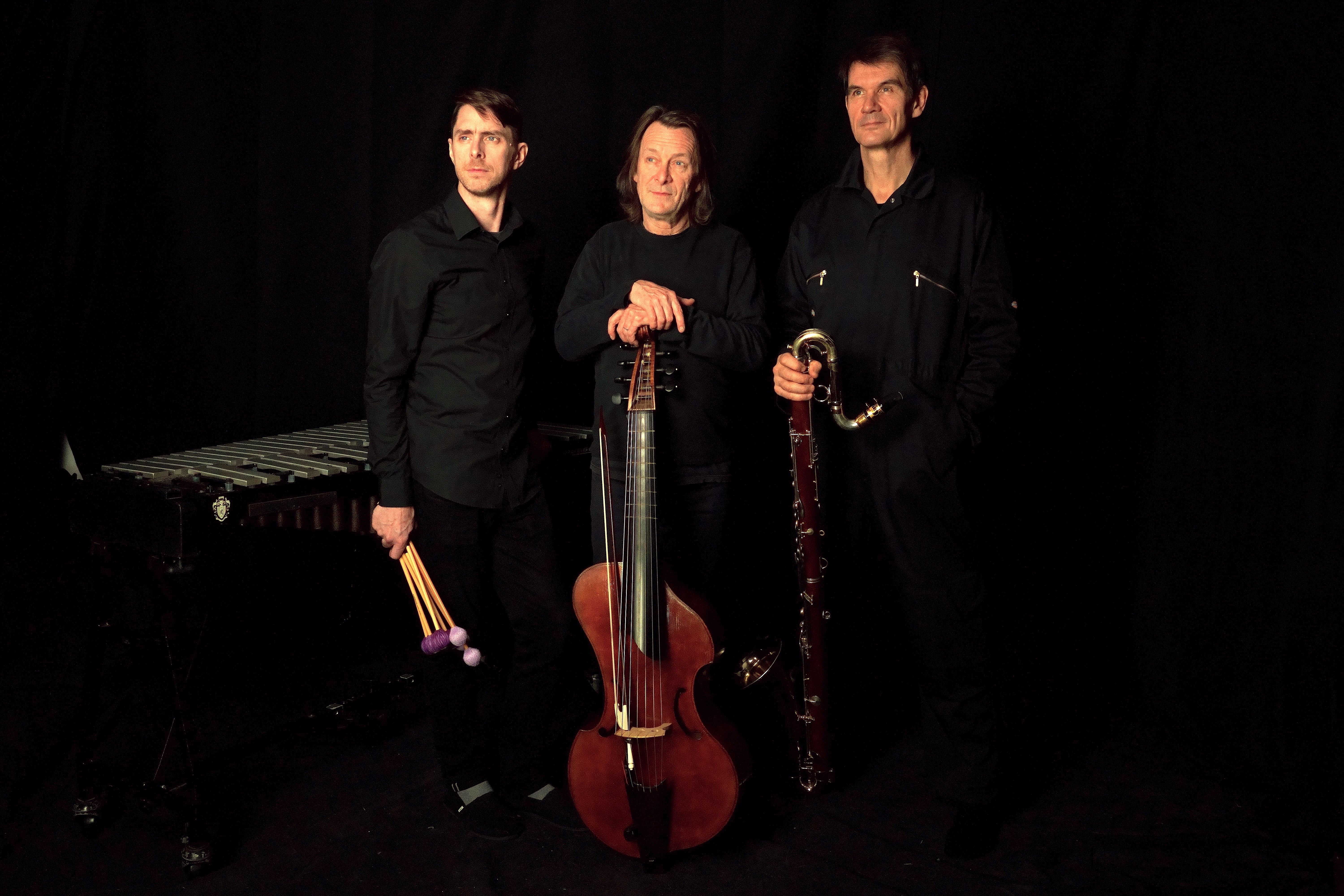 Soft Landing Option Interview Image (c) the artists
“Culture must not be guided by intentions — except for the one intention of making art.“
Video