Name: Cici Arthur
Members: Joseph Shabason, Chris A. Cummings, Thom Gill
Interviewee: Chris A. Cummings
Nationality: Canadian
Current release: Cici Arthur's debut album Way Through for is out February 21st 2025 via Western Vinyl.
Global Recommendation: If you’re visiting Toronto and an architecture fan, there’s a glorious gigantic Art Deco building on the lakeshore called the R.C. Harris Water Treatment Plant, which I was surprised to discover was in the opening shots of the John Carpenter film In The Mouth of Madness (1995). It also appears very briefly in my video "Guarantee You A Good Time,“ directed by Jes Singer of the band HANK, in which I’m also the keyboard player.
You should also go to the Tranzac Club.
[Read our Joseph Shabason interview]
[Read our Joseph Shabason interview about his work as a session musician]
If you enjoyed this Cici Arthur interview and would like to know more, visit the band on Instagram.
Do you think that some of your earliest musical experiences planted a seed for your interest in writing lyrics or poetry? How and when did you start writing?
I wrote songs on the piano when I was a little kid - 6 or 7 years old. They are still preserved on cassette tape. I would make “albums” and design the covers. My main influence was The Beatles. But because I couldn’t play guitar, the piano itself was a huge influence and still is.
Sample lyrics from my childhood songs: “When I wake up in the morning/I get out of bed/When I wake up in morning/My face turns red,” “In the playtime, you can play,” “Once there lived a king/You wouldn’t like him/He’s king of the forest/King/King …” There’s a sense that the lyrics are just a means to an end, something to fill up the space. Maybe I still think that way, I don’t know!
I definitely struggle with making sure the lyrics all have meaning and connect together well. The melodic and harmonic content of the song comes more easily to me than the lyrics, but I can’t seem to start a song without a lyrical idea.
Entering new worlds and escapism through music and literature have always exerted a very strong pull on me. What do you think you are drawn to most when it comes to writing?
I really don’t think of it as escapism - either listening to music or reading literature.
I guess you could say it’s a retreat into some sort of inner world, some sort of sanctuary where you can connect with your innermost thoughts and feelings, but when I think of escapism, I think of something like going to see The Last Boy Scout or something. Some kind of Tony Scott movie (and don’t get me wrong, I love Tony Scott)! But a bombastic, well-choreographed action movie - that’s escapism.
What was I drawn to? I always wanted lyrics that had the quality of "high speech" - the kind of language used in a church sermon or something like that. But it still had to have the qualities of everyday language. "The words of everyday speech, but steeped in wine" - that was how I put it in one of my Marker Starling songs (”Searching for a Song”).
What were some of the artists and albums which inspired you early on purely on the strength of their lyrics? What moves you in the lyrics of other artists?
It moves me when an artist can achieve something uncategorizable by fusing melody, lyrics, intonation and phrasing. It’s like when an actor causes you to cry unexpectedly in a movie, just by the way they say their line, it hits you right in that part of the sinus that makes you cry.
Most of the music I like, it’s because I like the singer’s voice. The way they phrase their words - it’s often more in the phrasing and the way the voice might break on certain word.
My early inspirations were the basic ones: Lennon, McCartney & Harrison, Cat Stevens, Carole King, Joni Mitchell, Simon & Garfunkel, The Bee Gees (the album Main Course in particular).
I’m a child of the seventies - this was the music that was around.
I remember being affected by the lyrics of a song like “Help!” by the Beatles - I remember asking my parents what they meant, why it was the subject of a song, going from not needing “anybody’s help in any way,” to now needing it. I also wanted to know what was so important about a Paperback Writer.
By my early twenties I was deeply into African-American songwriting, and the lyricists I particularly liked were Sly Stone,Curtis Mayfield and Gil Scott-Heron. All three of them use some combination of ordinary and “high speech” language to create a space through which to view the world more clearly.
And in the case of Curtis Mayfield, the songs he wrote for The Impressions (e.g. “Keep on Pushing”) literally did change history.
The song “Winter in America,” by Gil Scott-Heron, is a particularly clear-eyed look at American society which was as relevant in 1974 as it was in 1994 when I first heard it, as it is now.
(“Like the forest buried beneath the highway/Never had a chance to grow” “All of the healers have been killed” “Ain’t nobody fighting because no one knows what to save”).
I’m still deeply affected by it.
I have always considered many forms of music to be a form of poetry as well. Where do you personally see similarities? What can music express which may be out of reach for poetry?
With music you have endless varieties of ways to colour the sound - instrumental arrangements, production techniques, the timing of the notes, the harmonies, etc. The lyrics alone can’t do that.
But written poetry - that’s a whole different ballgame. I remember being very impressed to learn that Nick Drake studied Elizabethan poetry and that David Berman was a poet before he was a songwriter - to me, the Purple Mountains record from 2019 is absolutely perfect, lyric-wise.
Leonard Cohen also was a poet before he was a singer. But I never really got the poetry "bug."
I like it when a poem pops up in a film I’m watching and I go and look it up. There was one in the film 84 Charing Cross Road (1986) by W.B. Yeats called “Aedh Wishes for the Cloths of Heaven,” which is very short and ends with the line “Tread softly because you tread on my dreams” - it was a profoundly sad poem, seemingly about unrequited love, the longing for an unattainable other. Or one that the poet was in an unequal relationship with who treated them harshly - a reminder to be gentle.
There was something deep and stirring about it that song lyrics can’t always reach.
The relationship between words and music has always intrigued me. How do you see it? How far can music take you to places with your writing you would possibly not have visited without it?
I don’t know - all I can offer is some insight into how the relationship between words and music has worked for me.
I often will sing nonsense syllables until I’m able to fill the melodies in with lyrics. And the lyrics may alter the melodies slightly, but they have to obey the same feeling as the melody.
By using that method, the lyrics may turn out to be surprising, and the subject of the song may change, and force you to rewrite earlier sections of the song.
On the basis of a piece off your most recent release, tell me about how the lyrics grew into their final form and what points of consideration were.
I usually only write from my own life experience.
The day I started writing the song “Cartwheels for Coins,” I had been watching a film from the 1930s (it might have been Anna Karenina (1935) - something with Greta Garbo) and someone said the phrase “turning cartwheels” as in “I’ll be turning cartwheels for joy” (another phrase is “turning handsprings”).
And the phrase “just another showbiz kid turning cartwheels for coins” popped into my head, as both words and a melody, and I immediately went to the piano and made some voice memos trying to get the idea down.
I had been an actor in my childhood and teen years, mostly unsuccessfully, and both my parents had been actors in community theatre, so the atmosphere of a live theatre was always very special to me. Not even watching a play, just being in a theatre - rehearsing, sitting in an empty auditorium, the backstage areas, dressing rooms, imagining weird storerooms full of props and costumes.
But my disillusionment at seeing some of the shittier aspects of showbusiness up close, how superficial it was - I’m still affected by it. So making it a song about my childhood experience going to auditions, getting one’s hopes up, and then never booking anything - that seemed like good grist for the mill.
The choruses were very easy to write, using the aforementioned refrain as an anchor. I remember at some point I simplified the opening - the lines that go “These are the words that should be easy to write/they’ve been written on the walls of my heart” replaced some other words that were less direct, and I liked it because it gave the song a kind of “framing story” about a songwriter with writer’s block.
And the pre-chorus part “But it’s a grey sky, nothing to say” - that was part of the second-draft simplifying of the words as well - it seemed to sum things up by saying “my disillusionment with showbusiness makes the whole world seem grey and empty.”
“I would have died for an occasion to rise to” - this was a scrap of verse that had been kicking around my head since the 1990s. “Success isn’t all it’s cracked up to be” - the phrase “cracked up to be” is again using old, circa 1930 language, which seemed to hold a particular power over me and seemed appropriate, and chimed with the oldness of “turning cartwheels”. And then the “to be, to be, to be” chant at the end which of course echoes the “To be or not to be” soliloquy from Hamlet - every actor’s dream is to play Hamlet.
I got particularly enamoured with this song while writing the demo and kept revising it and revising it. And I know I can only do so much - I’m circumscribed by my own artistic limitations, my limited abilities. But I felt I really got somewhere with that song.
Do you tend to start writing with what will be the first line of the finished lyrics? The chorus? At a random point? What are the words that set the process in motion?
I seem to get stuck writing choruses first, and in fact starting the song with the chorus, like in “Dancing Queen,” but then having to write verses that build to the chorus in a convincing way – it’s harder than starting with a verse, I think.
I'd love to know how you think the meaning or effect of an individual song is enhanced, clarified or possibly contradicted by the EPs, or albums it is part of.
I love a well-sequenced album. Or a series of 3 or 4 songs that is particularly alluring.
I’ve never been particularly drawn to the idea of a rock opera or concept album, but I like it when a series of songs seems to present a larger canvas of the songwriter’s overall point of view - like the way the song “People’s Parties” goes into “The Same Situation” on Court and Spark by Joni Mitchell.
Two songs segue together and it goes from a somewhat more extroverted song describing a rather bad-sounding party to an introverted song, wondering what to do about an unsatisfactory love life, wondering where prayers go “with heaven full of astronauts and the Lord on death row.”
This song seems to clarify all that has come before it on side 1 of Court and Spark, coming just before the end of the side.
It’s true that when you hear a song within the context of the album it’s in, it has a different impact than when you hear it by itself. It’s like a series of paintings in an art gallery - each one is different but together it adds up to an impression of a moment in time or a point of view.
Creativity can reach many different corners of our lives. Do you feel as though writing song lyrics or poetry is inherently different from something like making a great cup of coffee? What do you express through music that you couldn't or wouldn't in more 'mundane' tasks?
I tend to separate the act of music-making from everyday tasks. My everyday tasks get neglected when I’m writing music! Though I did decide to become a singer one day in 1995 while I was washing dishes and singing along to a Syl Johnson record (Total Explosion).
Doing the dishes can sometimes be a pathway to creative thoughts. Putting your hands in the soapy water, the minute sense of satisfaction at having made a dirty thing clean, it’s like a “touch grass” moment.
The song “Way Through” was written while I was going for long bicycle rides during the lockdown. I had nothing to do but I wanted to get out of the house and not be around other people, so I started going on long rides in Scarborough, the huge suburban city immediately to the east of Toronto proper.
I was always trying to find ways through the sidestreets so I could avoid the main streets as much as possible, and the map in your phone can only help you so much - sometimes you meet more than a few dead ends. And the phrase “What good are dead ends when I’m looking for a way through?” just popped into my head.
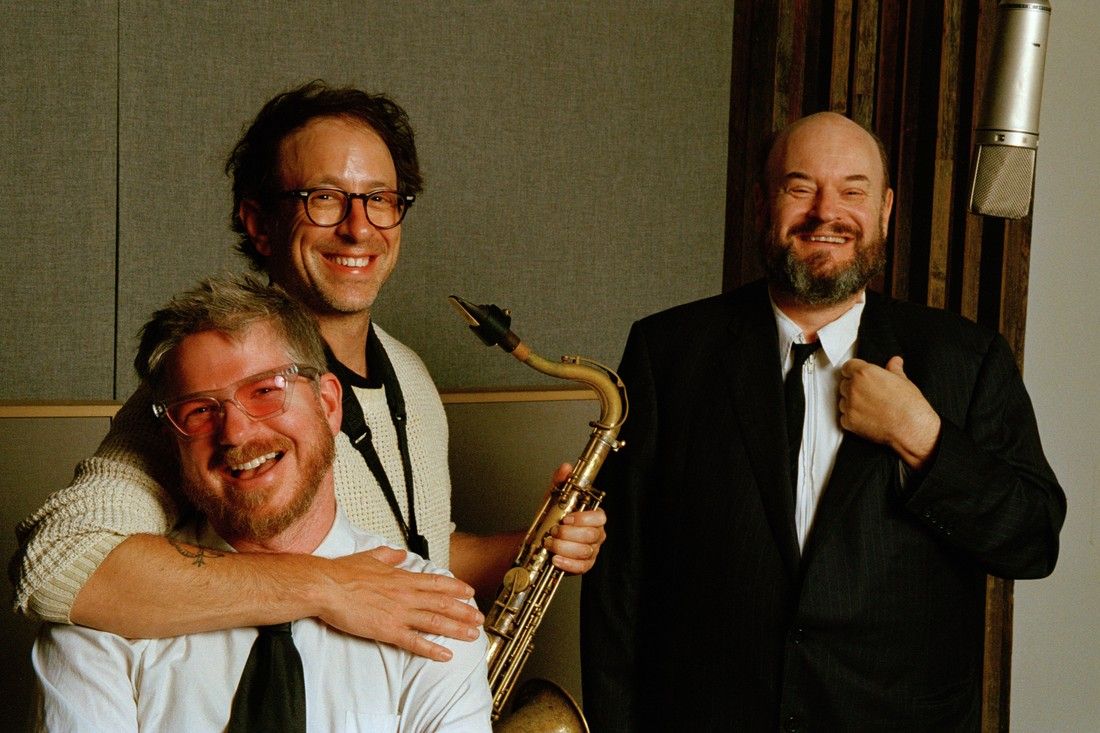 Cici Arthur Interview Image (c) the band
"It moves me when an artist can achieve something uncategorizable by fusing melody, lyrics, intonation and phrasing."
Video