Name: Calum Builder
Nationality: Australian, Copenhagen-based
Occupation: Composer, saxophonist, organist
Current Release: Calum Builder's new album Although Changed, I Arise the Same, featuring himself on (Re)Constructed Pipe Organ and alto saxophone as well as Zola Mennenöh (voice) and Johanna Sulkunen (voice) is out via Thanatosis.
Shoutouts: I'm drawn to artists that perform their own music. It keeps it fresh and works can develop live. I don't think that only comes from people who call themselves composers.
I'm really into the band Statoil at the moment — they're doing cyclic, trance, noise music. They'd probably laugh if you called them performer-composers, but that's sort of the point.
OOH-Sounds and Thanatosis have also shown me how important labels can be when they genuinely work with artists and their communities in mind. The same goes for organisers like Final Descent (Denmark) or N:ear festival (Slovakia). Copenhagen's own Organ Sound Art Festival, with Björn and Jan at Koncertkirken, is one of the most interesting gatherings of organ-related music happening at the moment.
I sense the future of composition is more about intense niches than one grand movement.
Hometown Recommendations: One thing to visit in Copenhagen? JUNO the Bakery. If anyone comes to Copenhagen, hit me up and we’ll go on a bakery tour.
Things that I am passionate about but rarely get to talk about: I have two young children right now, so there isn't a lot of time for reading or watching films these days. Though, what I've gained instead is this deeply fascinating unfolding reality of watching two human beings develop. I'm genuinely interested in the psychology and phenomenology of that.
Then there's the side tangent of being both a parent and a musician, two insanely unquenchable fires in your life that burn everything up. Trying to feed both, seeing how they can feed each other, working out how to live with that. A lot of my music these days has to do with the resilience and hope I find in my children, and with their perception of time alongside my own, which is only growing stranger. That's what I'm really into right now.
If you enjoyed this Calum Builder interview, visit his official website for more information. He is also on Instagram, and bandcamp.
The borders between producers, sound artists, and even songwriters are becoming increasingly blurry. What does being a composer mean today, would you say?
Honestly, I don't think these labels ever matter as much as people assume. The borders have never been clear-cut, they're just different lenses to look through. I sense they're getting more blurred now because knowledge and tools are more readily available.
We're all just shaping material, whether that's through recording, orchestration or lyrics. For me, composing is specifically about developing the raw musical elements and shaping how they function and transition, as well as considering ensemble/performer dynamics.
Although Changed, I Arise the Same, written for (Re)Constructed Organ, saxophone and voices, is an example of that blurring taking place.
Many people perceive classical music and contemporary composition as having high barriers of entrance, both for listeners and musicians. What have your own experiences been in this regard?
Perhaps the conversation itself is what’s really important. Is it up to us, the artists, to disseminate our work and make it more accessible, or is that someone else’s job? It’s becoming increasingly clear the responsibility lands more on the artist these days.
We should give people more credit. My own experience is that curiosity gets people past the barrier. When I perform with my (Re)Constructed organ, I’m often met with more curiosity from audiences than when I play saxophone, I suppose the organ looks a little intense and there’s a perceived novelty to it.
One audience member came up afterwards, said he had no reference for this music and thought it was strange … he then asked if I'd pulled apart my vacuum cleaner. We laughed and then he said how he felt the sound ‘in his gut’ and was genuinely moved.
People aren't as put off by unfamiliarity as we assume, they're put off by feeling like something is being withheld from them.
As of today, what kind of materials, ideas, and technologies are particularly stimulating for you?
I'm interested in physicality. As an instrumentalist (saxophone and pipe organ) I work mostly with air and pressure. Compositionally I enjoy working with instability, odd cycles, and acoustic instruments behaving in ways that almost feel electronic.
That's very present in my latest album Although Changed, I Arise the Same, where voices, saxophone and my (Re)Constructed pipe organ sit inside this almost protosynth world.
Recently, I've started working with solenoids, Arduino modules and MIDI controllers, as a way of extending that sound. I’m finding it interesting that the electronics are still leading me back into something physical.
Where do most of your inspirations to create come from – rather from internal impulses or external ones? Which current social / political / ecological or other developments make you feel like you need to respond as an artist?
I’m for sure inspired by stories.
I had a period where a lot of my work centred around post-Christian thought. I studied to become a pastor for a couple of years in my late teens, then walked away from it. A lot of that music, Messe especially, came directly out of deconstructing faith.
I’m drawn to the small moments: glances, anecdotes and the strange, paradoxical nature within people. There’s an utter absurdity to our lives that is so damn interesting, funny and depressing.
It’s hard not to feel hopeless in the current political, ecological and social climate but what pulls me to make something is the human residue underneath it all, I think it’s people’s ability to persevere.
Tell me a bit about the sounds & creative directions, artists & communities, as well as the colleagues & creative hotspots of your current hometown, please. How do they influence your music?
Well, many things to name. I went to the Rhythmic Music Conservatorium (RMC) in Copenhagen, which runs more like an art school than a traditional conservatorium. It's very focused on peer-to-peer critical reflection.
I've been out about four years now, following a post-grad artistic research position there, and I'm still living off the creative flow I found in that place. I met Zola Mennenöh, Johanna Sulkunen, and Simon Mariegaard through RMC, who are all a part of Although Changed, I Arise the Same.
The improv and experimental scene here is genuinely welcoming. Being from Australia and landing in Copenhagen, I feel lucky the city I ended up in happened to be this supportive. Because the scene is like this, I've been able to let side tangents, like building a pipe organ, become main areas of interest. Without that, I don't think I'd have gotten here, or at least certainly not this fast.
Composing has always had an interesting relationship between honouring its roots and exploring the unknown. What does the balance between these two poles look like in your music?
There’s a particularly condensed focus on lineage in the conservatorium model. At some point I realised being skilled in multiple indepth traditions is basically unachievable, the expectations are too high, there's too much to consider. You're inevitably going to miss things.
What matters more is knowing your context and where you sit within it. You don't need to compose or play perfectly in a tradition before you're allowed to move beyond it, but you do need to understand what you’re working within, particularly if you want to break away.
Both directions can go wrong. Too much reverence for the roots goes stale; exploring the unknown without context feels ungrounded … ignorance is bliss. People can make interesting music regardless, but that's roughly where I sit.
How much potential for something “new” is there still in composition? What could this “new” look like?
I don't spend much time thinking about whether something is objectively new, sounds like a good way to psych yourself out! But if composers develop work that feels necessary, or honest to whatever question they’re asking themselves at that moment, their unique context (cultural or otherwise) can be what makes it new (or renewed).
I suppose the correct answer is ‘AI’, which is changing things for sure. I hope it’s more that with AI we reach greater levels of niches and abstractions, not the other way, into a homogeneous blob.
What role do electronic tools and instruments play for your creative process? What does your creative space / studio look like and what tools does it contain?
My studio is full of organ pipes, quite a lot of woodwinds, plus a piano and a lot of tubing. Last stocktake put me at around 300 pipes, though I've lost a few recently. It's a packed space.
My process is: do first, then think, then do and think together. I have to keep it simple and build from there otherwise it can become overwhelming.
I've started bringing electronics into that process too through Arduino modules and solenoid valves. I want to extend what the pipes can do rather than replace any of it.
It is my impression that adding a conceptual, non-musical dimension to one's work is almost a prerequisite for commissions and grants. How do you view this tendency and how “conceptual” is your own approach to writing?
For me, a grant application is really an exercise in communication: explaining as clearly and honestly as possible what you want to make and why it matters to you or them. I just try to be sincere and I believe this gives a project its best chance. Regardless of whether you're awarded the commission or grant, it's a cathartic or helpful process either way.
I don't think a project needs an elaborate concept to be treated seriously by a committee. Whether it’s conceptually driven or materialistically concrete matters less than whether it feels authentic.
Working with long forms, complex concepts or new vocabulary is potentially more challenging today because they require us to remember things that happened perhaps minutes ago – while most of us are finding it hard to focus even on what's happening right now. Both as a composer and as a listener yourself, how do you deal with this?
I’d push back on the assumption that people have lost the ability to listen.
Rather than adapting to the fear that people can't concentrate anymore, I'd rather keep making the music I believe in and trust there are listeners willing to be open to it in some way.
Though if people start playing on their phones at gigs I’m going to reconsider my answer …
For many artists, life-changing musical experiences take place live. Few works these days, however, are performed beyond their premiere. What do you feel, does this mean for composers, and the music they write, and how does this reality influence your own work?
Well, it’s a shame. Perhaps it's a tendency that has become more pronounced, but many works have always had relatively short performance lives.
Being both a composer and a performer helps as I can keep returning to pieces myself, I drive the work in a way and can present them in new contexts rather than treating the premiere as the end of the process. That gives the music a longer life and allows it to keep evolving.
In my piece Renewal Manifestation, I'm on saxophone joined by Crush String Collective and Svend Hvidtfelt Nielsen on Organ. The piece has been reworked for different organs and orchestrations.
How, would you say are live performances of your music and your recording projects connected at the moment? How do they mutually influence and feed off each other?
They feed off each other because recording and mixing reveal what could be possible live. Sometimes you notice something in the process “two mics together making the organ sound like it’s phasing itself” and realise “oh that’s not the mics, that’s just how it sounds in the room. How can I make that live?”
My sound engineer Simon Mariegaard has a philosophy that recording shouldn’t always just be true to what the listener would hear; it should sometimes carry the physicality of a live experience too.
In a live setting, you see the tension and movement in performers’ bodies. A recording should try to capture that same physicality or tactility, not just a clean room-mic recording.
To some, the advent of AI and 'intelligent' composing tools offers potential for machines to contribute to the creative process. What are your hopes, fears, expectations and possible concrete plans in this regard?
My hope is that AI brings about a shift that leads artists to new levels of abstraction, just like photography did with painting.
My fears are more dystopian, that creative work becomes completely absorbed and devalued by society. I really don’t know what to expect, honestly, we're sort of going off script now …
My own engagement with it is through a collaboration with Miguel Crozzoli at the Intelligent Instruments Lab in Reykjavík. We're developing a project involving an AI-driven organ system alongside my (Re)Constructed Pipe Organ. Still in the early stages.
Miguel's approach is centred on co-creation, and he's considerably more optimistic than I am. I'm hoping his vision of the future proves more accurate than mine …
The Montreux Festival intends to preserve its archive of recordings for future generations. Do you personally feels it's important that everything should remain available forever - or is there something to be said for letting beautiful moments pass and linger in the memories of those that experienced them?
Temporal moments matter. Not to get too existential … but that's also why life itself matters, if we lived forever, things would mean a whole lot less.
So no, I don't think everything should remain available forever. We won't be around forever, our names won't be around forever, time takes care of that on its own anyway. We have to make space for new things too (and it’s getting crowded).
There's something to be said for live music existing only in the memories of whoever was actually there. I'm a fan of that.
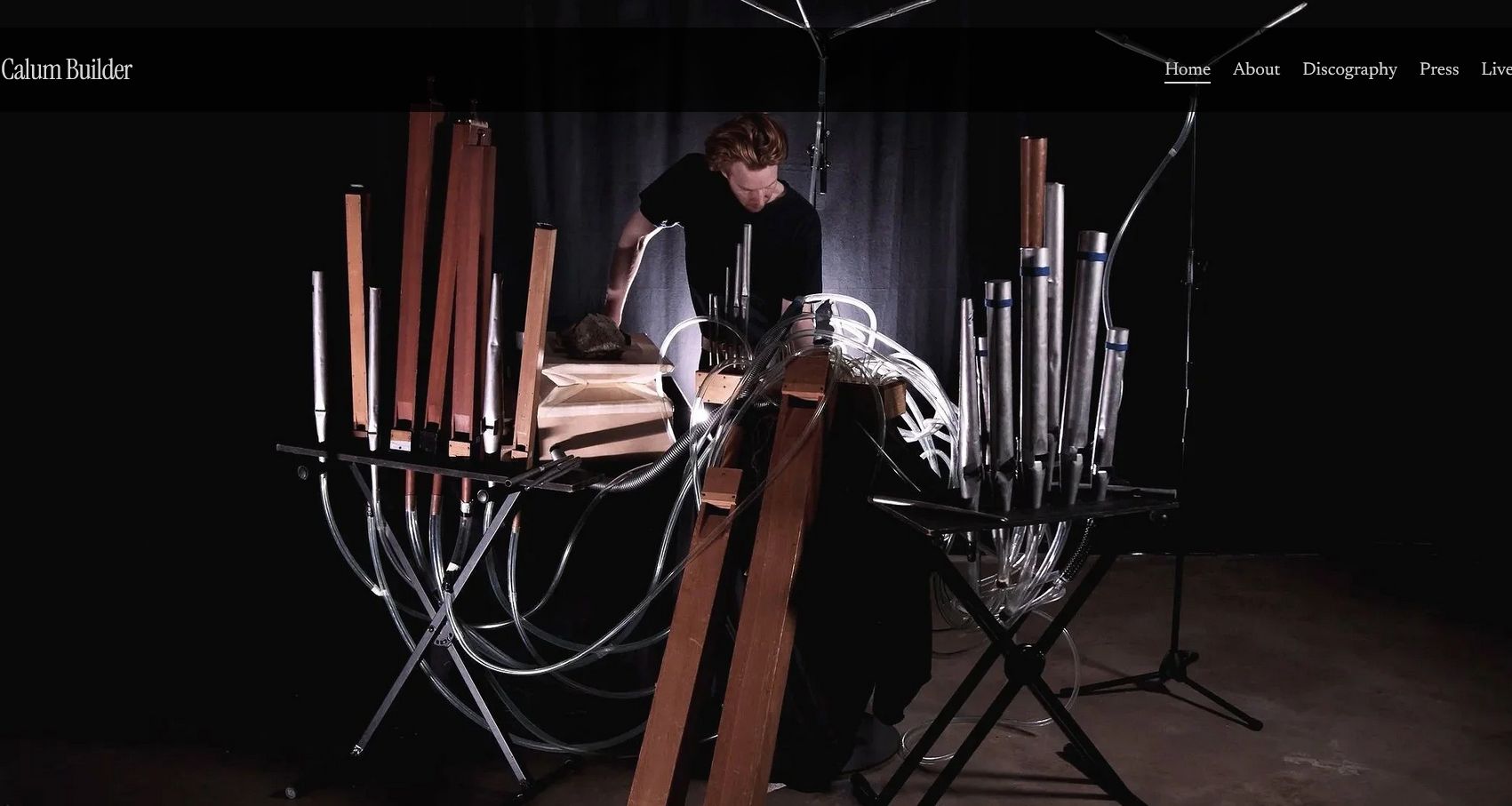 Calum Builder Interview Image by Örn Ingi Unnsteinsson
"People aren't as put off by unfamiliarity as we assume. They're put off by feeling like something is being withheld from them."
Video