

Published
Name: Yellowjackets
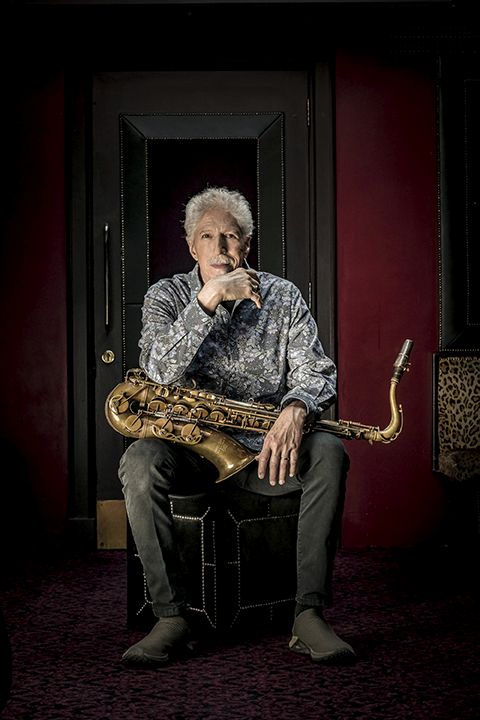
Members: Russell Ferrante (piano, synthesizers), Bob Mintzer (woodwinds, EWI), Will Kennedy (drums), Dane Alderson (bass)
Interviewee: Bob Mintzer
Nationality: American, Australian (Dane)
Current release: Yellowjackets' new album Fasten Up is out February 21st 2025 via Mack Avenue.
[Read our Dane Alderson interview]
If you enjoyed this Yellowjackets interview and would like to know more about the band and their music, visit their official homepage. They are also on Soundcloud.
What were some of the musical experiences which planted a seed for your interest in jazz?
Growing up in the NY metropolitan area afforded me the opportunity to hear live jazz music starting around age 14.
I heard all the greats play up close, and at that point the seed was planted for me to pursue the jazz life.
What does the term jazz mean today, would you say?
To my way of thinking, the term jazz refers to a set of parameters that are loosely followed and surrounded by interplay and in the moment improvisation.
As of today, what kind of materials, ideas, and technologies are particularly stimulating for you?
I enjoy hearing the LA and NY Philharmonic orchestras.
I always enjoy hearing a well constructed composition with spontaneous and heartfelt playing in any genre.
Where do most of your inspirations to create come from – rather from internal impulses or external ones? Which current social / political / ecological or other developments make you feel like you need to respond as an artist?
I get inspiration from music I've heard that makes me hear another version of that music. I also get inspiration from thinking about the people I regularly play with, in a way where I can imagine what a certain idea would sound like if those individuals were playing what I've written.
Sometimes dissonance and conflict can represent the same in world affairs. But more often than not, I try to convey love, harmony, and cooperation in the music I create.
Music has become a lot more global, and incorporating elements from other parts of the world or the musical spectrum is commonplace. Do you still think there are city scenes with a distinct, unique sound? How does your local scene influence your work?
Every place on earth has a distinctive feel, as does the music that comes from there. I have been influenced by living and training in NYC, where one can hear and play in so many different styles and flavors.
NYC is one of the most comprehensive melting pots of art and culture on the planet. Los Angeles, my second home, is very similar in that regard.
What role do electronic tools and instruments play for your creative process?
Electronics, in my case, the Electronic Wind Instrument, can expand one's dynamic and timbral palate.
However, it is imperative that the player have an intimate knowledge of how to produce beautiful melodies on an acoustic instrument, incorporating dynamic and color change.
Thanks to technological advances, collaboration has become a lot easier. What have been some of the most fruitful collaborations for you recently and what approaches to and modes of collaboration currently seem best to you?
I've been playing on recordings from artists all over the world through recording myself at home. I use Logic and an Apollo interface. It is quite convenient, and I can leisurely work on a track without being on the clock in a recording studio.
However, the ideal situation is to get in a room with musicians and play together.
Jazz has always had an interesting relationship between honouring its roots and exploring the unknown. What does the balance between these two poles look like in your music?
It is imperative to know the history of whatever art form you are dealing with. It is also imperative to take that knowledge and apply it to live playing situations, and compositional / improvisational exploration.
All the great improvisors worked hard at formulating a compositional approach to improvising.
How much potential for something “new” is there still in jazz? What could this “new” look like?
There is always room for new sounds and flavors. Every musician has a different combination of influences and varied work ethics.
For me playing in bands on an extended basis has afforded me the opportunity to try things and develop a style of playing. Every distinct combination of players will yield something different, and hopefully new.
For many artists, life-changing musical experiences take place live. How do you see that yourself?
Playing with all the great bands I've been fortunate to play in has formed my musicianship, along with being a band leader, composer and arranger.
Deodato, Tito Puente, Buddy Rich, Thad Jones/Mel Lewis, Jaco, Mike Manieri, various orchestras, my big and small bands, the Yellowjackets, and playing on hundreds of recordings.
How, would you say are your live performances and your recording projects connected at the moment? How do they mutually influence and feed off each other?
Performing live and in a recording studio are both performing. They share many of the same traits.
The major difference is that when you play live, you get feedback from the audience, which is an uplifting spiritual situation, and could inspire you to play differently.
Ímprovisation is obviously an essential element of jazz, but I would assume that just like composition, it is transforming. How do you feel has the role of improvisation changed in jazz?
I find that many younger inprovisors are playing in a dynamicly narrow zone, playing consistently loud and with a lot of information. This might be ok, but there are other options.
Excitement can be generated by understatement and beauty of sound, placement, and interplay. (Wayne Shorter, Paul Desmond, Lester Young)
What, would you say, are the key ideas behind your approach to improvisation?
Serving the music. Conversing with the people I play with. Being selfless, and empathetic. LISTENING!
Are there approaches, artists, festivals, labels, spaces or anyone/-thing else out there who you feel deserve a shout out for taking jazz into the future?
Jazz is alive and well. There are ample festivals and venues around the world right now.
Of course there are the "flavor of the day" bands that are playing all the major festivals at any given time, but my experience has been if we keep working on keeping the music honest and compelling, there will be opportunities, maybe not the ones you thought you might have.
The Montreux Festival intends to preserve its archive of recordings for future generations. Do you personally feels it's important that everything should remain available forever - or is there something to be said for letting beautiful moments pass and linger in the memories of those that experienced them?
Documenting musical performance is a good thing.
It is always great to discover a previously uncovered performance of an iconic musician years later.