Names: Bo Wiget, Luigi Archetti
Occupations: Cellist, composer, improviser (Bo Wiget), guitarist, composer, improviser, visual artist
Nationalities: Swiss (Bo), Italian (Luigi)
Current release: Bo Wiget and Luigi Archetti 's album Gekritzel is out via unit.
Hometown Recommendations: At the “Haus am Waldsee” in Berlin, there’s a small strip of reeds on the lakeshore that Peter Ablinger planted. Go there and listen to him! There’s a large lake in Zurich. Go and have a swim in it!
Things I am passionate about but rarely get to talk about: Oh, there’s so much to enjoy. Have we already mentioned the birdsong and the squeaking brakes of the bus? It’s a real treat when you’re out hiking or walking in the woods!
If you enjoyed this Bo Wiget and Luigi Archetti interview and would like to find out more about their music, visit their respective homepages: Bo Wiget; Luigi Archetti.
Where does the impulse to create something come from for you? What role do often-quoted sources of inspiration like dreams, other forms of art, personal relationships, politics etc play?
Other art forms are of great significance to us. Paintings, performances, dance.
But natural phenomena can also be crucial and influence our work. Seemingly random harmonies or coincidences – such as birdsong and the screeching brakes of a streetcar – are sources of inspiration, or provide confirmation that accompanies the compositional process, in the sense that thought finds confirmation in art and nature.
For you to get started, do there need to be concrete ideas – or what some have called a 'visualisation' of the finished work? What does the balance between planning and chance look like for you?
When working on albums, we actually always work in such a way that we send each other short improvised pieces, to which the other person then responds and uses as a starting point to continue working and composing. This can happen very intuitively, by drawing on associated ideas.
Or it can be entirely planned, for example, where we write out sheet music for a multi-track cello part that then fits with a guitar motif of whatever nature. And this might then be replaced by a new improvisation.
So, ultimately – if you like – our compositions are always a mixture of recorded improvisations and intuitive or planned actions and reactions.
Is there a preparation phase for your process? Do you require your tools to be laid out in a particular way, for example, do you need to do 'research' or create 'early versions'?
Our work on an album always begins with an improvisation.
The preparation involves switching on a microphone and getting the computer ready to record.
Do you have certain rituals to get you into the right mindset for creating? What role do certain foods or stimulants like coffee, lighting, scents, exercise or reading poetry play?
Coffee is important. No sugar! A splash of milk for Luigi. Bo drinks his black.
The rest is part of the artist’s routine: work.
For Gekritzel, what did you start with? If there were conceptual considerations, what were they?
There were no set plans.
Whilst working on this album, we realised that we both preferred to use the more conventional sounds of our instruments and hardly used any electronic effects. Instead, we added a few other instruments.
Tell me a bit about the way the new material developed and gradually took its final form, please.
These are always very long processes. On average, it takes us five years to make an album. This is partly because we’re both involved in so many other things.
As well as being a musician, Luigi is also a visual artist, whose musical creativity manifests itself in performances, videos, installations and painting. As for Bo, he’s involved in various other music projects, ranging from experimental improvisation to classical and contemporary music. He also works as a composer for classical ensembles, as well as for radio plays and theatre projects.
On top of that, we don’t live in the same city and can’t see each other very often. (Luigi lives and works in Zurich, whilst Bo lives in Berlin). But our work also thrives on a sense of calm. That’s why we like to take our time.
Many writers have claimed that as soon as they enter into the process, certain aspects of the narrative are out of their hands. Do you like to keep strict control or is there a sense of following things where they lead you?
We’re also open to being influenced by things like untuned instruments or instruments we haven’t quite mastered, as well as by the weather or by having had too much or too little coffee.
And the rest is work. Lovely work.
There are many descriptions of the creative state. How would you describe it for you personally? Is there an element of spirituality to what you do?
The longer we work as artists, the more we come to appreciate routine. This daily musical and artistic practice, where you delve a little deeper every day.
Routine replaces spirituality.
Once a piece is finished, how important is it for you to let it lie and evaluate it later on? How much improvement and refinement do you personally allow until you're satisfied with a piece? What does this process look like in practise?
As described above, this always takes a very long time.
Sometimes, by the end of this process, which can take years, not a single note of the original improvisation remains. We keep polishing right up to the very end, until eventually we decide that the stone is fine enough.
How do you think the meaning, or effect of an individual piece is enhanced, clarified or possibly contrasted by the EPs, or albums it is part of? Does each piece, for example, need to be consistent with the larger whole?
In fact, each track can stand on its own. And because of the creative process, the tracks on an album naturally belong together.
Sometimes, however, a track that’s been started falls by the wayside for various reasons.
What's your take on the role and importance of production, including mixing and mastering for you personally? In terms of what they contribute to a song, what is the balance between the composition and the arrangement (performance)?
As well as our main instruments, the guitar and the cello, the third instrument is the computer we use for recording. So we’re always grappling with technical challenges too. That means composition, recording and mixing are inseparable in our work.
For the final mix and mastering, however, we always go to someone else. For Gekritzel, we teamed up with Werner Dafeldecker, who conjured up a really lovely, subtle mix for us.
Music and the accompanying artwork are often closely related. Can you talk about this a little bit for your current project and the relationship that images and sounds have for you in general?
As we’re both involved in other art forms as well, we could say far more than just a little bit on this subject. It’s a vast, wonderful and complex topic. Perhaps we could go into more detail in 15 extra questions?
As for the cover, we can say this: we were lucky enough to release our first records on Rune Grammofon. There, the brilliant Kim Hiorthøy took charge of the cover design and, with his creative power, manages to give every album just the right look.
The cover of our latest record, Weltformat, released on Die Schachtel, features one of Luigi’s beautiful drawings.
When discussing Gekritzel, we realised that the cover offers space for doodling, so to speak. Stefanie Kunckler then basically just left the frame suggested by the label. There’s nothing else there.
So anyone who buys the CD is welcome to doodle on it whilst listening …
After finishing a piece or album and releasing something into the world, there can be a sense of emptiness. Can you relate to this – and how do you return to the state of creativity after experiencing it?
The routine continues. New spaces open up.
Creativity can reach many different corners of our lives. Do you personally feel as though writing a piece of music is inherently different from something like making a great cup of coffee? What do you express through music that you couldn't or wouldn't in more 'mundane' tasks?
Enjoying good food and a good cup of coffee is important. But creating art is something fundamentally different.
Through our daily artistic routine, we take our minds off things like making a cup of coffee, harvesting potatoes, dealing with income tax returns and maintaining dental hygiene.
And, of course, we hope that those listening to the record can also forget the hardships of everyday life, if only for a moment.

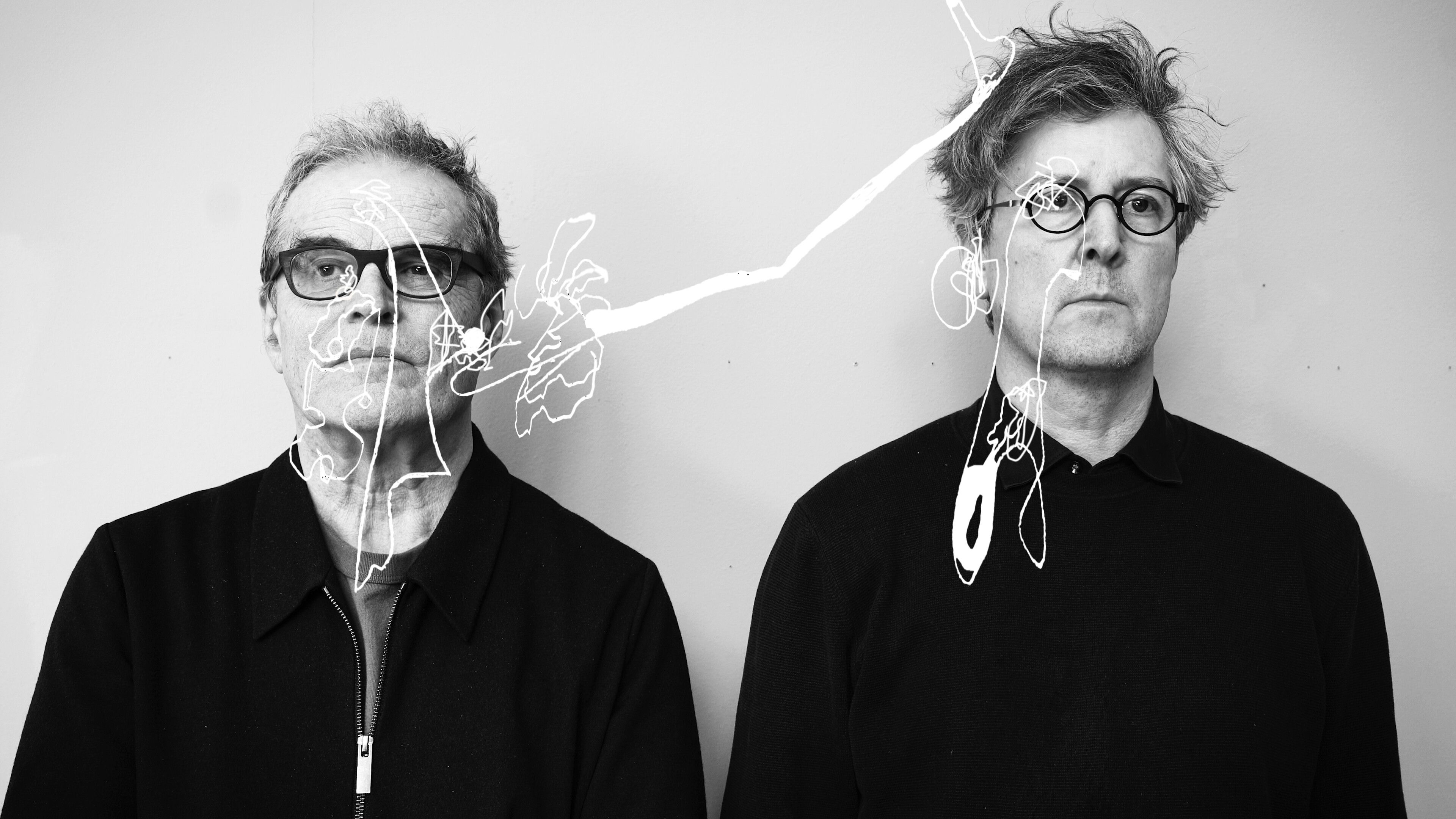 Bo Wiget & Luigi Archetti Interview Image (c) the artists
"Our work thrives on a sense of calm."
Video