

Published
Name: Azmari
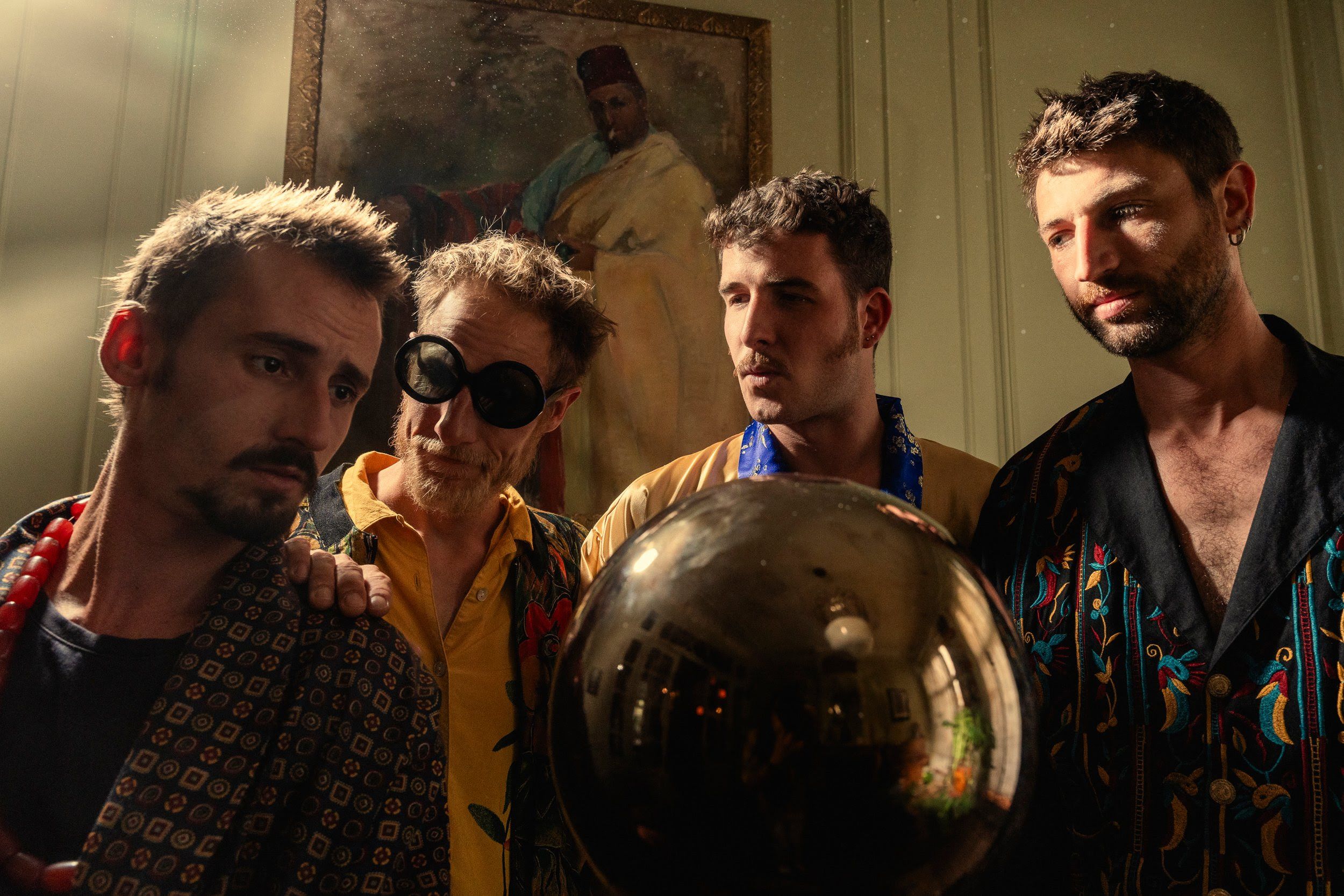
Members: Niels D'haegeleer (bass), Basile Bourtembourg (keys), Arthur Ancion (drums), Ambroos De Schepper (Flutes, Sax), Mattéo Badet (turkish kaval, sax)
Nationality: Belgian
Current release: Azmari's In Oculis EP is out via Sdban Ultra.
Global Recommendations:
Guillaume: I am currently living in Marseille. For music, I would recommend “L’embobineuse”, a great place for alternative music or “Baharestan”, a tiny place for intimate traditional music gigs. Otherwise, get some sun at “Vallon des auffes”, “Goudes” or “Calanques National Park”.
Niels: Living in Brussels, there are small alternative music places like “Labokube” where we released our new EP on the 9th of May. Other places like “Ateliers Clause”, “Crix café” or “Zonneklopper” offer gigs and events but usually open on events and are not open every weekend. You can always party in bigger structures such as “Brasserie Ilegaal” or go to listen to everyday concerts at “Ancienne Belgique” or “Botanique”.
If you enjoyed this Azmari interview and would like to know more, visit the band's official homepage. They are also on Facebook, Soundcloud, and bandcamp.
When it comes to experiencing the sensation of “energy” as a listener, which albums, performances, and artists come to mind?
Guillaume: For me, the sensation of energy as a listener is really intense, with music linked with a traditional / spiritual / everyday life context. I personally think about ceremonial music like gnawa music or Kurdish Sufi music. It can also be “everyday life” music like farming songs or laments songs.
In those different contexts, the energy is spontaneous, raw. The music is related to spirits, ancestors, deeply connected with immemorial human knowledge, far from commercial, marketing purposes. Otherwise, in the music industry, I would think of artists like Sun Ra, Pharoah Sanders, Alice coltrane, Jimi Hendrix.
In recent years, I think about labels like International Anthem, Leaving record or Moon Glyph. Am album like Carlos Niño and Friend’s More energy fields, current for example.
[Read our Carlos Niño interview]
Mattéo: I think that listening to every kind of music is about feeling a sort of energy, low or high, soft or intense.
I feel really close to any music that tends to make you dance, beginning with funk, afrobeat and disco music like James Brown, Gwen Mccrae, War, Fela Kuti and many more.
I love the clearness and the speed with which the energy is transmitted through the body. It is also the case with electronic music
Niels: I feel different kinds of energy depending on what I listen to.
For example, the feeling of simple happiness comes with listening to Congolese rumba, with artists such as “Grand Kallé”. It often gives me the strength to go over difficulties and think positively.
I recently listened a lot to one of El Michels Affair's albums, Yeti Season. For me, this album gives me the energy to think differently, to go somewhere I never explored, somewhere between cinematic and trad music.
Music can also give me the power to ramble in my deep spirit with albums such as Upon Reflection by John Surman.
But I think what remains strongest is the act of playing music. Indeed, when I feel that what I'm playing is in place and that all the instruments form a whole, a kind of trance emanates from the music, which is for me one of the best sensations I could feel.
Also, sometimes music can’t give me energy and I need to find it somewhere else, for example by going out into nature and becoming part of it.
There can be many different kinds of energy in art – soft, harsh, healing, aggressive, uplifting and many more. Which do you tend to feel drawn to most?
Guillaume: Obviously, this is a subjective question depending on each of us and our mood of the day. But I think we tend to feel drawn by active energy related to dance and body based experiences and on the contrary soothing and healing energy related to mind experiences.
Niels: As Guillaume said, art gives us different kinds of energy depending on what it is and on what is the sensibility and emotional mood of the person who receives it.
I have had a hard time explaining that listening to death metal calms me down. When you listen to a song with a particular energy, does it tend to fill you with the same energy – or are there “paradoxical” effects?
Guillaume: We generally tend to experience the same energy expressed in the music.
But as a music therapist working in cancerology, I am personally very sensible to this subject. Music for relaxation can give anxious effects to some people for example. On the contrary, I met a patient who asked me, like you, to play some metal music to ease his pains …
To me, music is very subjective and there are no universal settings like this music or this frequency for this effect.
Mattéo: It is often the case for me to feel happiness by listening to soul music even though it deals with sadder topics like loss and struggles. That can be paradoxical but also logical since we can find hope and love also in those topics.
Niels: For example, I don’t think that you must feel sad to listen to sad music. As human beings, we can change from one mood to another and that’s what makes us human.
Also, people can have different feelings about the same song because they lived different stories listening to it for the first time or simply because they have a different instinct about it.
When it comes to experiencing the sensation of “energy” as a creator, how would you describe the physical sensation of experiencing this energy?
Guillaume: This is a difficult question because the act of creation is so immersive that we tend to forget about our sensations at this very moment. That is a question I already ask myself in my practice.
I would personally say that there is a build up of tension/pressure in the solar plexus and brain areas during the very creative process. Then, it comes to a release when the idea is finally taking form in the material world.
All this can be linked with abstract visual representations like patches of colours for example or very concrete and vivid images like a waking dream.
Niels: That's an interesting question because I think that creating music has a big impact on the mind and body. For example, when you can't make any headway in composing a piece, you can feel your body tense up, due to the frustration of not being able to move forward.
On the other hand, when a track has just come out of the egg, the body seems excited, more free and full of a new energy.
When it comes to composing / songwriting, are you finding that spontaneity and just a few takes tend to capture energy best? Or does honing a piece bring you closer to that goal?
Guillaume: I think with Azmari, it’s a combination of these two aspects.
We always compose from improvisations where spontaneity is the key word between us in terms of capturing the energy at the present moment. We then talk about it and carve this raw material to bring it to the image, emotion we want.
Niels: It's always a toss-up between the two. I'd say that first comes the excitement of a potential new track with a new loop or a new melody and then you get into the real work of composition, which I personally find takes longer and requires more diligence.
In my opinion, this second stage is more cerebral, whereas the first is more about the energy of discovery.
How much of the energy of your own music, would you say, is already part of the composition, how much of it is the result of the recording process?
Guillaume: Azmari has always been a project more shaped by and for the stage's context. The energy of our music is already mostly part of the compositions.
But things got a bit different since we began working with producer and sound engineer Frederik Segers (Maelström and In Oculis). We found in him another member of the band that help us to see the recording process differently.
Sometimes, we come with an idea that will take with him a total new direction or new energy. We kinda like it.
For the In Oculis EP, what kind of energy were you looking for?
Guillaume: With In Oculis, we were definitely looking for a different energy as I came back to the project just for this release. The band was ready to explore my own influences and new paradigms. As a result, the new songs are more calm and introspective.
I think we also wanted to move a bit from the general image of Azmari as an ethio-jazz band.
Niels: We clearly searched for something different on this new EP. Working with someone from outside Azmari was a desire to do something different, to get away from the usual ways of doing things.
Although Guillaume was formerly a member of Azmari, he has in the meantime been able to experiment several traditional instruments such as the Guembri, Shenaï and the Daf and play them on a daily basis. This contribution of new instruments with new sounds was a great inspiration for us.
We've tried to boil things down to their essentials, while retaining the grace we were able to capture.
In terms of energy, what changes when you're performing live on stage, with an audience present, compared to the recording stage?
Guillaume: We are definitely more focused during the recording process. Things can get a bit tight because everyone wants to express the best of themselves.
On the other hand, performing live on stage is more of a celebration for us where everyone is in a spontaneous and let go mode.
Mattéo: The energy is always the result of a tight bond between us and the audience when playing live. So it may vary from one venue to another. But it is often higher since you have only one chance to play each song so we must do our best.
During recordings, since you can always redo a take, it is difficult to get the best of everybody on the same take and we only have the opinion of the sound engineer as a feedback of how was the energy as a listener (which is never the same as the energy we think we give as a performer).
Niels: For me, these are two totally different sensations, at least in my role as a bassist.
When we're in the studio, our energy is more focused on the desire to get a good take. Although the pleasure of playing is there, we're more focused on ourselves and on the details of playing. However, this can be a time when creativity is at its peak, because anything is possible when you can redo takes and add several layers.
When we play live, we’re not alone anymore, the outside world is much richer in information and can disturb us in a good or bad way. For me, the exchange of energy with the audience is essential and defines the shape of the show.
How does the presence of the audience and your interaction with it change the energy of the music and how would you describe the creative interaction with listeners during a gig?
Guillaume: Obviously we want to offer the best of ourselves to the audience that comes to see us. But in terms of interaction, there is definitely an intersubjective and codependent link between the two sides. We depend a lot on the audience’s energy.
On this subject, our gigs during the pandemic era were sometimes difficult because the audience members were sitting separately from each other and just observing us without moving or dancing. Our feeling on stage was a bit strange and dead sometimes. As a musician, hearing the crowd screaming and seeing people enjoying your music is a very intense experience that can come close to a drug hit.
Also, we spontaneously kinda react musically to the audience in terms of tempo, colours of our solos or effects we put in our sound. Finally, how our music is received by the audience can lead us to change the shapes of our songs or our set list.
Niels: As I said in my response to the previous question, the interaction with the public influences us in many ways. There's always an energy that the audience reflects. Sometimes it can be totally different from what you think, because you can quickly get the wrong impression.
People in the audience can also influence each other. For example, if someone starts to dance, it's very likely to inspire other people to dance too.
What kind of feedback have you received from listeners or concert audiences in terms of the experience that your music and/or performances have had on them?
Guillaume: We often hear that our music is different and that it makes people travel to other directions.
Some people feel drawn into another space/time continuum, forgetting for a moment about their everyday life concerns. Other ones share to us some personal insights or visions they got from our music. Sometimes it takes forms of a real altered state of consciousness.
Would you say that you prefer to stay in control to be able to shape the energy or do you surrender to it and allow the music to take over? Who, ultimately has control during a live performance?
Guillaume: I think it’s a mix of the two. I mean, we need to be in control of our instruments, technically and sonically speaking. All the basic structures of our songs also need to be under control.
But it’s also important and fundamental to surrender and allow the music to take over by itself as you say. In a live performance, songs are stretchable and some “errors” in an improvisation can lead to new directions followed by the others for example or some new ideas can come out after some new sounds are discovered with effects pedals.
To answer your second question, I think we are the only ones to have control during a gig about the bases of the songs. Nevertheless, during creation or improvisation it’s a question of faith. There is definitely something magical happening, call it inspiration, spirit, God, universe or energy.
The energy that music is able to generate can be extremely powerful. How, do you think, can artists make use of this energy to bring about change in the world?
Guillaume: There is an inherent feature of music which permit us to feel, express emotions and to share the same feeling with complete strangers. This is already a powerful effect that we need in our world.
I mean, even if we are technically more connected with each other with the internet and social media … It feels like everyone is locking themselves away behind their screens and looking at things they should like, proposed by some algorithms. In this sense, live performances are important for connecting people and for proposing sounds, ideas that you don't think you would like or think about by yourself.
On the other hand, depending on your point of view, you can also think that the purpose of music in our modern societies is getting more and more useless, more and more led by financial and ego purposes.
I personally decided to study music therapy at the university to share the healing power of music on a different scale (hospitals, centres for handicap people …).