Name: AYEN GL
Occupation: Composer, sound artist, producer, vocalist
Nationality: German
Current release: AYEN GL's BIOME is out via PLUSH EMBER. Listen to the EP here.
If you enjoyed this AYEN GL interview and would like to stay up to date on her music, visit her on Instagram, and Soundcloud.
Do you think that some of your earliest musical experiences planted a seed for your interest in sound?
Absolutely. My earliest encounters with music were deeply rooted in my upbringing within a church community. The resonance of my voice intertwined with others in the choir, harmonising with the organ's bass during momentous celebrations left an indelible mark on me. And during Easter, there were these wooden rattles that I loved shaking for their shrill, dazzling sounds.
I get so many sounds coming up when I think of that time. Surely that all affected my interest in synths and basses. I still tend to go for big and loud instruments just because they make me feel alive and outside of this world. It's as if they awaken something primal within me.
I’m still asking myself if that is an attempt to flee from reality, an ongoing quest for escapism. But I honestly haven’t figured that out by now.
Do you experience strong emotional responses towards certain sounds? If so, what kind of sounds are these and do you have an explanation about the reasons for these responses?
Sure. For the longest time, music and sound were the only realms where I found myself opening up to emotional responses. However, in recent years, I've started to feel more connected to my emotions. So, my focus lies more on unravelling my emotionality beyond music and sound currently.
But I still love the unexpected rush I get at a performance where the bass hits me like something wants to come out of my womb. To physically feel sound brings tears to my eyes or makes me just burst out of joy. That’s why I love club spaces so much.
I wouldn’t wanna miss the transformative power of sound ever. Period.
Are there places, spaces, or everyday devices which intrigue you by the way they sound? Which are these?
I'm very connected to moments where a sound allows me to experience the world more cinematically. I'm a fan of drastic dramaturgy and not very connected to very natural sounds, although the human voice always resonates with me.
One thing I particularly enjoy is when someone starts humming very softly in the subway. It always captivates me because I can truly feel the vibrations from a distance even though I can't discern where it's coming from. It's like a whisper from the dark.
But yeah moreover, I'm drawn to everything connected to audio manipulation—voices through broken speakers and similar phenomena.
For some, music equals sound, to others they are two distinct things. What is the relation between music and sound for you? Are there rules to working with sound, similar to working with harmony, for example?
To be honest, I don’t differentiate between them so much at the moment. I believe music is akin to the associations one creates when hearing different sounds combined.
For instance, the revving of racing motors can evoke something deeply musical within me. Perhaps that’s also just what I connect with motors. I find their sound alluring, with a captivating energy.
Hmm, it's difficult to articulate, but I think harmony is intrinsically intertwined with sound. To truly experience harmony, the sound must possess the capacity to convey it. If the sound is overly bass-heavy, it can obscure the harmony for me.
Harmony, I believe, is the profound connection of specific potential sounds that allow musical expression to open up and evoke a connection and togetherness in tonality.
What were your very first active steps in terms of working with sound and how would you rate the gains made through experience?
I attempted to write some music for movies. That was when I truly realized the limitations of my perspective, which was only based on a musical standpoint at that time.
It ignited my drive to establish a deeper connection with sound and that was actually when I started producing music.
For your own creativity, what were some of the most important things you learned from teachers/tutorials, other sound artists, or personal experience?
Being curious to delve deeper into a narrative has been so nourishing for me. I’ve seen such a ton of tutorials and am also extremely happy from all the experience I got playing live. Through this journey, I've come to realise that I don't always need an abundance of tools or techniques.
My production decisions are primarily guided by the narrative I aim to convey. In 'UNLEASH,' for instance, every aspect—from structure to sound design—was meticulously crafted to narrate the journey of shedding skin, donning armor, and preparing for battle in an arena. It symbolises an awakening, a transformative moment.
In essence, I've learned that storytelling is paramount in my creative process. It shapes every aspect of my work, guiding my decisions and infusing my creations with myth and catharsis.
How and for what reasons has your music set-up evolved over the years and what are currently some of the most important pieces of gear and software for you?
It’s constantly changing. Right now I’m just working digitally besides my vocals. So my gear is literally a laptop, a mic, and an interface.
I can be easily distracted by too many things around me so I wanted to focus more on essentials and at the moment I’m really happy with the simplicity of it.
Already as a little kid, I was drawn to all aspects of electronic/electric music but I've never quite been able to put a finger on why this is. What's your own relationship to electronic sounds, rhythms, productions like – what, if any, are fundamental differences with “acoustic“ music and tools?
I used to work on music for large ensembles, and I was always captivated by the result that the plugin of the notation program, with which I wrote the music, gave me.
However, when I handed out the sheets to a big band for instance, the sounds that came back were so far from what I wanted them to sound like. Despite my best efforts to convey my musical intentions through traditional means, the gap between expectation and reality remained vast and insurmountable, leaving me longing for a medium that could bridge this divide.
So I believe that's how I discovered my deeper interest in electronic music, or perhaps it's just more aligned with my current imagination than what acoustic music could offer.
Late producer SOPHIE said: “You have the possibility with electronic music to generate any texture, and any sound. So why would any musician want to limit themselves?” What's your take on that and the relevance of limitations in your set-up and process?
Love to hear that. I mean SOPHIE’s work left a huge mark on my music. And, indeed, why limit yourself, even beyond the realm of music?
For me, my creative process is less about limitation or restriction and more about focus. Obviously in setting a process to focus on a way, an image or a sound, you’re heading towards a direction without necessarily excluding other possibilities. Limitations just don't align with how I naturally think.
I prefer to dive into intuition. For me, it’s a journey guided by curiosity and transformation.
Could you describe your creative process on the basis of one of your sounds, pieces, or live performances that's particularly dear to you, please?
"AVALANCHE" is a song from my EP BIOME and began like many of my songs, with a concept in mind.
The entire EP is set within an arena, and for the final song, I envisioned it as the exit from this world. The song was set to describe what you feel after the final fight, delving into the vulnerability of what lies ahead.
So I had already written the lyrics, which were connected to longing, uncertainty, and a relationship in this world of the BIOME. During the writing process, I found myself revisiting some of my early compositions.
One particular track, from years ago featuring a more classical arrangement for strings, vibraphone, horn, and flutes, kept playing in my mind. I got rid of the melody and used the ensemble as some texture to sketch the piece and start my production with Neve who coproduced on this.
The process boiled down to simple sample work, yet we approached the production with the mindset of treating each sound and instrument as part of an orchestra. Then Neve added this beat that glued the whole piece together and connected it to the vibe of the epic pop ballad one might anticipate at the conclusion of a movie – a vision I had been yearning for.
In relation to sound, one often reads words like “material”, “sculpting”, and “design”. How does your own way of working with sound look like? Do you find using presets lazy?
I dearly find it very mesmerising and love to use presets. Actually would love to use more presets as they are, but that just doesn’t happen so much in my process at the moment. There's a certain magic in delving into a library of preconfigured sounds and I use the energy from that to build up something new from a different starting point.
But I have to say, I still like to keep my sound and production work very separate.
To some, the advent of AI and 'intelligent' composing tools offers potential for machines to contribute to the creative process. What are your hopes, fears, expectations and possible concrete plans in this regard?
My hopes definitely lie in AI unlocking the limitless potential of the mind. I believe there will soon be numerous collaborations with digital entities, and I'm eager to explore this.
However, I also fear that reliance on AI might diminish the recognition of craftsmanship over the transition to everybodys access, posing challenges for artists.
To me, it’s surreal to think 20 years ahead, but I think this could really open up a lot of creativity and access.
How important is sound for our overall well-being and in how far do you feel the "acoustic health" of a society or environment is reflective of its overall health? What importance does silence hold in this regard from your point of view?
I think it cannot be overstated. It holds a sacred essence of reverence and care. I believe we should treat sound with the same respect we afford to the divine. Silence serves as a sanctuary, offering solace and restoration.
While I currently do not allow myself much silence, I’m looking forward to an Elysium where I’m freer to experience that.
Tinnitus and developing hyperacusis are very real risks for anyone working with sound. Do you take precautions in this regard and if you're suffering from these or similar issues – how do you cope with them?
Fortunately, I don't have any experience with that. Like with any other stress, I also try to listen to my body and gauge its capabilities at the moment.
Seth S. Horowitz called hearing the “universal sense” and emphasised that it was more precise and faster than any of our other senses. How would our world be different if we paid less attention to looks and listened more instead?
I believe my journey would undergo a significant transformation. Currently, my process doesn't prioritise this auditory utopia.
While writing and producing BIOME, I found myself already collaborating with creative directors to shape the visual aesthetic of the envisioned world, even before completing half of the EP. So that heavily influenced the way I added sounds and structure to the music.
I’m in love with audio, I’m in love with visuals and I love performance. It comes very naturally to me to explore these processes simultaneously and head with everything into the dark unknown.
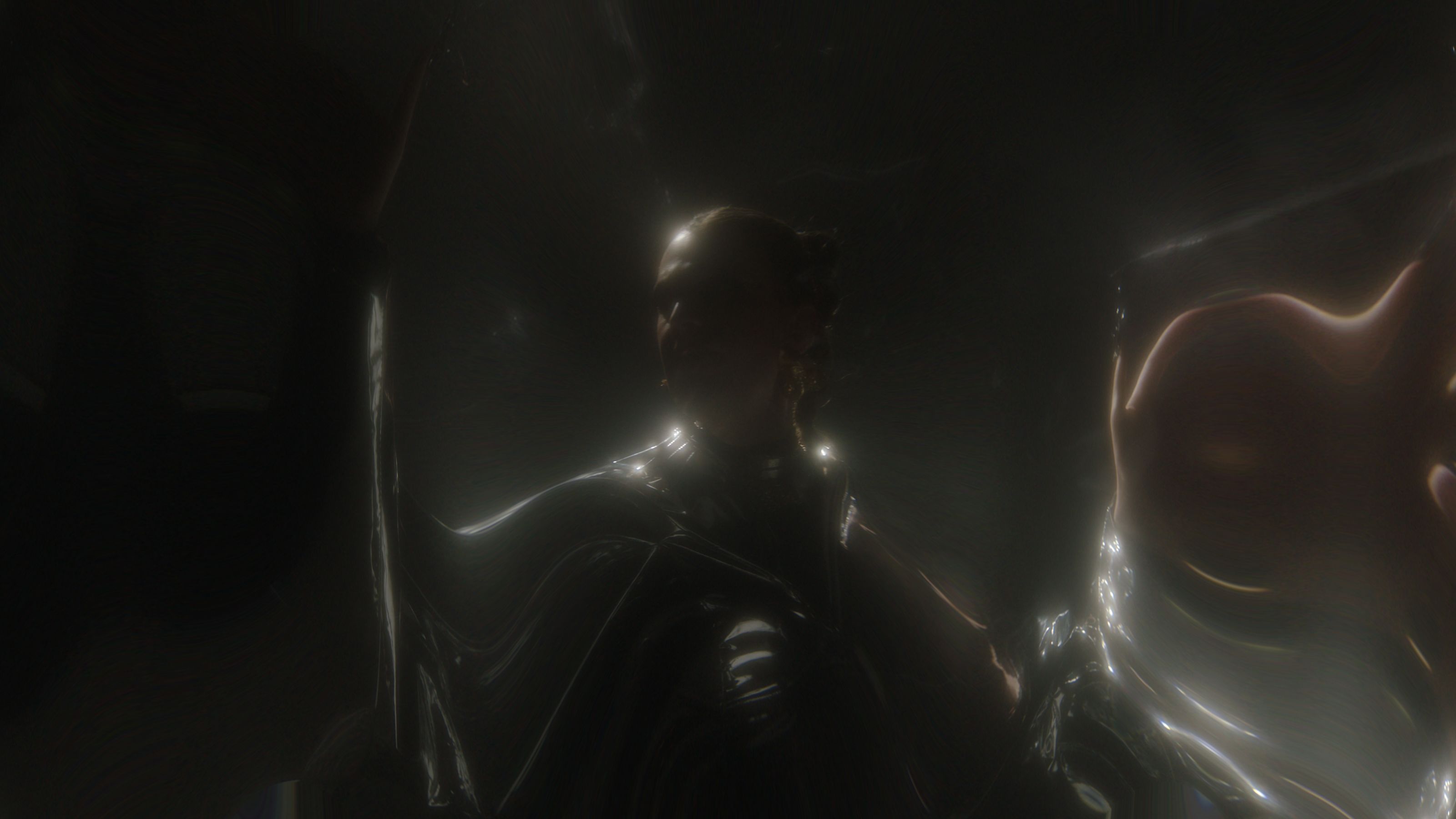 AYEN GL Interview Image by Ouroboros.Studio
 "I particularly enjoy when someone starts humming very softly in the subway. It's like a whisper from the dark."
Video