Name: Ashley Henry
Nationality: British
Occupation: Pianist, composer, improviser, producer, bandleader, vocalist
Recent event: Ashley Henry has announced the dates for his 2025 UK tour. Catch him perform live at one of the following dates:
12th April 2025 – Queen Elizabeth Hall, London
29th April 2025 – Band On The Wall, Manchester
30th April 2025 – CLWB IFOR Bach, Cardiff
1st May 2025 – Louisiana, Bristol
4th May 2025 – Headrow House, Leeds
5th May 2025 – Hug & Pint, Glasgow
6th May 2025 – Bodega, Nottingham
Recent release: Ashley Henry's latest album Who We Are is out via naive.
Topic I am passionate about but rarely get to talk about: Langston Hughes, Audre Lorde and Maya Angelou are some of my favourite poets. Their writing really articulates and uplifts the aesthetics of Black music and culture.
I have been a really great admirer of painters such as Frank Bowling, whose work has moved and inspired me.
I love to read, and recently have been learning a lot from writers including Fred Moten, Bell Hooks, and Saidiya Hartman. All of their ideas and thoughts transport me, and allow me to open myself up creatively.
I’m also working on a project with the Thorneywork Lab in Oxford university called “Colors of Noise” where we explore how we understand the different sound colours alongside music and improvisation.
Recommendations for London: I highly recommend “Maestro Records” In Peckham, South London. It’s an absolute gem, has been around since the 80s and is ran by a great DJ/Selector called Michael Fontaine – I interviewed him a few years back about the social, political and cultural underpinnings of what it means to have a record shop that’s available online!
If you enjoyed this Ashley Henry interview and would like to stay up to date with his music, visit his official website. He is also on Instagram, and Facebook.
What were some of the musical experiences which planted a seed for your interest in jazz?
I think of the living room of my childhood home, the piano, relatives visiting, music blaring – not much of an excuse was needed for this.
My dad had a sound system and I grew up embedded in that rich culture.
What does the term jazz mean today, would you say?
For me it represents aligning one's self with who they truly are and actualising that within a musical context.
I hear self actualisation in so many styles of music beyond the distorted view of what jazz is which is why I find myself blending so many together
As of today, what kind of materials, ideas, and technologies are particularly stimulating for you?
I’ve been incorporating a lot more technologies and sampling techniques into my creative practice and production such as using the MPC Live 2.
I feel like we’re at a place in music where so many more people can play their instruments to a high level technically, but for it to be stimulating, for me, it needs to tell a story and to move me.
That’s what got me into music in the first place and is also what I try to do with my music.
Where do most of your inspirations to create come from – rather from internal impulses or external ones? Which current social / political / ecological or other developments make you feel like you need to respond as an artist?
My inspiration always comes from love and all its forms. I feel that’s our purpose as people who create art.
We are surrounded by so much harm, thinking about climate disasters, social injustice and destruction I feel it’s more important than ever artistically to spread the message of bringing us to our true nature – connecting with each other, nature and bring a sense of collectivity within a society that’s socialising us to avoid or run away from those things.
Music has become a lot more global, and incorporating elements from other parts of the world or the musical spectrum is commonplace. Do you still think there are city scenes with a distinct, unique sound? How does your local scene influence your work?
On the live scene I believe there will always be a distinctive sound as long as the musicians continue to allow themselves to be contaminated by the flow of the city that they’re in. I’ve been fortunate enough to travel a lot, so whether I’m in New Dehli or London there’s a soundscape, tinged with live music of various forms.
At the same time, this hyperconnectivity of our times through the internet puts us at risk – the internet has made the world a lot smaller, music is getting around a lot quicker, and our openness to music that doesn’t follow trends is at risk of reducing.
But there are always people taking risks, and also paying homage to their musical inheritances and where they are from - to find the more distinct music you just have to search harder.
What role do electronic tools and instruments play for your creative process?
For my music, electronics has always played a huge role.
I’ve been using my MPC Live 2 a lot for drum programming and sampling as well as a producer from Los Angeles “Dane Zone” who has a huge collection of analogue synths and drum machines for all of the post production
Thanks to technological advances, collaboration has become a lot easier. What have been some of the most fruitful collaborations for you recently and what approaches to and modes of collaboration currently seem best to you?
Collaboration is everything.
I have been thinking a lot about, as creatives, how much more we need each other every day; I have been spending a lot of time at my local record shop in Peckham, trying to find answers – looking for inspiration – thinking, what would they have done if they had to create music, how would they have responded to these new demands placed on artists by social media, algorithms, streaming platforms.
I have been thinking about collaborations across time, looking for time right now when I feel like I am running out of it constantly! It really is down to establishing community and finding ways to be inspired by others. Co-conspiring is much more fun than constantly thinking about oneself and one's practice and all the demands we face alone as musicians.
Aja Monet always comes to mind when I think of collaborations - and wow, it was such an hononur to have her on this album. The piece I created with her, “Fly Away,” celebrates Black childhood, collective dreaming, and resistance.
Jazz has always had an interesting relationship between honouring its roots and exploring the unknown. What does the balance between these two poles look like in your music?
I think throughout the history of music, all black music creators were exploring the unknown whilst honouring the history and lineage alongside incorporating different styles of music that they had access to at the time.
That’s my definition of following the “tradition” - sometimes we can get lost in our own source as there’s so much music we have access to and so many eras of music that get romanticised and stamped as “the golden era” or the “tradition”.
How much potential for something “new” is there still in jazz? What could this “new” look like?
There’s always potential for something new, especially when it comes to exploring the unknown whilst honouring the past. The world is constantly changing and moving very quickly so it’s only right that we have music to reflect that.
It's less about ‘newness’ for me, than it is about being true to one’s voice, and being in pursuit of it.
For many artists, life-changing musical experiences take place live. How do you see that yourself?
I agree, especially with improvised music where the audience is also a participant in the music as well as the musicians.
When I play my shows I always like to keep things open so that way every show is different and unique in it’s own way.
How, would you say are your live performances and your recording projects connected at the moment? How do they mutually influence and feed off each other?
The recorded material is a great foundation for myself and the band to springboard from. The music has so much room for the spontaneity you get from a live performance, especially with the jazz influence and the improvisation.
The recorded material is almost like a rough guide
Improvisation is obviously an essential element of jazz, but I would assume that just like composition, it is transforming. How do you feel has the role of improvisation changed in jazz?
I don’t think improvisation has “changed” in the same way composition has.
Improvisation has always been the purest form of self expression. It’s like talking to someone in a conversation – we learn the English language enough for us to be able to have a fluent conversation but we don’t plan in advance what we’re going to say and how we’re going to say it.
What, would you say, are the key ideas behind your approach to improvisation?
For me, it’s always been about vulnerability, storytelling and to just lose yourself in the music. Surrendering to the moment.
Are there approaches, artists, festivals, labels, spaces or anyone/-thing else out there who you feel deserve a shout out for taking jazz into the future?
I have to shout out Jazz refreshed for constantly pushing the music and being the backbone of the UK jazz scene for the past 20 years – I played a set at their legendary Mau Mau bar residency back in 2015. I was still a student at the time.
And as soon as the founders Adam and Justin realised I was about to record, they instantly offered to release it as part of their 5ives EP series that took a five year hiatus. Following the likes of Richard Spaven and Kaidi Tatham.
It’s been amazing to see what they’ve achieved and the music they’ve been putting out since then! The scene would be a much different place if it wasn’t for them.
The Montreux Festival intends to preserve its archive of recordings for future generations. Do you personally feels it's important that everything should remain available forever - or is there something to be said for letting beautiful moments pass and linger in the memories of those that experienced them?
I don’t think my music would exist without archives; I feel like I must have spent half my life on youtube and various platforms listening to Jazz archives and listening to interviews of my favourite artists.
I came from the generation where you could begin to watch full concerts on Youtube for the first time ever! Being a Black Jazz musician, seeing myself represented at the time was so important for me to be able to imagine what’s possible. I hope to do the same for the next generation.

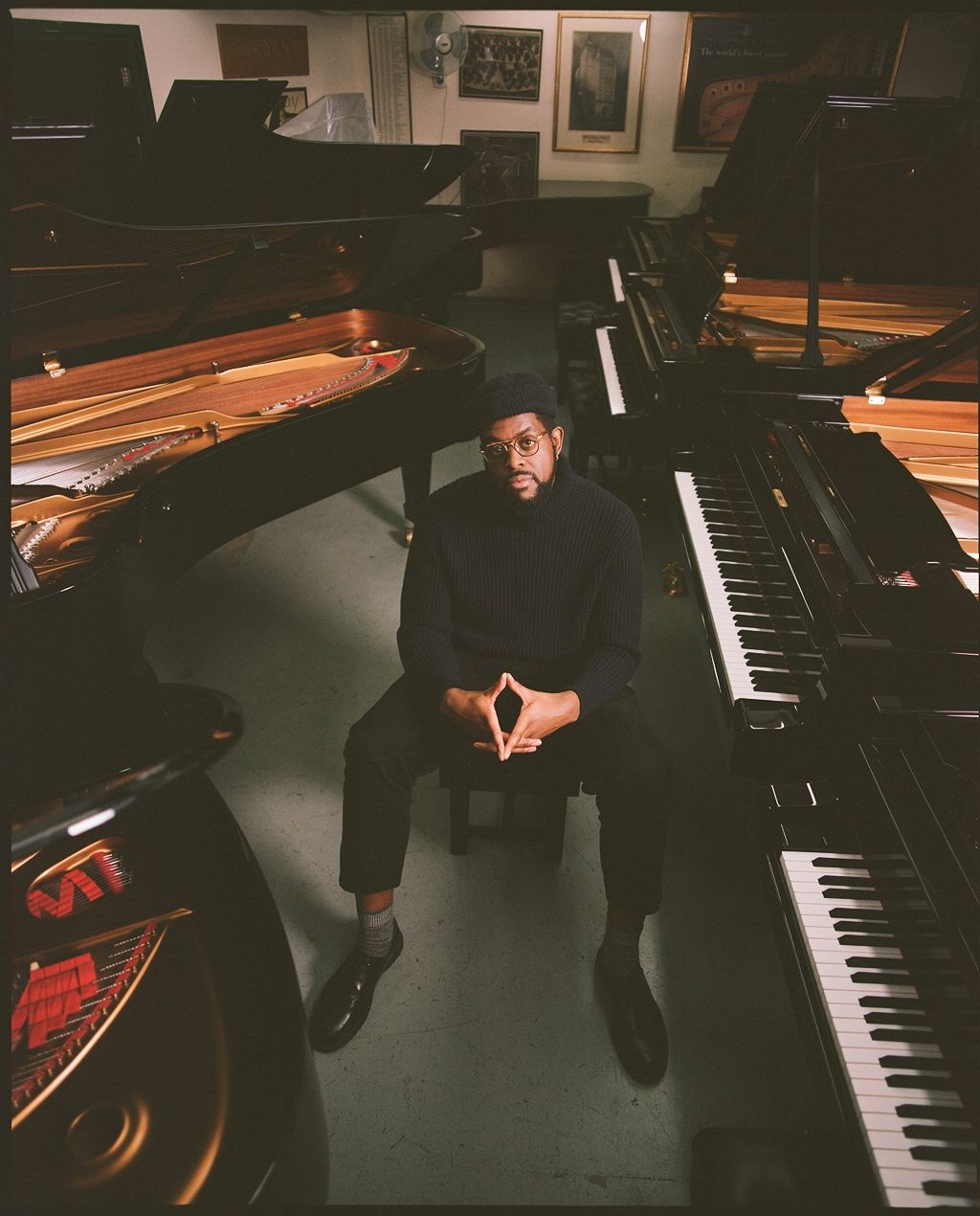 Ashley Henry Interview Image by Rashidi Noah
“My inspiration always comes from love and all its forms. I feel that’s our purpose as people who create art.“
Video