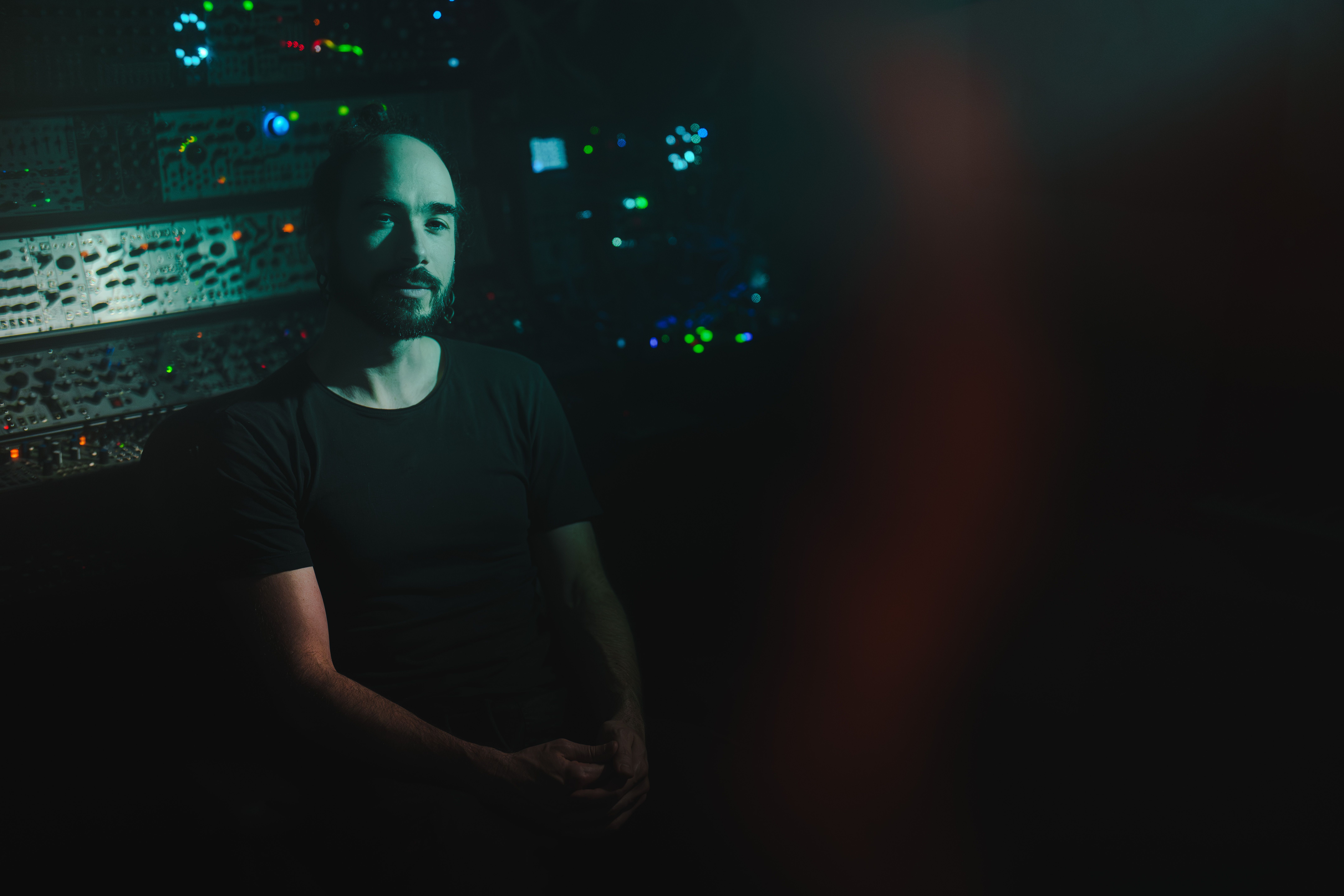


Name: Anthony Baldino
Nationality: American
Occupation: Producer, composer, sound designer
Current release: Anthony Baldino's new album Conveyor is out September 18th 2026 via BL_K Noise.
Shoutouts: It would be a crime for me not to mention the works and support of Tom Hall, Richard Devine, Surachai, Moe Espinosa, Rodent, Bana Haffar, Tony and Kelly at Make Noise, Gur Milstein at Tip Top Audio, everyone at Qu-Bit and Stephen and Kris at Noise Engineering.
Hometown Recommendations: For the synth heads, check out Perfect Circuit in Los Angeles. For everything else, hang out in Little Tokyo.
[Read our Bana Haffar interview]
If you enjoyed this Anthony Baldino interview and would like to stay up to date with his music, visit his official homepage. He is also on Instagram, Soundcloud, and bandcamp.
Many artists have told me that they're in discovery mode when working with the modular. What are some of the things you recently discovered while working with your own set-up?
Great question. I think the modular inherently pulls you into discovery mode whether you intended to be in that mode or achieve a very specific idea. But I suppose one thing you could say that I recently discovered about my setup is the way I have things setup changes my thinking.
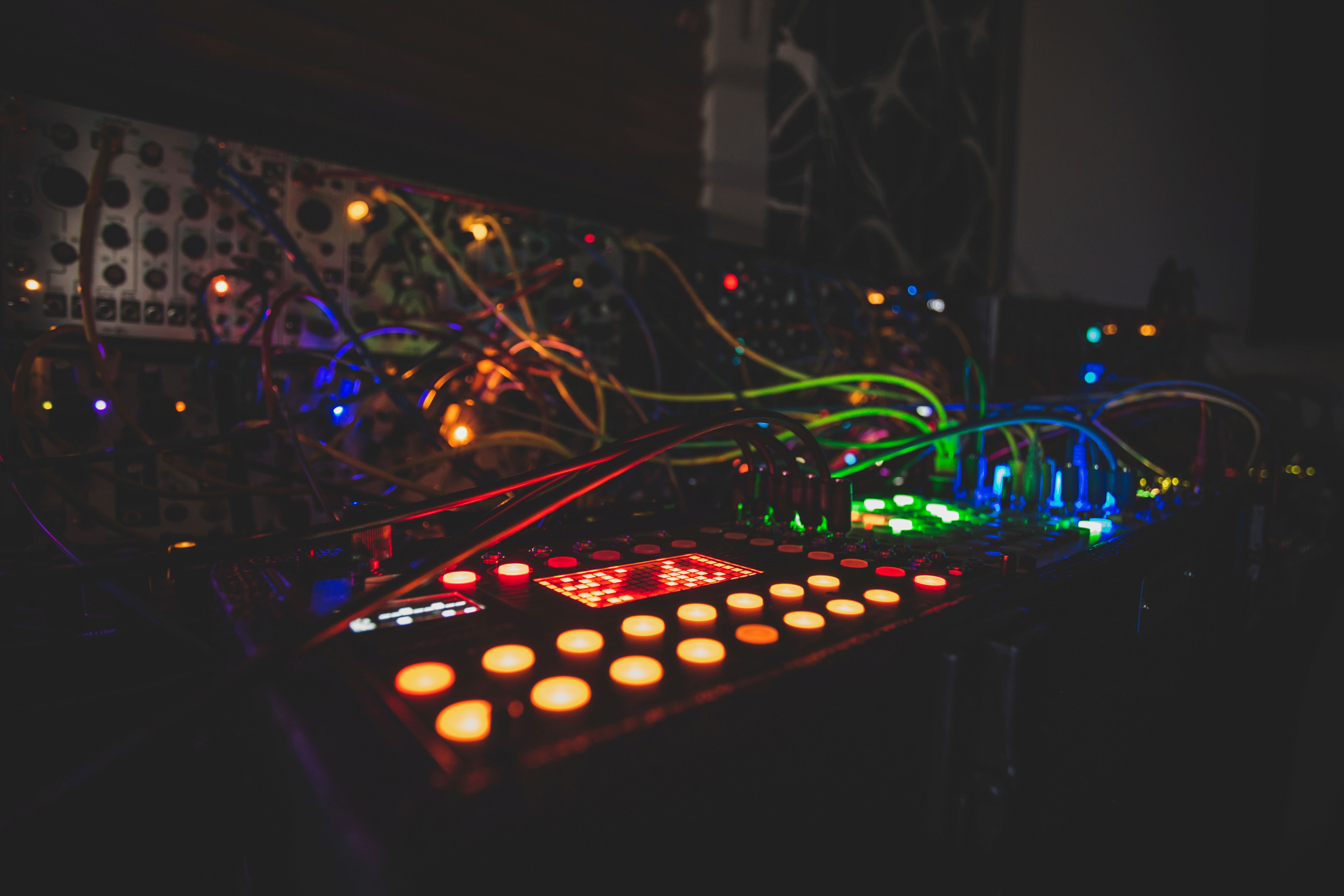
I recently consolidated my five Tip Top Audio 252 cases into one large case and it’s changed how I react to my system completely. I’m still getting used to it but having several smaller cases let me compartmentalize and focus on different parts of the idea. Maybe my main drums would all be coming from one case while my ambient and glitchy textures would be coming from another.
It’s interesting how the music that comes out of larger, singular case varies from several smaller cases and something I’m still exploring.
There are artists who can realize their ideas best with a traditional – or modified – piano interface, others with a keyboard and a mouse, yet others by turning knobs or touching screens. What's your preferred and most intuitive/natural way of making music and why?
When it comes to making records for myself, the most natural starting point is at my modular system. For me, the modular is as much a source of discovery as it is a composition tool. I’ve gotten to the point where I am as comfortable defining a track’s structure within my modular system as I am within a DAW or even making a specific sound I have in my head.
From those initial starting points, I love how easy it is to implement randomization into almost every aspect of your patch, whether it’s as simple as subtle nuances in a kick drum or randomizing time signatures and drum patterns. It just offers a certain amount of variation to my original idea that I may not have thought of.
I also think the fact that there are no “default parameters” like you might find in a typical DAW like tempo, time signature, defined bars etc. help make the modular system feel like a limitless space of possibilities. This lack of boundaries approach has allowed me to create tracks like “Leave The Reminder” from my new album CONVEYOR.
Sieh dir diesen Beitrag auf Instagram an
What did your first modular look like? Tell me about the first pieces you produced and performed on it, please.
My first case was a Modular World 6U 84hp case. This was in the early days of Eurorack when there weren’t as many manufacturers and my first modules were a Tip Top Audio z8000 sequencer and a Make Noise DPO.
This quickly grew and expanded to a Tip Top Audio 252 case filled mostly with Make Noise, Tip Top Audio, Intellijel and 4MS modules. The goal was to make glitchy IDM patches on it.
As my understanding of modular systems grew, so did the number of modules and eventually I ended up at my first record, “Twelve Twenty Two” which was inspired by early Warp Records, Schematic Records and Hefty Records artists.
There is a worldwide community around modular synthesizers. How would you describe your involvement with it and its role for your creative development especially in the early days of your modular journey?
I was very fortunate to be in Los Angeles and have been into modulars for a few years before Modular On The Spot started. This was truly a magical period in time that will never happen again.
The shows were ultra renegade, the community was incredible and Eurorack hadn’t quite exploded yet. Everyone at those shows were pushing boundaries in their own way and the community was so supportive of each. It was an incredible source of inspiration and knowledge for me. Being a part of that really helped me find my voice and build a system that felt like an instrument to me.
This all lead to finishing records, playing shows with some of my heroes and performing around the globe.
Modular synthesizers allow for the most diverse and personal set-ups. What were some of the most surprising/inspiring configurations or ways of playing the modular that you've seen?
This is a really tough question. I’ve seen so many systems with the same modules in them and hear completely different music come out.
I always thought that Make Noise’s “Shared System” series was such a great concept and wildly fascinating. If you’re not familiar with these, it was a series of records put out by Make Noise where they had artists such as Richard Devine, Surachai, Robert A. A. Lowe, Alessandro Cortini and others all create music on the same modular configuration. Those records were so inspiring both musicly and in the sense of the restricted system, especially compared to what’s available today.
There’s obviously something to be said for some of the gigantic setups out there, but I think it’s amazing hearing complex music come out of smaller systems.
[Read our Alessandro Cortini interview]
Can you take me through the evolution of your modular system up to your current set-up? What are aspects you consider when buying a new module?
My system has expanded from simple sonic and sequencing capabilities to something that allows for more complex arrangements and a true sound design tool that let’s me do everything from ethereal drones to dynamic, constantly evolving IDM patches. This includes multiple VCAs, oscillators, filters, sequencers, clock dividers, FX etc.
When I’m buy a new module nowadays, I’m looking for two things. First of all, I’m looking for modules that will allow me to do something I can’t already do. But more so lately, I’m looking for really high quality sounding modules. Things like the L-1 Blacksea VCA which, to me, sounds amazing and offers different response curves to each channel. Things like this that make what’s coming out of the system sound more record ready.
I know that’s a pretty boring answer but modules like that or the Macbeth oscillators excite me just as much as some of the crazier FX modules out there.
Which modules incisively changed your way of making music – and why?
The Tip Top Audio Circadian Rhythm changed everything for me.
It allowed me to create complex sequences, helped with transitions and allowed my patches to start evolving in a very musical way.
Portability has been one of the main drivers for music production over the past years. What importance does mobility have for you when it comes to production – and what strategies for making the modular portable have you developed?
Portability really only matters when I’m performing.
I used to perform with two Tip Top Audio 252s and a 126hp skiff with patch cables interconnecting all three cases. For every show, I’d create a new patch and figure out the arc of the performance in my studio but when I had to go to the venue, the only solution I had was to write down every single patch point, then pull every single patch cable, as I use a lot of stackable cables in my patches and couldn’t close the cases, and then pray. I’d show up to the venue with pages of patch notes and would need an hour to rebuild the entire patch.
This just got to be way too complicated and stressful so as much as I loved patching each and every kick and snare from scratch for a show, I started recording them and putting those into the 4MS STS. This allowed me to swap out six modules for one and eventually pair down to a single MDLR case.
Sieh dir diesen Beitrag auf Instagram an
With a keyboard and a traditional synth, I would instantly know what something would sound like if I pressed down the keys a certain way. Would you say the same is true for the modular and certain patches and modules? How does working with wires, cables, and plugs change your perspective on music?
It depends on the module but one of the great aspects of working with a modular synths is that there is no “default / init patch”.
You may leave knobs a certain way, not touch those modules for a while and then when you come back, it’s starting point is completely different from the last time you started a patch with it. So while the characteristics may be familiar, it’s hard to know exactly what to expect when you turn the system on.
Modulars suggest a more immediate relationship with sound. In how far does this hold true from your point of view and what has working with them taught you about sound in general?
This is 100% percent true and one of the greatest parts of working with a modular system. Each patch cable can add to or change the course of your idea so there’s this constantly refreshed excitement while working.
Maybe the most important thing this has taught me is to not confuse excitement for being done. When you suddenly find some wild sound that completely surprises you in the best way, it’s common to step back and just listen. Why wouldn’t you, it feels like magic.
But while it’s important to stay in that excited headspace, it’s equally as important to zoom out and ask yourself “Is this done?” or “Can this be better?” That’s usually when the real work starts and you get to refine and push the idea as far as it can go.
In which way does the modular influence musical results and what kind of compositions does it encourage / foster?
I think this truly comes down to the artist as each artist has specific tastes in music and is able to set up their own system to function a certain way.
One artist could setup their system to do polyphony and arrange chord changes whereas another may focus on glitchy drums.
Describe the creative process for Conveyor, please.
In various ways, all of these tracks started at the modular system. The second track off the record, “Leave The Reminder” started as a patch I made for a Qu-Bit interview / performance. I pushed that patch as far as it could go with the amount of gear I have and laid out an entire structure for the track on the modular system.
I later added stand alone synths like the Black Corp. Deckard’s Dream for melodic parts to keep the track evolving emotionally.
On other tracks like “Live Forever”, I made the really aggressive bassline on the modular system and then turned to my ARP 2600 to play the melodic parts and used it to create chords by layering in different parts.
On other tracks I utilized the Polyend Poly 2 to send midi to my modular system while on others I would harvest as much sound design as possible from my modular system and organize it in a DAW.
Overall, the focus was the outcome of the music above working within a specific process.
Many modular set-ups still do not support saving patches or quickly switching between them. What possible benefits or inspiring consequences does this quite severe limitation have for your own music and creative practice?
The beauty of not being able to save anything is that it forces you to do the work and see an idea through to completion.
For me, there’s a certain feeling that I get when I know I’ve got something good and that’s usually when I start recording and adding to the patch because if you don’t push it as far as you can while it’s good, it will be gone.
If you cycle power on your system and come back the next day to record the patch, it may not sound the same as when you walked away from it.
I am under the impression that choosing the modular is not just a musical decision, but somehow extends into other parts of one's life as well. Can you reflect on this a little bit?
I think the answer to the last question plays a bit into this one. The mindset of “do this now while it’s still good” goes far beyond an awesome glitchy drum patch and well into everyday life.
Whether it’s time with your loved ones or any form of self care, certain people and opportunities might not be here tomorrow so don’t put it off.
For you personally, is the goal to become as proficient and fluent on the modular as others might get at the piano – or to keep discovery mode on forever?
I think both is the only way.
I’m always trying to get better and refine my proficiency surrounding modulars and all things music related. But even if you know exactly how your entire system or a specific module works, how it will react when you introduce a certain modulation source, even how it was built, there’s still so much music and sound hidden within in these systems that to turn discovery mode off would seem like a mistake.