Names: Angus & Julia Stone
Nationality: Australian
Occupations: Singers, songwriters
Interviewee: Julia Stone
Current release: Angus & Julia Stone's new album Karaoke Bar is out now.
Hometown Recommendations: I could write a whole travel blog on what to do in Tasmania and in particular Hobart. But if I had to say one thing it would be to visit Mona_ the museum of old and new art. It’s a phenomenal place.
If you enjoyed this Angus & Julia Stone interview and would like to stay up to date with their music, visit their official homepage. They are also on Instagram, tiktok, and Facebook.
Do you think that some of your earliest musical experiences planted a seed for your interest in writing lyrics or poetry? How and when did you start writing?
Definitely. I still remember sitting in my bedroom at 12, listening to Leonard Cohen: Greatest Hits and feeling completely moved by “Bird on the Wire.”
I didn’t really understand what he meant when he sang, “I saw a woman leaning in her darkened door … she cried out to me, why not ask for more” but I also somehow knew what he meant by those words.
Around that time, I asked Mum if I could paint my room. I’ll never forget it, partly because I was stuck with it for the rest of my teenage years … a bright blue with purple sponging over the top. I got tired of the sponging after one wall, so I never finished the whole room ... but right next to my bed, I wrote in purple, so it was the first thing I saw when I woke up: “How bad do you want it?”
I felt things incredibly intensely as a kid. I knew about loneliness and sadness from witnessing my parents' relationships, and I think I had this feeling that there had to be a way out. To not have to live like that … the question that came to me was: how badly did I want to get out?
The funny thing is, after all these years, I’ve realised there isn’t really anywhere to get to where you can escape yourself. I think about Mum always saying, “I’m getting there, I’m getting there”- when she’d be talking about things she needed to do … This repetitive idea that somehow we were getting there, to a place where everything would be better. Finished, complete, perfect somehow.
Now I don’t mind living with the complexity of the limbo. Things not being done … being a terrible person, a wonderful person, an ordinary person … just being a person with everywhere to go and nowhere to go.
I started writing songs later on though, after writing that on the wall … I didn’t really have a plan to get out … just a kind of willingness … at the time I started writing songs, it felt more like a way out of the confusion of being a teenager. When I was writing, I didn’t feel so bad. I loved the feeling of following melodies and lyrics in my head and seeing where they took me.
I definitely think those earlier artists who moved me were part of that choice: Joni Mitchell, Neil Young, Little Feat, Creedence, Fleetwood Mac …
Our dad’s band would rehearse every week in the living room, so we weren’t only listening to the albums … we were hearing his band's interpretations of those songs, too. Four-part harmonies being worked out, these incredible melodies and lyrics being brought to life right in front of us.
Mum and Dad, in spite of the difficulties in their relationship, always made music feel like a place to connect and a place where worries could dissolve. I suppose that left a mark too. It was a real source of joy for both of them.
I remember the first song I wrote that I really considered a song, not one of my Spice Girls inspired pop songs but my first song about heartbreak when I was around 16. It began:
“It was a wild autumn morning when you left,
and all the words I wanted to say were rising in my chest,
like a hot air balloon on the way to the moon.
It will never get there …
they will never make it to you.”
I remember how wonderful it felt to sing this song about someone I couldn’t reach anymore, someone who was no longer mine, maybe was never mine. I was finding a way to express the loss and sadness that filled my days.
There’s nothing quite like that first heartbreak and songwriting was such a blessing, and I think it was really gifted to me by my parents. Both their sadness and their kindness. Their kindness gave me a house full of great songwriting and music to be inspired by and learn from.
And their sadness, the difficulty of their lives, made me want to find pathways for myself to be free of it.
Entering new worlds and escapism through music and literature have always exerted a very strong pull on me. What do you think you are drawn to most when it comes to writing?
I’m drawn to the freedom that it can give us as individuals. I am very grateful for a career in music for sure but I feel more often than not the true beauty of writing is the sense of individual freedom and presence that happens in the process.
I was listening to a young songwriter who was asking me for advice the other day about a song she had written. It was a truly remarkable song from a fourteen year old girl. I had mistakenly anticipated that it would be like the songs I wrote when I was fourteen but it was so elegant and effortless and just really moved me.
I told her, my only advice was not to ask for advice and just keep doing whatever she was doing. That her song was so beautiful. I asked her about how she wrote it and she described to me how it just came to her … and then asked me so sweetly ‘do you feel a kind of euphoria when you write songs?’ and it almost made me cry. I said sometimes I do.
And that is true. Sometimes I do ... and other times it’s more thinking than feeling … but what she experienced and what is possible with art is so incredible. One of the perks of being human in my opinion.
Have there been song lyrics which actually made you change (aspects of) your life? If so, what do you think, leant them that power?
Yes. Definitely. Words have power. The power isn’t just in the lyrics themselves but the process of singing them. Saying them out loud.
“Santa Monica Dream” I wrote when I was finding it so hard to let go of a relationship that I just knew wasn’t the one for me.
We both just couldn’t quite let each other go, and that of course means you can’t move on in any way, like being stuck in slow motion. Writing and recording and then singing that song really helped me let go of that time, that place. The lyrics were literally saying goodbye.
“Death Defying Acts” was really healing for me at a time when I felt really out of control. I wrote that song in about twenty minutes, just all the words stumbling out of me over that really simple guitar part: “I will perform a death defying act and I won’t fall.”
Sometimes it felt like I was walking on a tightrope and it was so scary, and when I wrote that it was like a mantra to say I won’t fall. I’ll keep doing this and I won’t fall.
I wrote a song “Queen” … it was from a solo album called Sixty Summers. I wrote that song in such a state of rage with myself: “I’m dressed like a queen, begging in the street, hoping you’ll see me lying at your feet, give me a dollar boy, buy me a feed, I’m starving to death when I’ve got what I need.”
I just felt so angry at myself at that time. Just so desperate for scraps of love from someone who didn’t really see me … it definitely helped me change my life.
I had been in that state for such a long time and the song was so definitive. I couldn’t unhear what I really felt about myself in the situation. “I should have ended it, when it was over. I could have done it if I was sober. All of the love that I thought that I’d feel, I’ve given away for the scraps of your meal’
So songs to remind myself about what I really want or who I really am … Through my twenties that was mostly about relationships and my relationship with how I treated myself … that has shifted a fair bit through my thirties.
It is sometimes said that “music begins where words end.” What do you make of that?
My first instinct when I read that is that the silence between the sounds is what makes the music.
My partner often asks me why I don’t listen to that much music now, and for me it’s really because I like the sound of the spaces I’m in … It’s so noisy all the time, and the quiet is kind of where I can hear things. So much happens in the space between things.
I am speaking about life more generally, not just music, I feel like I have been so interested in getting to these moments. I can’t think of the word, but you know what I mean, flag-in-the-ground moments to mark our achievements.
But usually, the only thing you remember about the flag is how you made it: the fun of weaving it together and the hours spent chatting to your friends whilst you moved the needle and thread in and out of the colours and shapes.
I have always considered many forms of music to be a form of poetry as well. Where do you personally see similarities? What can music express which may be out of reach for poetry?
Well, a great example of that for me is the artist Bon Iver. I love that the lyrics are not front and centre of the world he creates.
Sometimes they’re hard to decipher just from listening, but even when I read them, sometimes they’re not literal or linear. They are sometimes abstract and just amazing visual imagery. But to me, the poetry isn’t in the words. For me, it’s the sounds of his melodies and voice and the music altogether. The music itself, the combination of everything, is the poem.
Not all artists are like that. Sometimes you could take their words alone and read them, and that would transport you. And for some people maybe Bon Iver’s words alone would do that for them … But to me, he is a perfect example to me of how music as sound alone can be the embodiment of poetry.
What are areas/themes/topics that you keep returning to in your lyrics?
At the heart of every song I’ve written is connection. Connection to self, to others, to nature, to the world … I reckon if I dig into any of my songs, that thread is there.
I now find, since becoming a mum, that I often want to sing about her … about my love for her. I wonder sometimes if love songs that I had previously thought were about romantic relationships are in fact about a parent loving their child.
Songs that previously I hadn’t understood how you could feel that way about another human, like “I don’t want to close my eyes, I don’t want to fall asleep ’cause I’ll miss you and I don’t want to miss a thing” … seems very intense being about a person you’re in love with, watching them sleeping haha ...
But if I think about my daughter, I understand that love and not wanting to miss a moment of her exploring the world and becoming herself.
But I would say enjoying art … music and film for me, not creating it, is sometimes where I find the most catharsis. I cry the most listening to other people's songs … watching extraordinary films. Maybe that’s also part of why I don’t listen to as much music at this moment because it is so overwhelming to me at times that I just need a break from it.
Do you tend to start writing with what will be the first line of the finished lyrics? The chorus? At a random point? What are the words that set the process in motion?
I would say on this record, it’s random where a song starts. When we start writing, we don’t know if we’re singing a chorus or a verse or a bridge … or something that won’t be anything. It becomes clear at some point whether it’s worth sticking with. I don’t know how, it just feels like we want to keep writing. We want to fill out the world around that initial idea.
Sometimes that world comes easily and sometimes it takes a while to find. “Brightest Place” took a while to find the world around the idea.
I loved the chorus, “Take me back, take me back where the neon lights are shining, hide my bones inside the light, I’ll get home” — but couldn’t quite find the verse to work with it. It took time. It was one of the earlier songs to start and the last one to finish.
And other times, the whole thing just happens in one go, like “Karaoke Bar.”
I'd love to know how you think the meaning or effect of an individual song is enhanced, clarified or possibly contradicted by the EPs, or albums it is part of. Does the song, for example, need to be consistent with the larger whole?
I don’t think there’s any rule for what works or doesn’t work.
People release singles that completely connect with people and inspire beauty and love, and people release records that are complete pieces of art, where the tracks fold into one another like a good book.
People make what they make and people like what they like.
When you're writing song lyrics, do you sense or see a connection between your voice and the text? Does it need to feel and sound “good” or “right” to sing certain words? What's your perspective in this regard of singing someone else's songs versus your own?
The reason people love singing in the shower is because of the natural reverb that happens on tiled walls and floors. We sound better when our voice travels … and then it feels good to keep singing. Caves, stairwells, churches, temples.
I like to write running my vocals through a simple busking PA with reverb. I don’t always write like that, but I find it really fun and gives an added feeling to creating. I get more lost in the sound of the voice …
There’s something to why churches and temples are built the way they are - prayer and chanting in those places travels and vibrates through our bodies. It can take us into presence. I’m not religious but when I have sung in churches it does feel really special.
I would love to know a little about the feedback you've received from listeners or critics about what they thought some of your songs are about – have there been “misunderstandings” or did you perhaps even gain new “insights?”
I’m sure people at times hear the music differently to what we wrote them about or the thread through the song. Fans tell us about the music in their lives and what the songs mean to them, from a soundtrack-to-my-life sort of experience. That’s really nice.
But I don’t really read reviews. Back when we started, my grandmother used to take clippings from the newspaper or magazines that reviewed our records or our live shows and give them to me. She didn’t just give me the good ones. She gave me anything she found.
I realised very quickly that it didn’t make sense for me to read what other people thought about my music, my voice, my style, my performances … good or bad. It took me away from how it felt to do those things. I felt like, as long as it felt good to me, it didn’t really matter either way.
Creativity can reach many different corners of our lives. Do you feel as though writing song lyrics or poetry is inherently different from something like making a great cup of coffee? What do you express through music that you couldn't or wouldn't in more 'mundane' tasks?
You can do anything with attention and love if you want to. Any mundane experience can be holy if you want it to be … I certainly don’t live like that, but I like the idea of it.
People’s creativity shows up in so many unique ways. I love that aspect about the internet … it has also created a space where everyone can be involved, and the thing that matters is the shared experience.
People can share their crafts on Etsy, or their poetry/writing on Substack, or their photography on Instagram, from places where they otherwise might not have found a community to share their art with. For all the difficult problems it has given rise to, I’m thankful that, for so many people who are creatively inspired, there is a space to share their world in corners where it might not otherwise be appreciated.
And sometimes all we need is one person to understand what we’re saying to feel connected and loved.
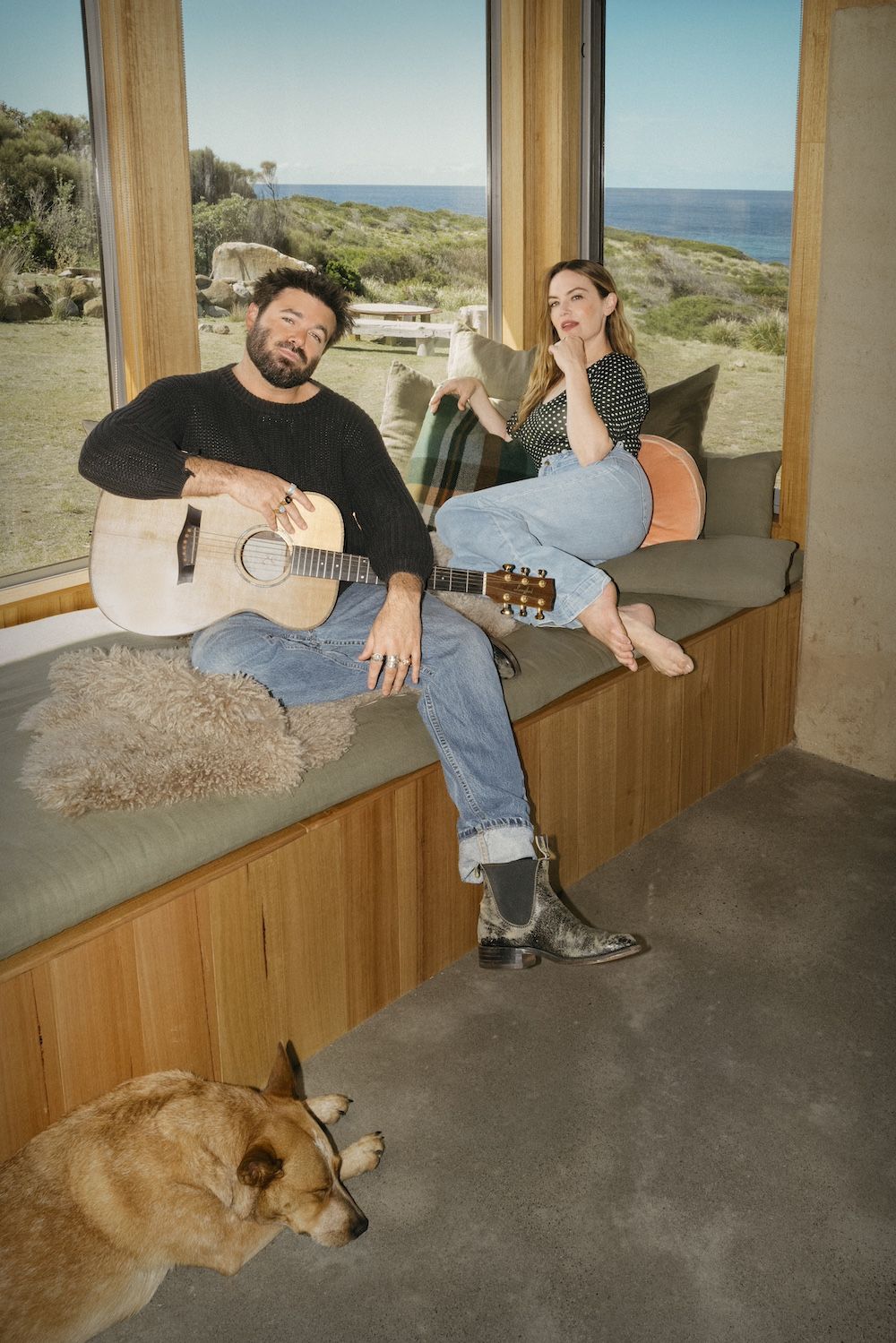 Angus & Julia Stone Interview Image by Sean McDonald
“The power of words isn’t just in the lyrics themselves but the process of singing them. Saying them out loud.”
Video