Name: Alan Pierson
Nationality: American
Occupation: Conductor, director
Current release: Alan Pierson teams up with Alarm Will Sound for a performance of Sophie's "Faceshopping," out now via Cantaloupe.
Current event: Alan Pierson will conduct Steve Reich's Music for 18 Musicians at Park Avenue Armory's Drill Hall in a performance featuring members of the original Steve Reich Ensemble, Alarm Will Sound ensemble, and students from Manhattan School of Music. For more information and tickets, go here.
Things I am passionate about but rarely get to talk about: I love Star Trek, and am a little embarrassed by how much of my brain it often occupies. Matt Marks, Alarm Will Sound’s brilliant horn player and composer, had this fabulous idea of “shame remixes," where he would write pieces for folks that were remixes of the music that they were embarrassed about loving. We talked years ago about the idea of a shame remix for me on music of Star Trek. Matt passed away in 2018, but … Paul and our families commissioned Alarm Will Sound’s pianist and composer, John Orfe, to write a birthday piece for me celebrating my love of Star Trek. It’s the greatest gift ever, and has brought me endless joy. And … AWS just released it to honor Star Trek’s 60th birthday, so now you can enjoy it too!
If you enjoyed this Alan Pierson interview and would like to know more about his projects, visit his official homepage. He is also on Instagram.
When did you first start getting interested in musical interpretation?
As a young musician, I didn’t think of interpretation as very important or interesting. Composing was my passion, and that was where I focused my musical creativity.
My thoughts about interpretation were shaped by Stravinsky and then by my first serious conducting teacher, Gunther Schuller, both of whom believed that a performer’s prime directive was to execute the score as precisely and literally as possible. Injecting your own personality in front of that was ego.
It was actually through my early work with Reich’s music that I started exploring interpretation as something more personal. I became obsessed with Reich’s Tehillim just before I went to college, and managed to organize a performance with friends at MIT.
I was fascinated by how massive a departure the third movement was from Reich’s whole history of process-oriented music: here, Reich was using harmony for moment-to-moment expressivity in a way that seemed totally new for him.
It felt to me like those harmonies really needed time to breathe, and while Reich had described the piece as his first “slow movement,” it sure didn’t sound slow on his ensemble’s recording. So I developed a personal vision of the movement that really revelled in all of the expressive harmonies, while still honoring the relentless pulse and the clean non-vibrato sound.
Midway through recording the piece, I became terrified that I’d gone too far. I was so inexperienced — just 25, and recording for the very first time — and I’d chosen the tempo purely by instinct, without any real planning. I realized at some point — well past when I could have changed it! — that I’d ended up taking the movement at something like 80 beats-per-minute vs. Steve’s 108-112 indication, and that my tempo was creating a nightmare of breathing and intonation problems, which I’d been too inexperienced to have foreseen or thought through.
I really thought I’d made a disastrous mistake, letting my ignorance and my ego get in the way of the composer’s intention, just as Schuller and Stravinsky had warned against. And I was sure it was all going to collapse on my head in a complete disaster.
But … we made it work! And then when the recording was finished, I discovered that I totally loved what I’d created: both the slow movement on its own, and how my interpretation had impacted the experience of the composition as a whole. For the first time, musical interpretation felt like a topic that I had something to say about.
What do you personally enjoy about the act of interpretation? Are you finding that this sense of enjoyment is changing over time?
The Schullerian/Stravinskyian idea of excellent performing as really faithful, impeccable execution is still very dear to me. So I get a lot of joy out of just giving an exemplary performance of really challenging music.
I had a peak experience of that a couple of weeks ago, performing Georg Friedrich Haas’s In Vain with Alarm Will Sound and members of Jack Quartet.
Georg texted me about a passage that he’d never heard played correctly, and that he’d worried was impossible and a “composer’s mistake.” That set out a challenge I felt determined to meet. We worked on the passage diligently through rehearsals.
And then in the show, it was just electrifying: the music just shone in a way I’d never heard before. During the applause after the performance, Georg shushed the audience to make sure everyone knew what a special thing had just happened: “like dreams turned into sound,” he said.
So performance purely as excellent execution still brings me a ton of joy.
But any time I really love a piece of music, the thing I think about is: how do I share with others my personal experience of it? And of course, fundamentally, I can’t: I’ve spent hours and hours living with the music, tearing it apart and putting it back together in my mind, finessing it in rehearsal, maybe even trying to perfect it in the studio. My experience of the music is so deep and multi-dimensional, and … What of that could possibly be transmitted in a single performance?
But I’ve come to think of storytelling and theater as a powerful kind of interpretation, and it’s one that I’ve been more and more drawn to over time. A really special experience of that for me was working on Leonard Bernstein’s Mass — which I’d been obsessed with since high school — for Alarm Will Sound’s theatrical storytelling event, 1969.
At some point during my study of Mass, I’d come to understand the brilliance of what Bernstein had done with the “Agnus Dei”: transforming the traditional prayer for peace into a 1960s protest for peace. That realization transformed how I thought about the music. And the theatrical storytelling format opened up space to actually bring that experience viscerally to the audience:
I could weave together music with dialogue between Bernstein and his collaborators talking about what they were creating, and then have the band embody an anti-war protest while playing and singing. And suddenly we’d created a radically new experience of the music, one which brought audiences inside my experience of it.
Could you describe your approach to interpretation on the basis of a piece, live performance or album that's particularly dear to you, please?
Well, there’s no piece more dear to me than Music for 18 Musicians. And Staged Variations is my very personal interpretation of it: an interpretation on a massive scale, beyond anything I’ve done before.
It began with a flash of inspiration for a 50th anniversary celebration of the piece: build on the composition’s cyclical structure to create a durational, cycling experience; and transform it into an immersive installation, using staging to take the audience into the heart of the music’s inner workings.
The first step was to interrogate the inspiration: Why was this the right way to experience the piece? Was it even possible? And then, because of the scale of the interpretation I’d imagined, the next step was convincing others to embark on this journey with me.
I emailed Steve first to pitch him the idea for an all-day event, where Music for 18 Musicians would be played 24 times in a row. (That was the scale that I was imagining at first.) He responded quickly and enthusiastically. I then pitched the idea to my husband and trusted artistic advisor, Paul, who said that he thought it sounded crazy, but nonetheless spent hours discussing the idea deeply and thoughtfully with me.
It was clear to me that there was only one presenter in New York who could do this: the Park Avenue Armory. And so my next task was to sell their artistic director, Pierre Audi, on the idea. That one took a while! It was nearly nine months between first proposing the idea to them and actually getting into a room with Pierre to really talk about it.
Pierre helpfully gave some focusing parameters to the initial inspiration: it would be 3 hours, not 24; and the brilliant Urs Schoenabum would be our lighting designer.
Then came the fun part: in summer 2025, I rolled up my sleeves and actually got to work designing the staging. I made a diagram of the setup I’d envisioned, and then created a series of slides in Google Sheets, showing where each player was at every step of the three-hour experience. [Here’s an example!]
Of course, there were still countless hurdles to deal with, like when I realized that my staging for the second hour had created a nearly impossible puzzle of how to actually cover the parts with just 18 players. (Luckily, my genius computer scientist friend, Eddie Kohler, solved that one for me.)
What was your own learning curve/creative development like when it comes to interpretation - what were challenges and breakthroughs?
There’s been a gradual, slow journey of learning to take up space as an interpreter and to trust my own visions.
When I was working on 1969, for instance, I didn’t feel qualified to write or direct the show myself — my training is as a conductor and composer, after all — so I brought in people I trusted for those roles, and then collaborated with them. It’s only more recently that I’ve worked up the courage to take on those roles myself. And that still has sometimes felt intimidating.
Early in my meetings with Pierre, he told me that he thought that he should direct the production himself, and I had to make the case for why I thought it was right for me to helm it. Which was challenging and a little uncomfortable! But I’ve become increasingly comfortable in these roles. Directing Staged Variations has been a total joy.
I’m at my heart a collaborator. I put a lot of attention into articulating the mission and then into assembling the right team to carry it out. And then I trust them to make collaborative decisions with me. The core team on this show — associate director and movement coach, John Heginbothan; assistant director, Peter Ferry; and my husband and creative advisor, Paul Melnikow — have been my companions for all the big decisions I’ve made in realizing the vision. And they've contributed so much.
A real breakthrough for me came during our week of rehearsals in August, when I came to feel that this vision I’d created was now so jointly understood and carried by the team that it no longer rested so much on my shoulders. These remarkable people were lifting up the vision and making it real. That was a remarkable new experience.
In many cases, the score will be the first and foremost resource for an interpretation. Can you explain about how “reading” a score works for you?
Studying a score is a really creative process for me. I’m trying to get behind the notes to understand the big ideas that are driving the piece forward. What's behind the choice of the notes? Often what's most important in the music doesn’t jump out at first, and that’s what I’m looking for.
So the process of marking up scores is crucial to me. I’m marking the score up so that the big ideas become visible. (I’m mystified by conductors who mark up rental scores and then return them: my marked-up scores are so personal and important; I’d be devastated to have to turn them in after a performance!)
With Music for 18 Musicians, it always struck me that the brilliance of the piece was its simplicity, but that the score hid that from you: these really simple shapes would only emerge from the score after you spent a lot of time studying it. I was always interested in finding a way to represent Reich’s music that made those simple shapes immediately clear.
So while working on Staged Variations, I embarked on a side project of making a “map" of Music for 18 Musicians that made the structure of the piece visible at a glance. I did that in collaboration with my husband, Paul, and it’s been a real joy. And an essential tool for the project. Even knowing the piece as well as I do, I’ve discovered new things about it while working on the map.
One of the key phrases often used with regards to interpretation are the “composer's intentions”. What is your own perspective on this topic and its relevance for your own interpretations?
I always want to know as much as I can about the composer’s intention, and about how the composer has envisioned the music and why. And that’s the foundation for building a performance.
But working so closely with composers, I come to understand the ways in which performers can become a part of a piece. I’ve seen how my input has changed work by composers I work closely with. And I’ve read about the ways in which the community of performers that, for instance, Reich developed his work with impacted those pieces. So that gives me a somewhat different perspective from the Gunther Schuller approach to composition as an untouchable work to be revered and devoutly recreated.
Also, I think that once a work really enters the canon, there’s more space for performers to do something personal with it. When I’m bringing a composer’s work into the world for the first time, I feel a real responsibility to be an evangelist for the piece as the composer envisioned it.
But for a work like Music for 18, which is so well known now, I think there’s space for me to bring something new to it. It’s not on me to introduce the work to the world, because that’s already happened. People know what the work is already. And if my interpretation of it is a terrible one and people hate it … Well, that's just on me: everyone’s still really clear on what the piece is. That gives me more room to continue a conversation with the composer, and bring in new ideas.
Reich himself has a really beautiful practice of making room for his performers to bring their own wisdom to his music, once he trusts them. The line he uses — first and most famously with Michael Tilson Thomas — is “pretend I’m dead.” Steve is a fierce defender of his music when he feels he needs to be, but sometimes, he’ll answer a debate or a question with “pretend I’m dead.” It sounds a little grim, but it’s meant really lovingly and generously, like: “I composed it; but now you know it, and I’m trusting you to advance it wisely.”
Artists can return to a work several times throughout the course of their career, with different results. Tell me about a work where this has been the case for you, please.
It’s a great joy to get to come back to my favorite music again and again, and to continually make new discoveries and get deeper in.
It’s particularly valuable to move back and forth between doing the same repertoire with students and with top professionals. Working with professionals forces you to be really clear about what you're aiming for and to work quickly and efficiently; working with students demands more direct engagement with and command of exactly what every player is doing at every moment.
Music for 18 is one of those pieces that I’ve returned to again and again over my career, both with professionals and with students (starting from when I was one myself!). And each encounter with the piece deepens my experience of it, and my comfort with it. I never could have made Staged Variations without all of those past encounters with the work.

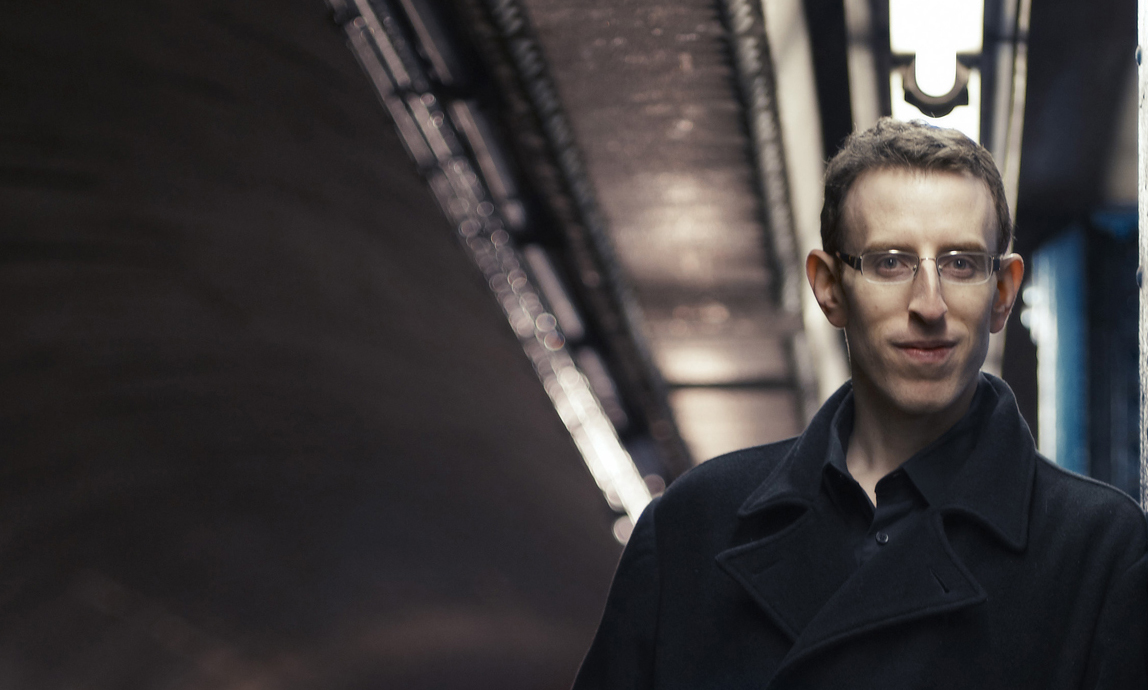 Alan Pierson Interview Image (c) the artist
"Often what's most important in the music doesn’t jump out at first. That’s what I’m looking for."
Video