Name: Agneya
Nationality: Canadian
Occupation: Composer, percussionist, drummer, educator
Current Release: Agneya's new, self-titled album is out now.
Current Event: Catch Agneya play live 22.9. Berlin, Kunstfrabrik Schrott or 24.9 Recklinghausen, Jazz Session.
Pure Drum Recording Recommendations: I’d probably recommend Trilok Gurtu, particularly his earlier work, because he completely changed my understanding of what a percussionist could do. He’s someone who doesn’t treat Indian percussion, jazz, electronics and improvisation as separate categories.
And if you want something closer to the West African side of my listening, I’d point people toward recordings of Mamady Keïta. His playing completely changed the way I understand groove, phrasing and physicality.
Recommendations for Toronto, Canada: The Aga Khan Museum. I’ve had the opportunity to work there through my arts work, but even outside of that connection, I think it’s one of the most beautiful cultural spaces in Toronto. It creates a really interesting meeting point between history, contemporary art, music and different cultural communities.
And if the question is specifically about music, I’d tell people to spend an evening wandering around queen west and end up at Drom Taberna! Toronto makes the most sense to me when you experience it through its different communities rather than through its landmarks.
[Read our Trilok Gurtu interview]
If you enjoyed this Agneya interview and would like to stay up to date on his music and live performances, visit his official website for more information. He is also on Instagram, and bandcamp.
What captivated you about drums and percussion?
I don’t think I was initially attracted to the drums because I wanted to be “a drummer.” I was attracted to rhythm.
Growing up in India, rhythm was everywhere, often without being presented as something you had to consciously study. There was music at home, folk music, Bollywood music, and then I was also growing up during this huge influx of Western pop and rock culture. Within minutes, I could go from listening to Pandit Bhimsen Joshi to watching Korn or Limp Bizkit on MTV.
After studying Tabla for a few years, when I eventually started playing drums, I realised that rhythm gave me a way to connect all these seemingly different things. That became much more interesting to me than any particular instrument or genre.
What happens in your body when you’re listening to music?
I definitely experience music physically. I often hear rhythm before I hear almost anything else. Even when something isn’t particularly rhythmically complex, I’m listening for where the weight sits, where the pulse moves, where something pushes or pulls.
I think that’s also why I’ve always been drawn to music from different rhythmic traditions. A West African groove, a South Indian tala, a jazz swing feel or a rock backbeat can be completely different on paper, but your body understands something about all of them.
Which percussion traditions do you draw from?
Probably too many to list!
My foundation is Indian music, but my playing has been shaped enormously by West African music, particularly Malinké traditions. I’ve spent many years studying and playing djembe and West African rhythms, including through Tam-Tam Manding in India and workshops with master drummers.
Jazz became another huge part of my musical language, particularly through my studies in Toronto and Berlin. I’ve also spent years playing Arabic fusion music, Zimbabwean Shona music, Nigerian folk-soul, hard rock and many other forms of experimental music.
What interests me is figuring out what these traditions can teach me about rhythm, and then finding an honest way for those lessons to exist together in my own music.
What were the main challenges in your development?
For a long time, I was trying to become “good enough” at everything.
In order to be versatile and hireable, I said yes to almost every musical opportunity I could find, and that meant playing an enormous variety of music with very different people. That was incredibly valuable, but it also took me a while to understand what my own voice was.
The biggest shift was realising that technique is only useful if you have something to say with it. Studying jazz helped me understand improvisation and listening, while Indian and West African traditions taught me completely different ways of understanding time, repetition and physicality.
Eventually I stopped asking, “How do I become a great drummer?” and started asking, “What can I actually contribute through music?”
How would you describe the physical sensation of playing?
At its best, playing feels like the body is making decisions before the brain has time to interfere. There’s a very physical relationship between the pulse, the instrument and the other musicians.
With groove-based music especially, I think you’re constantly negotiating tension and release. You can feel when something is sitting deep in the pocket, and you can feel when someone is deliberately pulling it somewhere else.
That’s one reason I love playing percussion. You don’t just hear rhythm, you literally live it.
What is the relationship between harmony, rhythm and melody?
I don’t really separate them as much as I used to. As a percussionist, it’s easy to think of rhythm as the foundation and everything else as sitting on top of it. But the more I compose, the more I realise that melody has rhythm, harmony has rhythm, and even silence has rhythm.
On my album AGNEYA, I’m often starting from a rhythmic idea and letting the melody or harmony grow out of it. “Teleology,” for example, began with a Konnakol phrase I learned from Ranjit Barot.
“Keiko” grew from a Malinké folk melody that I placed against a South Indian rhythmic structure.
Composition has definitely changed my drumming. I’m much more interested now in what the music actually needs than in proving what I can play.
What changes when the drummer is the bandleader?
You become responsible for the architecture of the music, not just the time.
As a drummer, you’re often trained to support everyone else. As a bandleader and composer, I have to think about where everyone is going, when to create space, when to build tension, and when the drums should almost disappear.
I think that’s particularly important with my music because rhythm is so central to the compositions. I’m not interested in simply putting complicated rhythms underneath melodies. I want rhythm to shape the identity of the piece itself. The hook of the song itself, can be rhythmic.
How do you use the timbral possibilities of percussion?
I’m increasingly interested in percussion as a colour rather than simply a rhythmic function. A drum can create a pulse, but it can also create atmosphere, tension, texture or even melody.
That’s something I think about a lot when arranging my own music. Sometimes the most powerful percussion part is not the busiest one. It might be a particular texture appearing at exactly the right moment.
In my song “Khoj,” for example, featuring the incredible Ingrid Jensen, we create these vast landscapes of cinematic textures, playing between timbrally effected drums, trumpet and synths.
The parts are all simple, but the changing timbres completely transform the arrangement.
How has technology affected your approach?
Technology has had a huge impact on the way we make and experience music, and I’m very aware of that.
At the same time, I’ve found myself moving in the opposite direction with my own music. At a time when we’re surrounded by increasingly artificial and digitally generated sound, I’m intentionally drawn to things that feel raw, physical, and human. I’m interested in the sound of people playing together, the physicality of rhythm, breath, touch, movement, and the small imperfections that happen when real people interact.
That doesn’t mean I’m against technology. If anything, I think being surrounded by so much of it has made me more conscious of why I want my music to feel organic.
For me, there’s nothing as powerful as hearing a human being make a sound in real time, without needing to disguise or perfect it.
What does composition change about your drumming?
A huge amount. When you’re only thinking like a drummer, you can become obsessed with your own part. When you’re composing, you start hearing the entire landscape.
Writing AGNEYA made me much more conscious of restraint. Sometimes I have an idea that I know I can physically play, but the composition doesn’t need it.
Learning how to write for, rehearse with, and make other musicians sound good has probably made me a better drummer than learning another thousand exercises would have.
What makes drums sound great on record?
For me, it’s less about making drums sound “big” and more about making them sound alive.
You want to hear the physicality of the instrument: the attack, the resonance, the small imperfections, the relationship between the different surfaces. But you also have to capture how the drummer sits inside the band. Drummer’s perspective on overheads, and NEVER too much reverb!!
The best drum sound I’ve heard isn’t necessarily the most impressive drum sound on its own. It’s the one where you suddenly realise that the entire band feels better because of it.
Why are percussion instruments useful for healing and physical therapy?
I think rhythm gives people something very fundamental to organise themselves around. You don’t necessarily need musical training to respond to a pulse. A heartbeat is already rhythm.
There’s also something very immediate about physically making a sound and having that sound respond to you. You’re listening, moving, anticipating, reacting. It creates a very direct connection between body and sound.
That’s part of what I love about rhythm generally. It doesn’t require permission to enter the body.

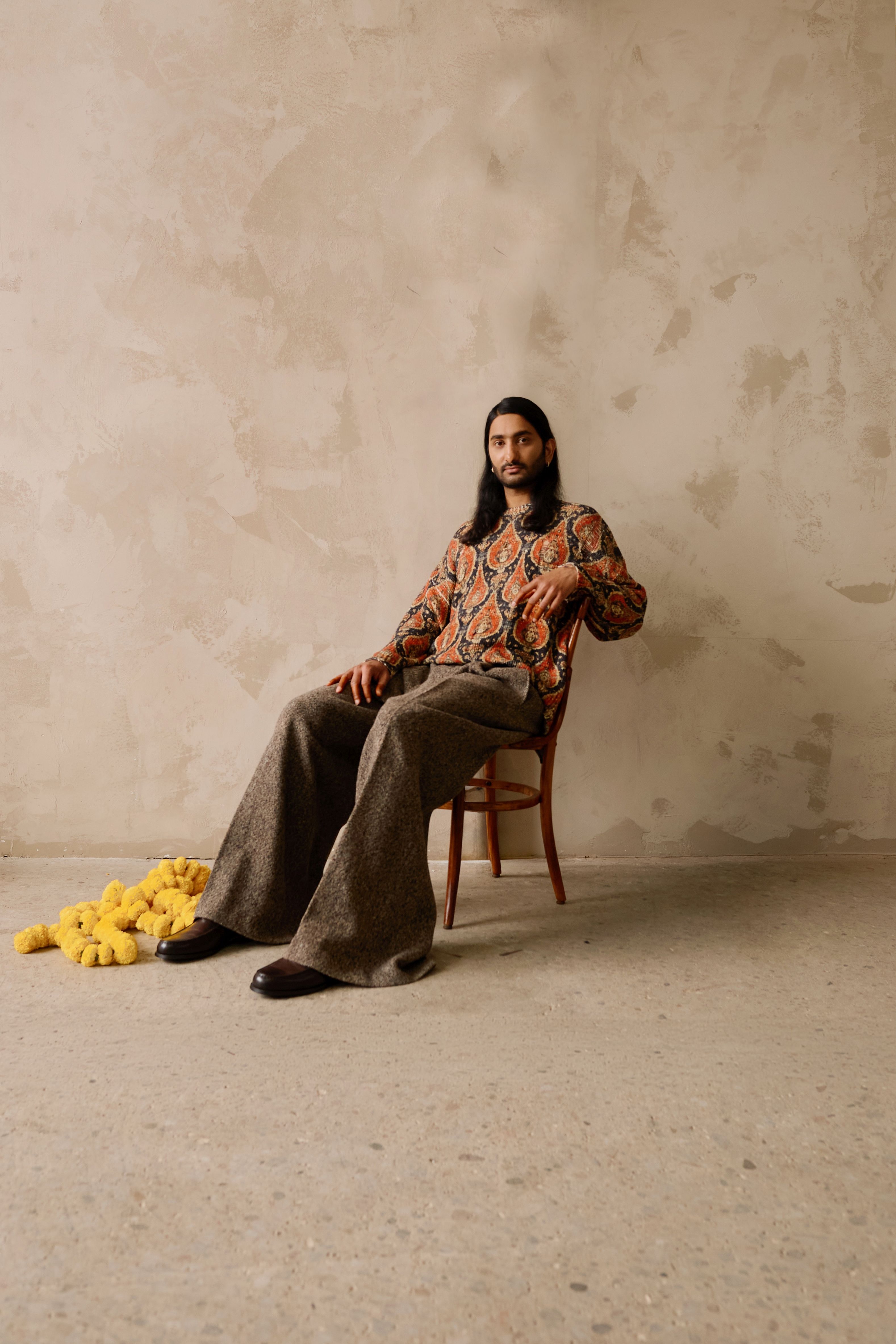 Agneya Interview Image by Nina Caputo
"When playing percussion, you don’t just hear rhythm. You literally live it."
Video